

Music Theory for Beginners in Four Bars
Music theory explains when notes sound, how high they are, how they form chords, and how the key can change. These ideas help you write music and choose where it fits in a video. Count four beats four times, then place notes and chords in the four bars. This exercise uses Western tonal music and common chord symbols. You can follow it with paper and your fingers.
Count the meter and decide where to place each sound
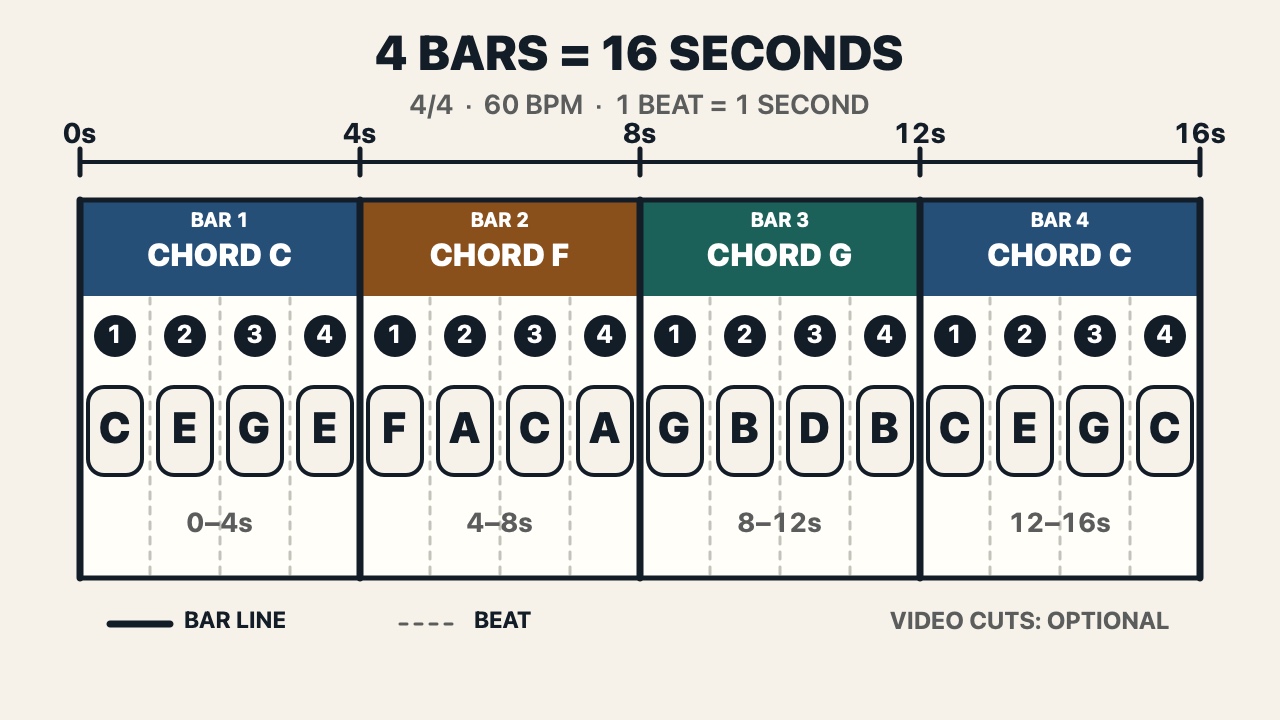
Tap a table at even intervals while counting 1, 2, 3, 4. Each pulse you mark with your foot or hand is a beat. In this exercise, every return to 1 confirms a group of four beats. In this 4/4 exercise, a quarter note lasts one beat and four beats make one bar. BPM describes speed. At 60 BPM with a quarter note as one beat, each beat lasts one second and each bar lasts four seconds. Four bars therefore last 16 seconds. If you keep the same four-beat grouping but raise the tempo, those same four bars take less time.
Rhythm is the sequence of when sounds begin and how long they last. Even if you clap only on beats 2 and 4, the beat spacing marked by your foot and the bar boundaries do not change. When matching music to video, place markers at the starts of the bars at 0, 4, 8, and 12 seconds. Then test how an action looks when it falls on a beat or between beats. Not every cut has to follow a beat.
Find the two-beat grouping in the existing track Breakfast Polka, then compare it with the four-beat exercise.
Use scales and keys to see how melody notes relate
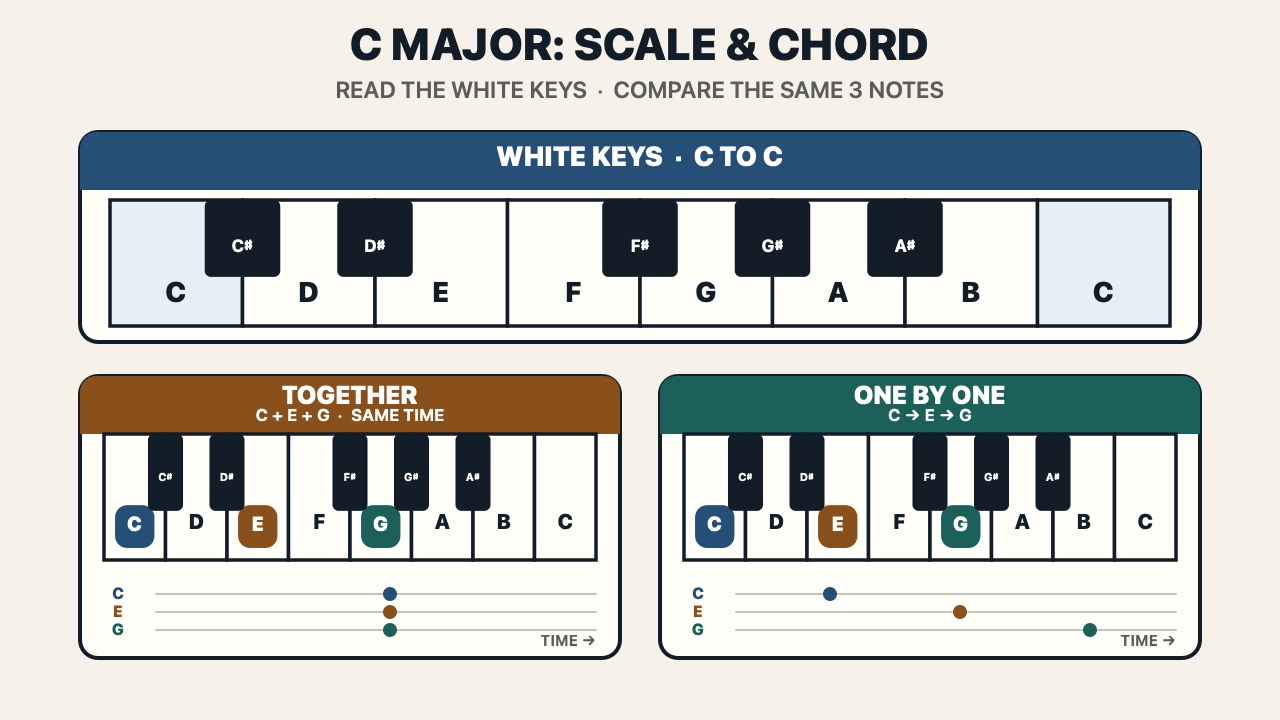
On a keyboard, follow the white keys from C to the next C in the order C, D, E, F, G, A, B, C. This is the scale used in C major. The same white keys can sound centered on different notes depending on how the melody ends and how the chords are arranged. A scale places the notes in pitch order; a key describes how those notes relate to a central note.
Play C first, pass through E and G, and return to C. C is the central note in this exercise. In a real piece, do not decide the key from the final note alone; listen to the surrounding chords as well. You can examine the difference between major and minor through the intervals between notes. The sense of brightness or darkness can also change with tempo and performance.
In the existing track Tea in a Patch of Sun, you can hear the section presented as a major-key example in the detailed guide.
Build chords and arrange them in time
Press C, E, and G together to make a C triad. Play the same three notes one after another to make an arpeggio. Both use the combination C, E, G. Even without a keyboard, you can mark those three notes with the same symbol to see the connection.
Write C, F, G, and C in the four-bar grid, one chord per bar. If each chord lasts four beats, the chord changes align with the starts of the bars. This order of chords is a chord progression. In C major, C, F, and G have roots on the first, fourth, and fifth notes of the scale, so the progression can be written I–IV–V–I. Looking at both chord names and scale degrees helps you find the same relationship in another key.
In the detailed guide for Salt on the Ropes, listen for the point where the chords move and then come to rest.
Transposition and modulation change the key in different ways
Move the exercise progression C–F–G–C up by a whole tone and it becomes D–G–A–D. Raising the entire piece by the same interval moves the center from C to D while preserving the I–IV–V–I relationship. This is transposition. You must move the chord tones as well as the chord names. In D major, the chords are D–F♯–A, G–B–D, and A–C♯–E.
If the first half of one piece keeps returning to C but the second half moves toward a resting point on D, it can be an example of modulation, a change of key within the piece. A single note or chord outside the key is not enough to establish modulation. Follow the later melody and chords to hear whether they support a new center.
The track page for Rainbow After the Rain and the existing modulation guide provide listening clues for the change near the end.
Try it with paper and your fingers in five minutes
Minute one: draw four bars on paper and write 1 through 4 in each bar. Tap at even intervals and circle every 1.
Minute two: on the keyboard diagram, follow the white keys from C to the next C and mark the C where you return.
Minute three: mark the groups C–E–G, F–A–C, and G–B–D. If you have a keyboard, sound each group together, then play its notes one at a time.
Minute four: write C, F, G, and C in the four bars and change chord on every 1. Play one right-hand note per beat. Bar 1 is C–E–G–E, bar 2 is F–A–C–A, bar 3 is G–B–D–B, and bar 4 is C–E–G–C. Without a keyboard, write the note names in 16 cells and check how they relate to each bar’s chord.
Minute five: move all four bars to D–G–A–D to check the transposition. Then connect D–G–A–D after C–F–G–C and notice how the second half settles on D. In the next piece you hear, first identify how the beats are grouped, then look separately for chord changes and points of rest.
This four-bar exercise is original to this article. The four featured tracks are listening examples for the individual ideas. All four are royalty-free and available as free downloads. They may be used commercially within the usage terms, with no credit required. Redistribution of the audio files by themselves and use for AI training are prohibited.
References
Choose one piece and count the beats first. Next, find where the chords change. Finally, listen for where each phrase comes to rest. This lets you examine three different aspects of the same piece separately.
FAQ
- Where should I start when learning music theory?
Count four beats and identify both the grouping and the speed. Next, follow a scale on a keyboard and place the chords C, F, G, and C in the same four-bar grid.
- What is the difference between meter and BPM?
Meter describes how beats are grouped; BPM is the number of beats per minute. In 4/4 at 60 BPM with a quarter note as one beat, one bar lasts four seconds.
- What is the difference between a scale and a key?
A scale arranges notes in pitch order. A key describes how melody notes and chords relate to a central note.
- What is the difference between transposition and modulation?
Transposition moves an entire piece or passage up or down by the same interval. Modulation changes the central key within a piece.
- Can I practise without an instrument?
Yes. Draw four bars and 16 beats on paper, then count with your fingers. Write one note name per beat and check how those notes relate to the chord in each bar.