
What Is an Arpeggio? Guitar, Piano, and How to Read the Symbol
An arpeggio means playing the notes that make up a chord one at a time in sequence. In a C major chord, playing C, E, and G together makes all three notes begin at the same time. Playing C, then E, then G creates an ascending arpeggio that moves from the lowest note upward.
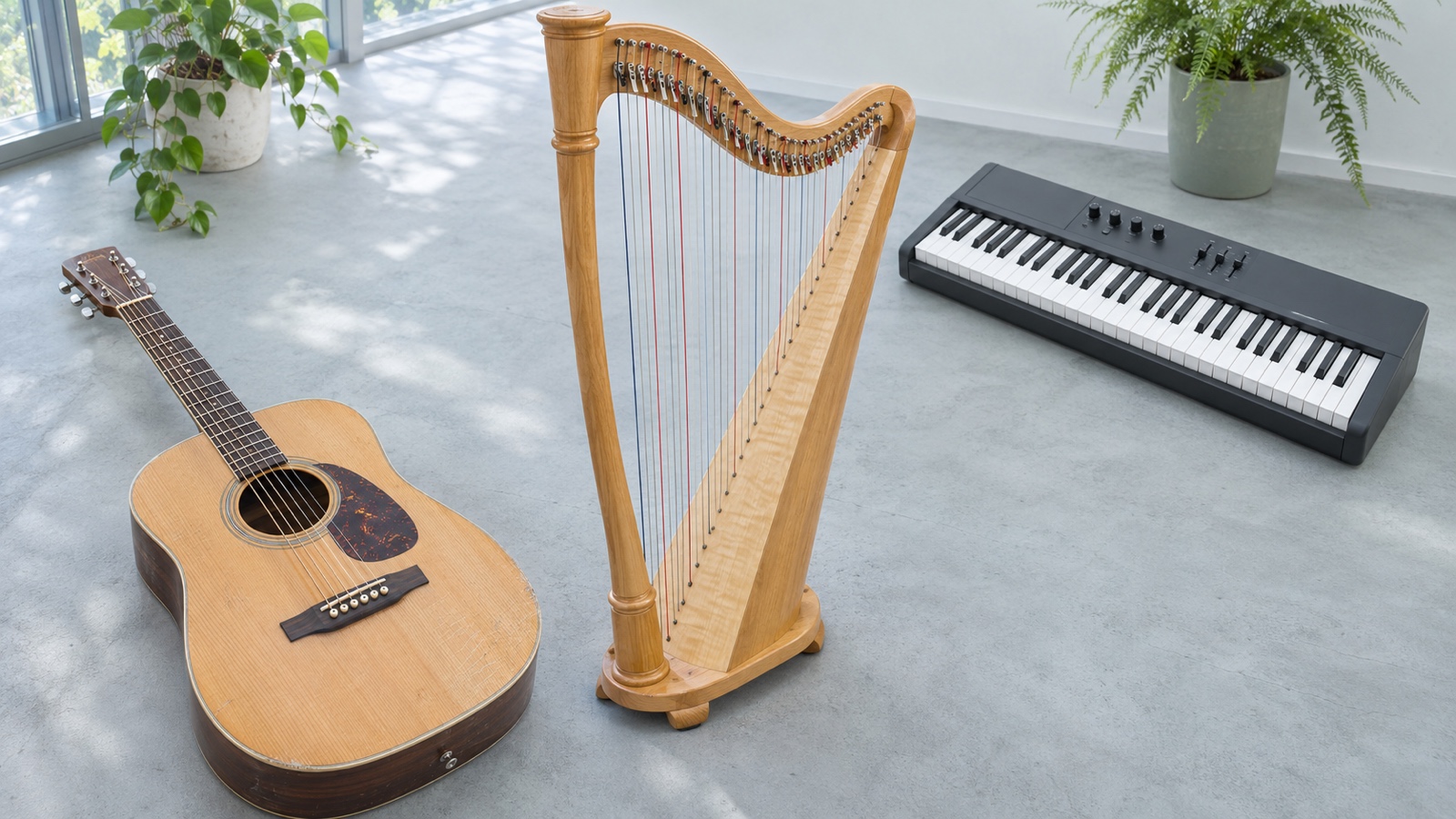
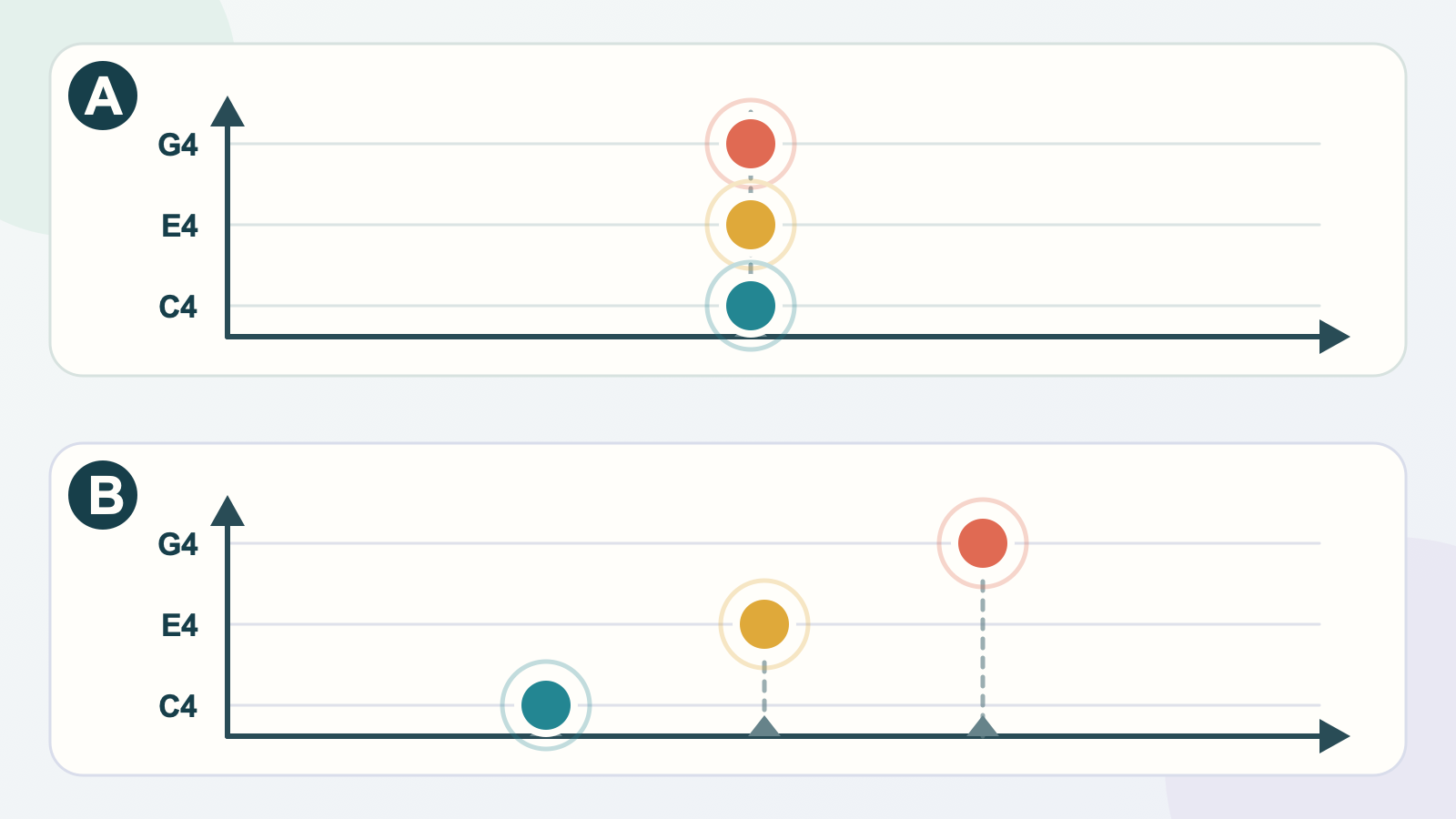
On guitar, hold the shape of a C chord and play the strings one by one. On piano, play the same three keys in sequence to hear the difference. Use the diagram to check the order in which the notes sound, then compare the vertical wavy line in notation with individually written notes in an accompaniment.
Compare when notes begin in the same chord
Middle C is written as C4. The diagram arranges the notes C4, E4, and G4 of a C major chord in two ways. In A, all three notes start together, so the dots form a vertical column. In B, each new note begins farther to the right, showing the order C4, E4, G4.
C4→E4→G4 is ascending, while G4→E4→C4 is descending. In an accompaniment, the pattern may change direction partway through, as in C4→G4→E4→G4, and repeat in the same form.
A vertical wavy line tells you to roll a chord over a short span
On a staff, a wavy vertical line to the left of a stacked chord is an arpeggio sign that tells the player to stagger the beginnings of the notes. It is normally played quickly from the lowest note to the highest. A downward arrow indicates that the player should begin with the highest note. An ascending indication beside a stacked C4, E4, and G4 means playing C4→E4→G4 as one continuous gesture.
If C4, E4, and G4 are written as three eighth notes, start each note one eighth note after the previous one while keeping the beat. Repeating the pattern gives the accompaniment its rhythm.
On piano, play the three keys together, ascending, and descending
Find middle C (C4), then E4 and G4 to its right. If your right thumb, middle finger, and little finger can reach them comfortably, use those fingers to press all three notes together. Next play C4→E4→G4, then G4→E4→C4. You will hear the same chord move first from low to high, then from high to low.
Once this feels comfortable, repeat C4→E4→G4→E4 at even intervals. Count each time the first C4 returns to hear the notes as groups of four. When listening to an actual accompaniment, try following the beat on which the low note begins separately from the order in which the higher notes move.
On guitar, hold a C chord and play strings 5, 4, and 3
An open C chord in standard tuning can be written x32010 from the sixth string to the first. The x marks a string that is not played, while 0 marks an open string played without pressing a fret. Hold the third fret of the fifth string, the second fret of the fourth string, and the first fret of the second string.
Keeping that shape in place, play the fifth, fourth, and third strings in order. The pitches that actually sound are C3→E3→G3. The third string is open. Playing the third, fourth, and fifth strings gives the descending order G3→E3→C3. Standard guitar notation on the staff is written one octave higher than the pitches that actually sound.
Start by playing strings 5, 4, and 3 one note at a time with equal spacing. Once you are comfortable selecting those strings, add strings 2 and 1. Whether you use your fingers or a pick, keep the fretting fingers in place while choosing each string.
On a synthesizer, an arpeggiator sets the note order
An arpeggiator is a function that uses the notes held on a keyboard as a trigger, then plays notes in a set order and rhythm. With an ascending setting, holding C4, E4, and G4 is enough to make the pattern play from C4 upward.
Depending on the instrument or preset, the pattern may repeat across octaves or include notes other than the keys being held. When listening to a piece, first focus on the part where the notes line up one by one and on the length of the repeating pattern. This makes the synthesizer accompaniment easier to follow.
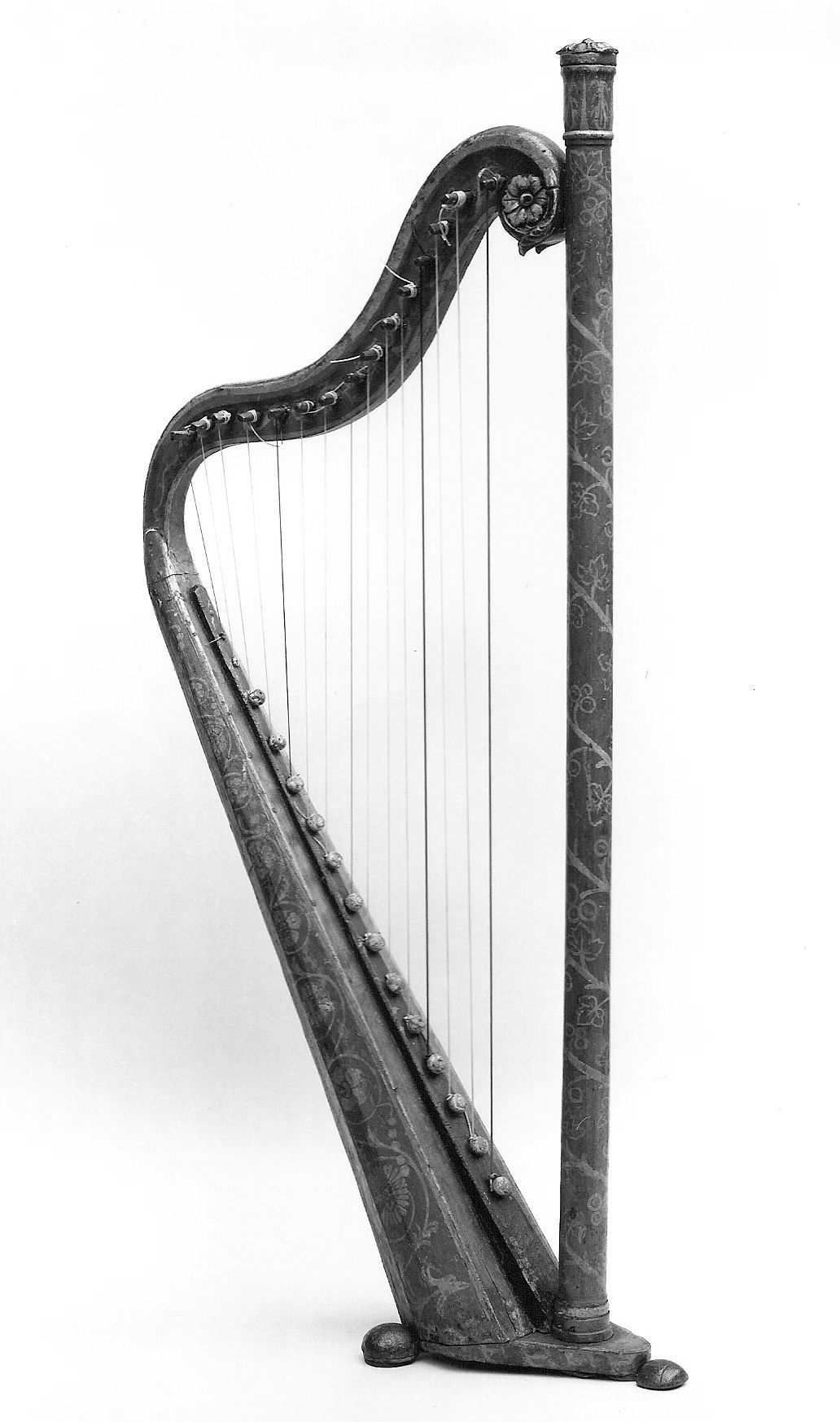
An 18th-century French harp shows how individual strings can be selected
The photograph shows an 18th-century French harp. Strings of different lengths run between the curved upper section and the sloping body. Because each string can be plucked individually, the player can select a low note, a high note, or a note in between from the notes of a chord.
Modern harps also use arpeggios that play the notes of a chord in sequence and accompaniments that repeat the same pattern. When each note continues to resonate, it overlaps with the notes played afterward, allowing a chord to emerge from notes that began separately.
Compare the accompaniment roles in three pieces featuring guitar, harp, and synthesizer
Each track page offers a preview and download of one piece. Each YouTube link opens the point in the video where that piece begins.
“Nel Drip” (4:30) uses a steel-string guitar arpeggio. Listen to the timing between the first two guitar notes.
In “Sail on the Snow Clouds” (3:45), a low whistle plays the melody while a light harp arpeggio supports the triple meter. Shift your attention between the melody and accompaniment to hear where the sequential notes mark the beat.
“Unboxed” (2:28) features a synthesizer arpeggio that creates a sense of anticipation. It is background music intended for moments such as taking a product out of its box, letting you check how the repeated notes fit the movement.
The three featured pieces are royalty-free and can be used commercially
All three pieces are free to download and may be used in monetized videos, streams, and games within the usage guide. There is no per-use fee, and credit is optional. Reselling or redistributing the audio by itself and using it for AI training are prohibited.
References
- 1
Listen to arpeggios in three tracks
Compare the spacing of the guitar notes, the harp’s triple meter, and the repeating synth pattern.
Use it forAcoustic guitar, Harp, Synthesizer
These sounds from arcalune
- Nel Drip4:30
- Sail on the Snow Clouds3:45
- Unboxed2:28
In notation, read the order and rhythm in which the notes begin. In a piece, listen for where a complete pattern repeats. Play the same chord together and then one note at a time on guitar and piano to hear how an arpeggio shapes an accompaniment.
FAQ
- What is an arpeggio?
It means playing the notes that make up a chord in sequence. In C major, playing C, E, and G from the lowest note upward or from the highest note downward both produces an arpeggio.
- Are arpeggios and broken chords the same?
Both terms refer to playing the notes of a chord in sequence and are used with the same meaning here. To determine the speed and rhythm, check whether the notation uses a vertical wavy line or writes out the individual notes.
- What does a vertical wavy line in notation mean?
It tells you to play the notes of a chord in sequence over a short span. The usual direction is upward from the lowest note. A downward arrow means to move down from the highest note.
- How can I try an arpeggio on guitar or piano?
On guitar, hold the open C chord x32010 and play the fifth, fourth, and third strings. On piano, first press middle C (C4), E4, and G4 together, then compare that sound with playing the notes one by one in sequence.
- Can I use the three featured pieces in monetized videos?
Yes, they may be used in monetized videos within the usage guide. Downloads are free and credit is optional. Reselling or redistributing the audio by itself and using it for AI training are prohibited.