

What Is Modulation? A Visual Guide to Transposition, Semitones, and Whole Tones
Modulation is a change of key within a piece. The musical flow moves away from the notes and chords that previously sounded settled and toward those of another key. Examples include a chorus that rises by a semitone and a passage that moves from a major key to a minor key.
Changing the key of an entire song before singing it at karaoke is transposition. After comparing the two through chord progressions, we will look at the sizes of a semitone and a whole tone and at how to hear whether the music continues in a new key.
Modulation changes the relationships between the notes and chords that sound settled
In C major, returning to the note C or a C major chord sounds settled. The reference note is the tonic, and the reference chord is the tonic chord. Listening to how other notes and chords lead toward them makes it easier to identify the key in which the music is moving.
When the music moves to D♭ major, the following phrases begin to settle on chords from D♭ major. In a move from C major to C minor, the tonic remains C, while the scale and the relationships among the chords change.
Transposition moves the entire piece by the same interval
Transposition raises or lowers the melody and accompaniment by the same interval while preserving the intervals between notes. When you choose an easier key for karaoke, the same shift applies from the beginning to the end.
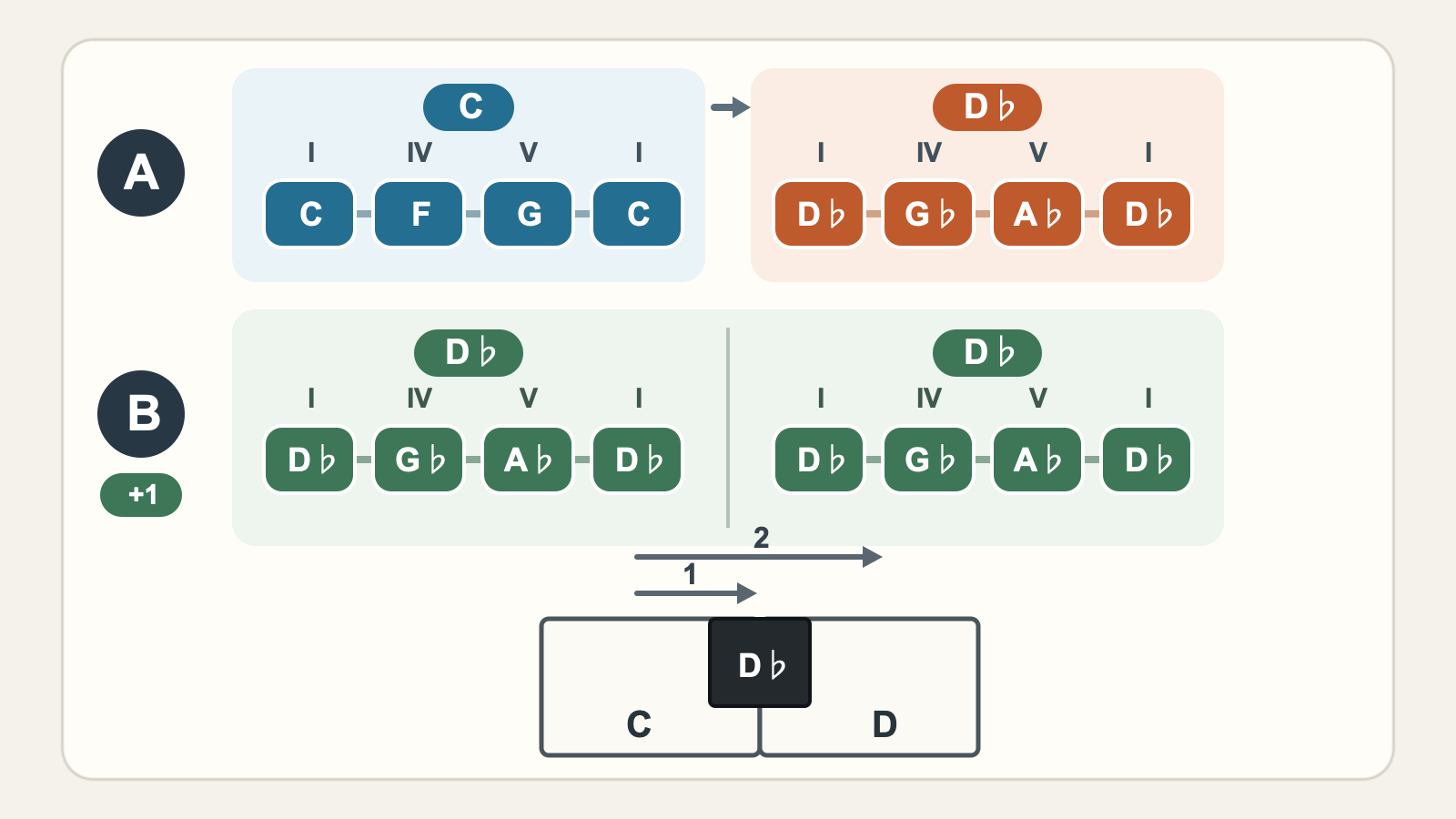
Raising C major’s “C–F–G–C” progression by one semitone gives “D♭–G♭–A♭–D♭.” The chord names change, but their functions within the key remain I–IV–V–I. The I chord at the beginning and end is the tonic chord.
Figure A modulates within the piece, while Figure B shows the whole piece transposed
Figure A moves from left to right through “C–F–G–C|D♭–G♭–A♭–D♭.” The first half is in C major. After the central arrow, the second half is in D♭ major, and its chord movement settles on D♭ in the new key.
Figure B takes the original “C–F–G–C|C–F–G–C” and raises the whole sequence by one semitone. The +1 means one semitone, so both the left and right sections are in D♭ major. The figures compare where in the piece the key changes.
C to D♭ is a semitone, while C to D is a whole tone
Using the keyboard in the figure, count one step from the white key C to the black key D♭ immediately to its right. This is a semitone. Moving from C to the white key D passes through D♭ and takes two steps, which makes a whole tone.
If one section is in C major and the next chord sequence begins in D♭ major, it is an example of a rise by one semitone. Beginning the next section in D major raises it by a whole tone. The I–IV–V–I chords in that key are “D–G–A–D.”
References
Listen to whether the new key continues through the chorus and accompaniment
A singer may reach a high note while the accompaniment and phrases still return to the original key. In that case, the piece may not have changed key. When the volume rises or more instruments enter, listen to where the accompanying chords settle.
In a final chorus raised by a semitone or a whole tone, both the melody and accompaniment move to a different pitch level, and the following phrases continue in the new key. If a chord chart is available, compare the same positions in the earlier and final choruses.
Check whether accidentals continue and where phrases come to rest
When a sharp or flat appears in the score, check whether the same alteration continues over the next several measures. A piece can briefly use a note from outside the key and then settle back on a chord from the original key.
To find a new key, identify the chord that sounds settled at the end of a phrase, then examine the chord immediately before it. In the second half of Figure A, for example, the A♭ chord returns to the D♭ tonic chord. This kind of close is called a cadence. The cadence and whether the music continues in the new key are both useful clues.
Follow the chords to hear a modulation
In the first chorus, note one chord to which the ending returns. When a similar chorus appears near the end, compare whether the chords in the same positions have each moved up by a semitone or a whole tone.
Without a chord chart, hum the note that sounds settled at the end of each section and find it on a keyboard or another instrument. Treat the bass note as one clue, then listen for repeated returns to the same note or chord. Even in a gradual modulation, you can compare where the middle and the ending come to rest.
Compare a rise by a semitone and a whole tone in two downloadable tracks
Listen from the beginning of each track, then compare the within-track sections listed below. These reference sections come from comparing the distribution of the 12 pitch classes before and after the change, with octave equivalents grouped together. The time shown in each YouTube link is the start of the track within a longer video.
“Rainbow After the Rain” (4:30) is electronica that rises by a semitone near the end. Comparing 2:30–3:12 with 3:36–4:24 within the track, the later section matched most closely when the earlier section’s pitch distribution was shifted up by one semitone. Listen for how the synth and bell textures change between the earlier and later sections.
“Snow Lantern Row” (4:44) is an example that rises by a whole tone near the end. Comparing 2:30–3:36 with 3:54–4:42 within the track, the later section matched most closely when the earlier section was shifted up by a whole tone. Follow where the phrases come to rest in the later section. All within-track sections are listening references for comparing the music before and after the change.
The two featured tracks are royalty-free and available for commercial use
Both tracks are free to download and may be used in monetized videos, live streams, and games within the terms of the media usage guide. There is no per-use royalty, and credit is optional. Reselling or redistributing the audio as a standalone file and using it for AI training are prohibited. Check the media usage guide for the latest terms before use.
References
- 1
Two tracks with a half-step and a whole-step change
Compare earlier and later sections and listen for where the chords and melody settle.
Use it forUp a half step, Up a whole step
These sounds from arcalune
As you listen, follow which chord sounds settled before and after the modulation. Playing the figure’s C major and D♭ major progressions in sequence on a keyboard also lets you compare modulation with transposing an entire piece.
FAQ
- What is modulation?
Modulation is a change of key within a piece. Chords and phrases continue in the new key, changing the relationships among the notes and chords that sound settled. A piece can also move between major and minor while keeping the same tonic.
- What is the difference between modulation and transposition?
Modulation changes the key within a piece. Transposition raises or lowers the entire piece by the same interval while preserving the intervals between the melody and accompaniment notes.
- What is the difference between raising a key by a semitone and a whole tone?
C to D♭ is one semitone, while C to D is one whole tone. On a piano, moving to the immediately adjacent key is a semitone, while moving two keys is a whole tone.
- Does a high note in the chorus mean the song has modulated?
One higher note in a chorus is not enough to show that the key has changed. Listen for whether the accompaniment’s chords also move and whether the following phrases continue in the new key.
- How can I hear a modulation?
Compare the chords on which phrases come to rest before and after the change. Recurring accidentals, the chord sequence, and phrase endings together can help show whether the music continues in a new key.