

What Are Diatonic Chords? How to Build Them and Charts for 12 Major and Minor Keys
Diatonic chords are chords built from the notes of a chosen scale. To build a triad, choose a note in the scale and take three notes by skipping every other note. Starting on C in the C major scale gives C–E–G, while starting on D gives D–F–A.
This article illustrates the seven chords in C major and provides charts for all 12 major keys and all 12 natural minor keys. Once you know the key of a piece, find that key's row and the column for the scale degree you need.
Take the first, third, and fifth notes from each scale degree
Write the scale as C–D–E–F–G–A–B and count C as the first note. E is the third and G is the fifth, so these three notes form a C chord. Start counting again from D and the third and fifth notes are F and A.
Counting from B gives B–D–F. Here, D and F are in the octave above B. In the diagram, the bottom note of each column is the chord's root, with the third and fifth stacked above it.
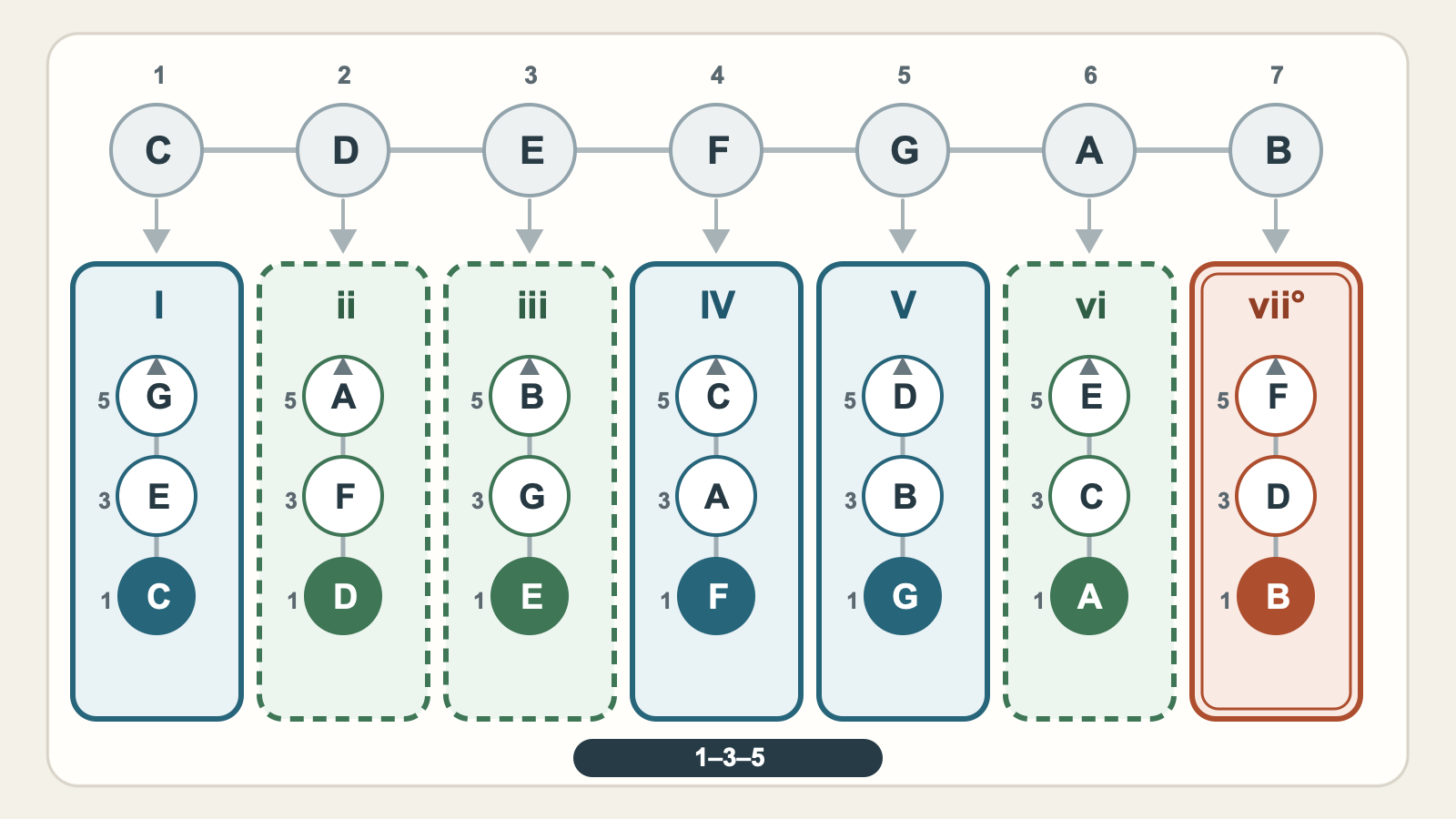
The seven chords in a major key follow major, minor, minor, major, major, minor, diminished
In C major, the chords from I onward are C, Dm, Em, F, G, Am, and Bdim. Roman numerals show which scale degree is the root. Uppercase I, IV, and V are major triads, lowercase ii, iii, and vi are minor triads, and vii° is a diminished triad. The pattern is I ii iii IV V vi vii°.
Count the semitone distances from the root to the third and fifth. A major triad has intervals of 4 and 7 semitones, a minor triad has 3 and 7, and a diminished triad has 3 and 6. In Bdim, for example, B to D spans 3 semitones and B to F spans 6. The m in a chord name means minor, while dim means diminished.
Diatonic chord chart for all 12 major keys
Choose the row for the key and read across the scale degrees. I–IV–V in G major gives G–C–D, while ii–V–I in E♭ major gives Fm–B♭–E♭. When building a chord yourself, write the scale first and then take every other note from the root.
The chart uses 12 representative spellings. The seventh note of F♯ major is E♯, so its chord is E♯–G♯–B, or E♯dim. E♯ is the same pitch as F on a keyboard, but it is spelled E♯ because it occupies the E position in the scale.
| Major key | I | ii | iii | IV | V | vi | vii° |
|---|---|---|---|---|---|---|---|
| C | C | Dm | Em | F | G | Am | Bdim |
| D♭ | D♭ | E♭m | Fm | G♭ | A♭ | B♭m | Cdim |
| D | D | Em | F♯m | G | A | Bm | C♯dim |
| E♭ | E♭ | Fm | Gm | A♭ | B♭ | Cm | Ddim |
| E | E | F♯m | G♯m | A | B | C♯m | D♯dim |
| F | F | Gm | Am | B♭ | C | Dm | Edim |
| F♯ | F♯ | G♯m | A♯m | B | C♯ | D♯m | E♯dim |
| G | G | Am | Bm | C | D | Em | F♯dim |
| A♭ | A♭ | B♭m | Cm | D♭ | E♭ | Fm | Gdim |
| A | A | Bm | C♯m | D | E | F♯m | G♯dim |
| B♭ | B♭ | Cm | Dm | E♭ | F | Gm | Adim |
| B | B | C♯m | D♯m | E | F♯ | G♯m | A♯dim |
Diatonic chord chart for all 12 natural minor keys
A natural minor scale beginning on the sixth degree of a major scale is its relative key and uses the same key signature. Rearranging the triads of C major from A gives Am–Bdim–C–Dm–Em–F–G in A natural minor.
Natural minor triads follow minor, diminished, major, minor, minor, major, major. Their Roman-numeral pattern is i ii° III iv v VI VII. The v in the chart is a minor triad, so the A minor row shows Em. If you are looking for the dominant chord commonly used in minor, also see the next example, which raises the seventh scale degree.
| Natural minor key | i | ii° | III | iv | v | VI | VII |
|---|---|---|---|---|---|---|---|
| A | Am | Bdim | C | Dm | Em | F | G |
| B♭ | B♭m | Cdim | D♭ | E♭m | Fm | G♭ | A♭ |
| B | Bm | C♯dim | D | Em | F♯m | G | A |
| C | Cm | Ddim | E♭ | Fm | Gm | A♭ | B♭ |
| C♯ | C♯m | D♯dim | E | F♯m | G♯m | A | B |
| D | Dm | Edim | F | Gm | Am | B♭ | C |
| D♯ | D♯m | E♯dim | F♯ | G♯m | A♯m | B | C♯ |
| E | Em | F♯dim | G | Am | Bm | C | D |
| F | Fm | Gdim | A♭ | B♭m | Cm | D♭ | E♭ |
| F♯ | F♯m | G♯dim | A | Bm | C♯m | D | E |
| G | Gm | Adim | B♭ | Cm | Dm | E♭ | F |
| G♯ | G♯m | A♯dim | B | C♯m | D♯m | E | F♯ |
Raising the seventh in a minor key creates V and vii°
The fifth triad in A natural minor is Em, spelled E–G–B. Harmonic minor raises the seventh scale degree from G to G♯, which produces E–G♯–B, an E major triad that functions as V. G♯ is a semitone below the tonic A.
Starting on the same raised seventh gives G♯–B–D, or G♯dim, written vii°. The triad on the third degree changes from C–E–G to C–E–G♯, or Caug. In C minor, raising the seventh from B♭ to B produces G and Bdim.
The seventh degree of D♯ minor is C♯. Raising it by a semitone gives C𝄪, which is the same pitch as D on a keyboard and is written with a double sharp. Keeping C as the note letter makes the raised seventh scale degree clear.
When a note falls outside the chart, check the chord that follows
The charts help you find chords that can be built from the chosen scale. Music can also include chords that raise the leading tone, as V does in minor, chords borrowed from the parallel key, and chords that temporarily lead toward a different chord.
Suppose an A major chord spelled A–C♯–E appears in C major. If it leads to Dm, you can hear C♯ move up by a semitone to D. After identifying the chord name, check which note actually moves into the next chord.
Hear the chord tones in a piano piece and an arpeggiated prelude
Begin at the start of each track and listen for the chord tones one by one. The times below are reference windows obtained by dividing the downloadable audio into short segments and examining their pitch content and bass notes. The YouTube links point to where each track begins within its video. These windows are not a definitive transcription, and they do not establish exact chord boundaries, inversions, or a continuous chord progression.
Peaks in the Window (5:00) is a solo piano piece. Analysis of the downloadable audio identified F–A–C at 5.00–7.00 seconds into the track, G–B–D at 8.25–9.75 seconds, and C–E–G at 30.25–32.00 seconds as candidate chord tones. Compare each window with the diagram and listen to the notes in that segment.
Prelude for the Night Shift (4:15) features arpeggios on harpsichord. C–E♭–G at 3.00–4.00 seconds into the track and G–B–D at 4.50–6.50 seconds are candidate chord tones. Listen for E♭ and B as the chord tones sound in sequence, then compare them with the example that raises the seventh scale degree in minor.
Both tracks are royalty-free and available for commercial use
Both tracks are free to download and may be used royalty-free in monetized videos, streams, and games within the scope of the media usage guide. There are no additional fees based on the number of uses or plays, and credit is not required. Copyright remains with the rights holder. Reselling or redistributing the audio by itself and using it for AI training are prohibited. Check the latest terms before use.
References
- 1
Two tracks for hearing chord tones on piano and in arpeggios
Listen to the suggested sections and look for F–A–C, G–B–D, and C–E♭–G.
Use it forSolo piano, Arpeggios
These sounds from arcalune
After choosing a chord from the row for your key, verify its chord tones by taking every other note of that scale. If you hear a major V chord in a minor-key piece, also try the form with the seventh scale degree raised.
FAQ
- What are diatonic chords?
They are chords built from the notes of a chosen scale. To build a triad, take the first, third, and fifth notes when counting from each note of the scale.
- Why are there seven diatonic chords?
A major or natural minor scale contains seven distinct notes before the octave repeats. Building one triad on each note as the root produces seven chords.
- What are the diatonic chords in C major?
They are C, Dm, Em, F, G, Am, and Bdim. In Roman numerals, they are I, ii, iii, IV, V, vi, and vii°.
- Why do both Em and E appear in A minor?
The fifth triad built from the natural minor scale is Em. Raising the seventh degree from G to G♯ in harmonic minor creates the E major triad E–G♯–B, written V.
- Can I use chords from outside the scale?
Yes. Common uses include raising the leading tone in minor, borrowing from the parallel key, and temporarily pointing toward another chord. Listening for which note moves into the next chord can help you identify the role.