

What Is the Difference Between Major and Minor? Scales, Chords, and How to Hear It
Major and minor keys arrange notes and chords differently around the note where the music comes to rest. With C as the tonal center, the tonic triad is C–E–G in C major and C–E♭–G in C minor. A clear place to begin comparing the two sounds is the one-semitone difference between E and E♭ in the middle of the chord.
We will compare the scales and chords in a diagram, then use the key signature and the note of rest as clues in written music. Finally, we will compare two tracks in which G sounds like the tonal center, one in G major and one centered on G minor.
Major and minor use different intervals above the tonic
The tonic is the tonal center, the note to which phrases often return at the end. The tonic triads compared in this article are built by stacking the first, third, and fifth notes of the scale above the tonic as the root. In both C major and C minor, C is the root.
A scale arranges notes in order from the tonic. Major and minor are names for keys, which include not only a scale and its chords but also how the music moves and where it settles. The impression of brightness can also change with the tempo, instruments, and dynamics.
Starting on the same C, the natural minor lowers the third, sixth, and seventh notes
Scale A in the diagram is the major scale, C–D–E–F–G–A–B–C. Scale B is the natural minor scale, C–D–E♭–F–G–A♭–B♭–C. Comparing the two rows shows that E, A, and B, the third, sixth, and seventh notes, are each lowered by one semitone.
Both scales have C as their tonic. C major and C minor share the same tonic and are called parallel keys. Play each scale one note at a time at the same speed to compare the sound while changing only the third, sixth, and seventh notes.
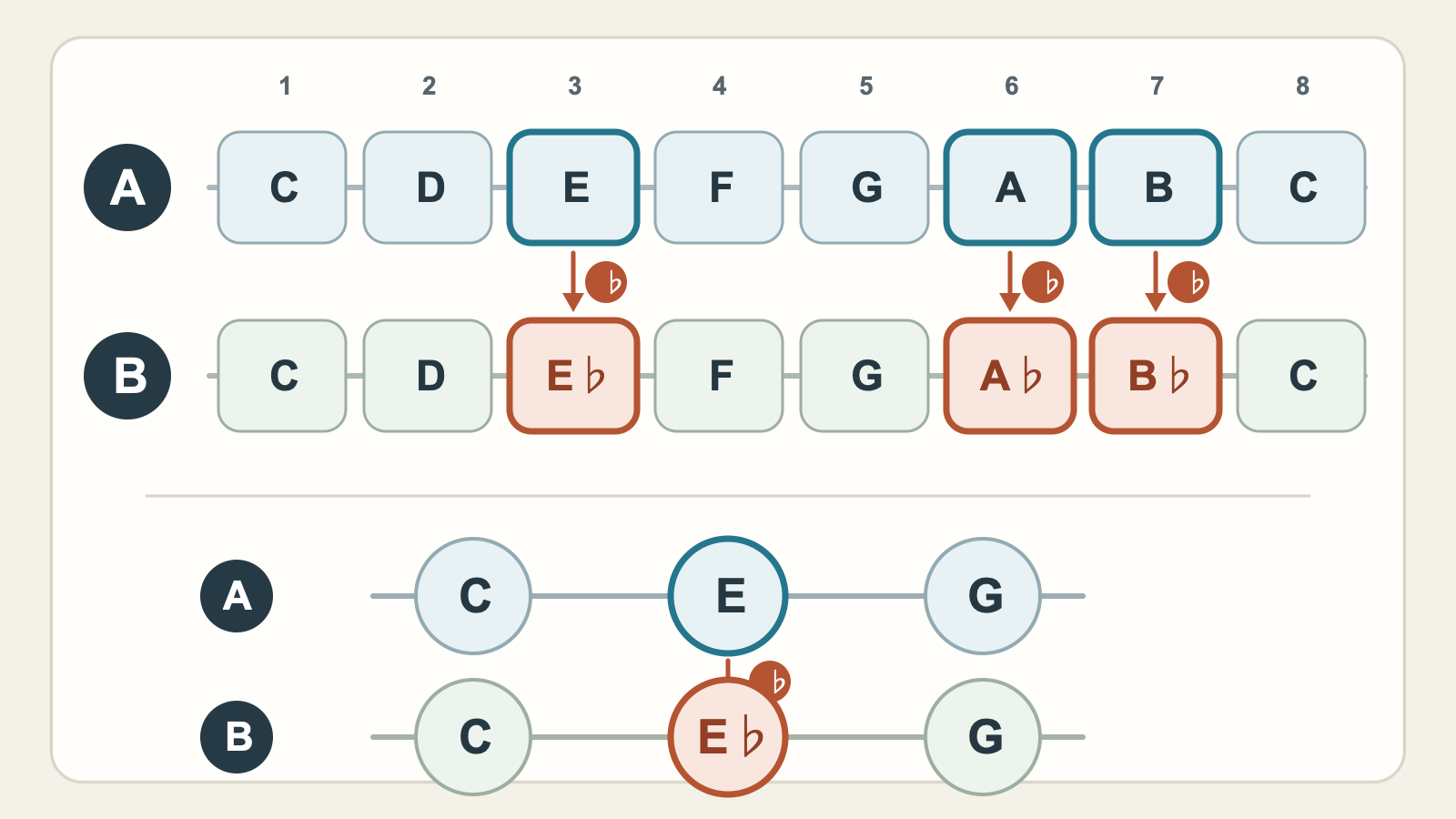
Keep C and G, then compare E with E♭
First play C–E–G together, then play C–E♭–G. Counting each move to the next piano key as one semitone, C to E spans four semitones and forms a major third, while C to E♭ spans three semitones and forms a minor third. The distance from C to G stays the same.
Using the same piano and volume helps you focus on the middle note. If the difference is hard to find, hold C and G and alternate only between E and E♭.
References
C major and A minor share a key signature but settle on different notes
Neither C major nor A minor has sharps or flats in its key signature. The major scale starting on C and the natural minor scale starting on A use the same white keys, but C major centers on C while A minor centers on A. A major key and a minor key that share a key signature are called relative keys.
When a score has no sharps or flats in the key signature, C major and A minor are the two candidates. Check whether phrases return to C or C–E–G, or to A or A–C–E. Repeated points of rest and the chord immediately before them provide further clues.
The sixth and seventh notes can be raised in music in a minor key
Scale B in the diagram is the natural minor scale. In the C harmonic minor scale, the seventh note is raised from B♭ to B. This places B a semitone below the tonic C and creates motion toward C at the end of a phrase.
In the classical form of the melodic minor scale, A♭ and B♭, the sixth and seventh notes, are raised to A and B on the way up. On the way down, the scale normally returns to the natural minor form. Music uses these forms according to context. E♭, the third above the tonic in C minor, belongs to all three minor scales.
Listen for the returning note and chord rather than the speed
Begin with one short phrase and hum the note where its melody and harmony come to rest. Listen for the same return in the next phrase, then determine whether the note a third above the tonic in the tonic triad forms a major or minor third. If a score or chord chart is available, check whether the tonic triad is major or minor.
A fast track can be in minor, and a slow track can be in major. If speed or brightness distracts you, pause the track and play a major and minor triad in turn at the same volume. Use the closer sound as a clue, then check another part of the track.
Hear major and minor around the same G in two tracks
The following two tracks can be played from their beginnings. We also mark sections where the distribution of pitch classes, with notes in different octaves grouped together, remains stable in the downloadable audio. In a tonic triad centered on G, the note a third above G is B in major and B♭ in minor. The YouTube links open both the beginning of each track within its long-form video and the beginning of the comparison section.
“Tea in a Patch of Sun” (3:44) is based in G major. G major was also predominant in the analysis of the downloadable audio from 3:00 to 3:30 within the track. Play G–B–D on a keyboard, then listen for where the felt piano and bells come to rest.
“Rain on the Washing” (4:15) centers on G minor, and its G minor pitch distribution was stable from 3:42 to 4:12 within the track. Play G–B♭–D, then listen for where the violin phrases and chords come to rest. Some passages in the middle sound closer to other keys, so the marked section is the clearest place to begin the comparison.
References
The two featured tracks are royalty-free and available for commercial use
Both tracks are free to download and may be used within the scope of the media usage guide in monetized videos, streams, and games. There are no additional fees based on the number of uses or plays, and credit is not required. The rights holder retains the copyright. Reselling or redistributing the audio by itself and using it for AI training are prohibited. Check the latest terms before use.
References
- 1
Two tracks centered on G in major and minor
Play G–B–D and G–B♭–D, then listen for where each track comes to rest in the suggested passage.
Use it forG major, G minor
These sounds from arcalune
To compare major and minor with the same tonic, begin by moving the third of the tonic triad by one semitone. In a score, use the key signature to identify the candidates, then check the notes and chords to which the music repeatedly returns. This connects what you hear to the key.
FAQ
- What is the clearest difference between major and minor?
With the same tonic, the third of the tonic triad differs by one semitone. With C as the tonic, the tonic triad is C–E–G in major and C–E♭–G in minor.
- Which notes differ between the major and minor scales that start on the same C?
Comparing the major scale with the natural minor scale, the third, sixth, and seventh notes differ by one semitone. In the C natural minor scale, they are E♭, A♭, and B♭.
- Why are C major and A minor different if they have the same key signature?
C is the tonic in C major, while A is the tonic in A minor. Even though they use the same set of notes, their melodies and chords settle in different places.
- Does music that sounds bright have to be in major, and music that sounds dark have to be in minor?
The impression you hear also changes with the tempo, instruments, and dynamics. Listen for the note that returns at the end of each phrase and check the third of the tonic triad to distinguish the two more reliably.
- Why do minor-key pieces contain notes outside the natural minor scale?
The harmonic and melodic minor scales use forms in which the sixth or seventh note is raised. In C minor, for example, raising B♭ to B creates a semitone step to the tonic C.