

What Is a Chord Progression? How to Read and Play 4 Common Patterns
A chord progression is a sequence of chords changing over time. Playing C, F, G, and C in order as C–F–G–C is one example. Even with the same types of chords, changing their order changes how each chord leads to the next.
This article compares I–IV–V–I, ii–V–I, the Canon progression, and the Royal Road progression in C major. Once you can match chord names to Roman numerals, you can move the same relationships into another key.
Read chord names and Roman numerals in the same order
The diatonic chords in C major are C, Dm, Em, F, G, Am, and Bdim. In scale order, they are written I, ii, iii, IV, V, vi, and vii°. Uppercase numerals indicate major triads, lowercase numerals indicate minor triads, and ° indicates a diminished triad. C–F–G–C is I–IV–V–I, while Dm–G–C is ii–V–I.
A Roman numeral shows the scale degree on which a chord's root is built. I is the tonic, the tonal center. In I–IV–V–I, IV acts as a predominant leading to V, and V acts as a dominant returning to I. In ii–V–I, ii leads to V.
I–IV–V–I moves away from the center and returns
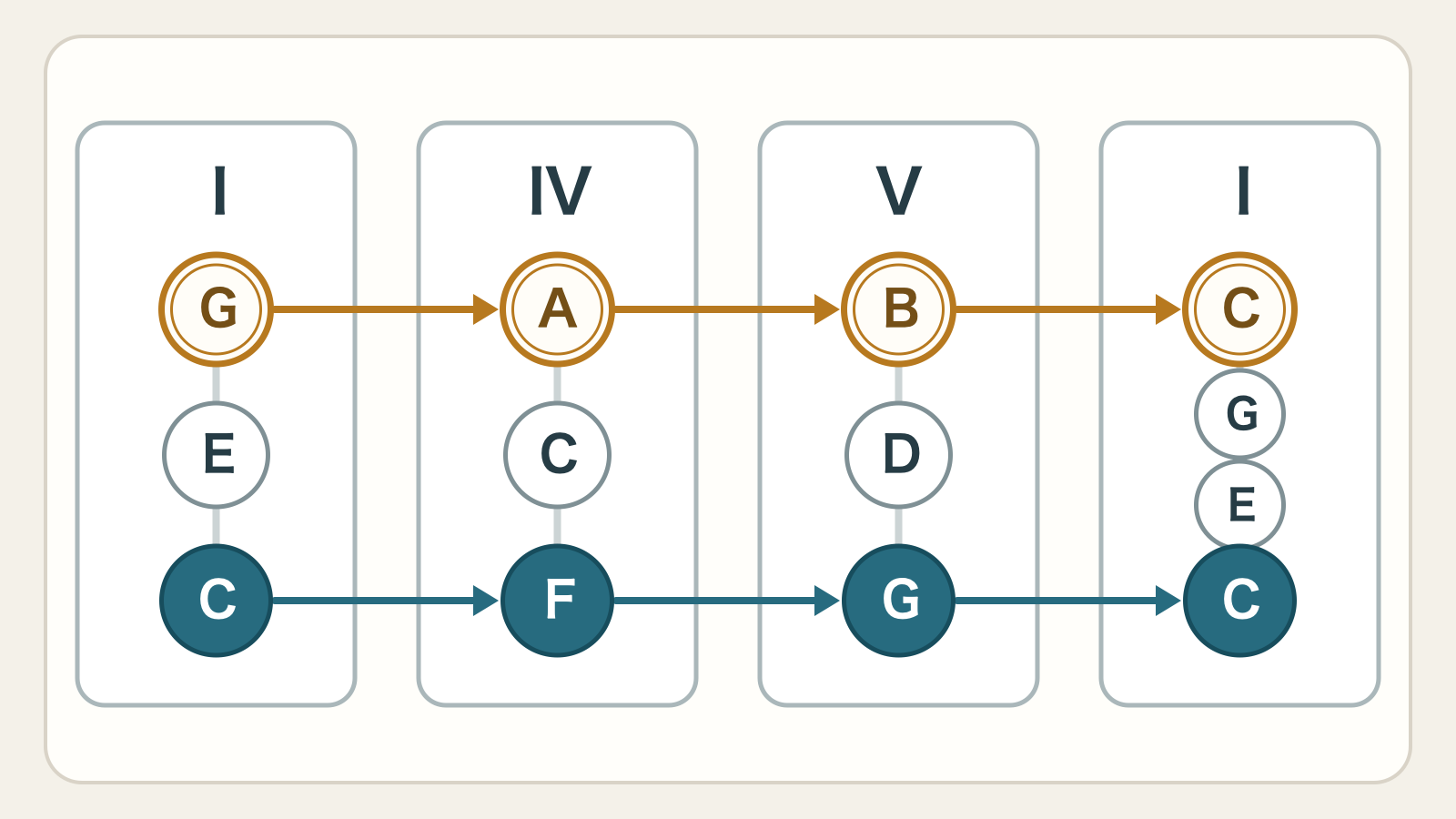
I–IV–V–I in C major is C–F–G–C. The first C is the tonic, F is the predominant, G is the dominant, and the final C is the tonic again. Play all four for the same length to hear the progression move away from C, pass through G, and return to C.
In the diagram, the roots move C–F–G–C while the top notes rise stepwise as G–A–B–C. The notes of an F chord are F–A–C, and the notes of a G chord are G–B–D, so A and B can be placed on top. Rearranging the notes within each chord keeps the roots at C–F–G–C while creating the separate G–A–B–C motion in the upper voice.
ii–V–I reaches I through three chords
ii–V–I in C major is Dm–G–C. Dm on ii is the predominant, G on V is the dominant, and C on I is the tonic. Play Dm for four beats, G for four beats, and C for eight beats, then listen to how the sound changes when G moves to C.
Add one note to each triad and you can play the same order as Dm7–G7–Cmaj7. A jazz textbook also gives the extended example Dmin9–G9(13)–CΔ9. First confirm the roots and order with triads, then compare the sound after replacing them with seventh chords.
Listen for ii–V–I changes in two existing tracks
The following excerpts let you compare sequences that sound like ii–V–I after examining the chord tones and bass in the downloadable audio. Each YouTube reference excerpt opens shortly before the relevant part of the track.
In “The Room Keeps the Warmth” (2:57), the chord tones from 162.25 to 166.75 seconds are candidates for F♯m–B–E in E major. The final E sonority may be E/B, with a low B still sounding. Use the times as a guide and listen for notes such as D♯ and G♯ that distinguish the sonorities.
“Salt on the Ropes” (3:09) features accordion on the main melody. The passage from 35.75 to 44.75 seconds is a candidate for Cm–F–B♭ in B-flat major. A low C or G appears in the first chord. Follow the low F and B♭ that come next and listen for the move into the final chord.
References
Try the Canon progression as an eight-chord practice pattern
The C-major practice pattern is C–G–Am–Em–F–C–F–G, or I–V–vi–iii–IV–I–IV–V in Roman numerals. In this article, each chord lasts four beats, making one cycle eight measures long. Return from the final G to the opening C and repeat the same eight measures.
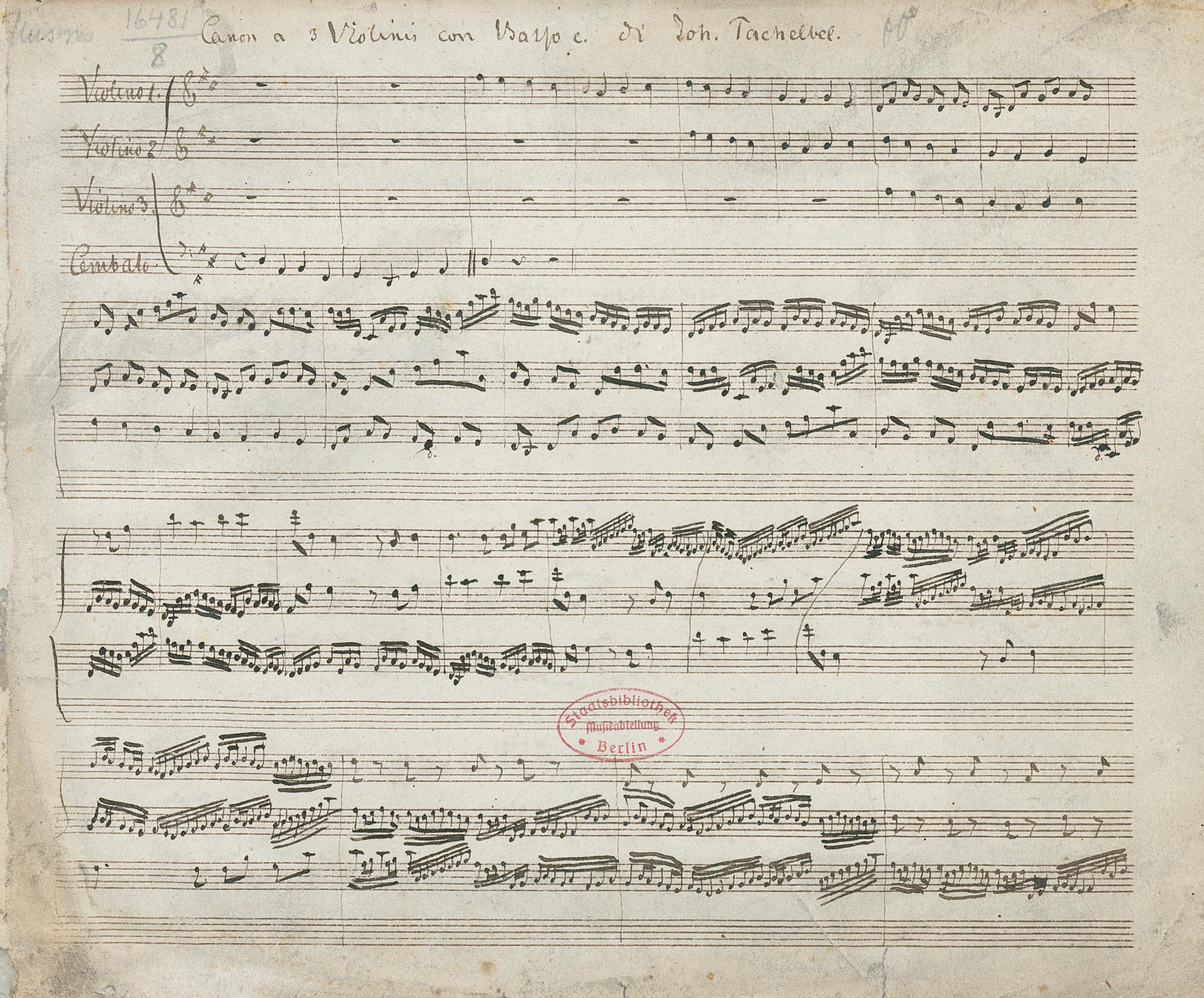
Pachelbel's Canon is in D major and was written for three violins and continuo. At the beginning of the surviving manuscript, the bass plays the eight notes D–A–B–F♯–G–D–G–A over two measures, and that bass pattern repeats. The violins layer the same melody at staggered entries.
The Royal Road progression moves from F–G to Em–Am
Played as triads in C major, the Royal Road progression is F–G–Em–Am. In Roman numerals, it is IV–V–iii–vi. Music theory research on Japanese popular music also discusses versions that use seventh chords on IV, V, or iii.
Play F–G–C and F–G–Em–Am at the same tempo. Both begin with F and G. On the next chord, C contains C–E–G while Em contains E–G–B. Compare the shared E and G with the C and B that replace each other, then continue to Am.
Use the same scale degrees to transpose into G major
Changing key changes the chord names, but the order of the scale degrees can stay the same. The diatonic chords in G major are G, Am, Bm, C, D, Em, and F♯dim. Transposing C–F–G–C, the C-major form of I–IV–V–I, into G major gives G–C–D–G.
Using the same method, ii–V–I becomes Am–D–G, the Canon progression becomes G–D–Em–Bm–C–G–C–D, and the Royal Road progression becomes C–D–Bm–Em. These are examples of transposing an entire progression to another pitch level. To find the chords in each key, use the key rows and scale-degree columns in the diatonic chord chart.
Compare common progressions in five minutes
In the first minute, sound each of the C-major chords C, Dm, Em, F, G, and Am once. In the second minute, play C–F–G–C followed by Dm–G–C. In the third minute, play C–G–Am–Em–F–C–F–G. In the fourth, repeat F–G–Em–Am. Keep every chord to four beats and listen through the move from the last chord back to the first. In the fifth minute, transpose I–IV–V–I to G–C–D–G in G major.
On a keyboard, begin by playing only the roots with your left hand, then add the triads with your right so you can check the bass and harmony separately. The root is the note on which a chord name is based, while the bass is the note that actually sounds lowest. If a C chord is voiced C–E–G, both its bass and root are C. In the first-inversion voicing E–G–C, the bass is E while the root remains C. Do not identify a chord from the bass alone.
Finally, play C–F–G–C again and set the top notes to G–A–B–C as shown in the diagram. By changing the placement of the notes while keeping each chord's name and root, you can create a melody in the upper voice.
Using the tracks as royalty-free material
Both tracks featured here are available as free downloads. Within the usage guide, you may use them in monetized videos, streams, games, and similar projects. No per-use fee or credit is required. Copyright remains with the rights holder, and standalone resale or redistribution of the audio and use for AI training are prohibited. Check the current terms in the material usage guide before publishing or distributing your work.
- 1
Two tracks for comparing ii–V–I
Listen for F♯m–B–E and Cm–F–B♭ in the passages linked in the article.
Use it forPop, Jazz, Chord changes
These sounds from arcalune
Chord progressions become easier to read when you line up the chord names and scale degrees, then check where the harmony changes and which chord it reaches at the end. First compare the four patterns at the same tempo in C major, then transpose your favorite one into G major.
FAQ
- What is the difference between a chord and a chord progression?
A chord is a single harmony. A chord progression is a sequence of several chords over time. C–F–G–C, played as C, F, G, and C in order, is one example.
- Why are chord progressions written with Roman numerals?
Roman numerals show each chord's position within a key and preserve the same relationships in another key. C–F–G–C and G–C–D–G have different chord names, but both are I–IV–V–I.
- Is ii–V–I only a jazz chord progression?
No. It also appears in classical and popular music. In C major, you can play it as Dm–G–C. Jazz often uses seventh chords such as Dm7–G7–Cmaj7 or extended chords with still more notes.
- How do I practice the Canon progression in C major?
Play C–G–Am–Em–F–C–F–G, holding each chord for four beats. This practice pattern makes one eight-measure cycle. In Pachelbel's original work, the eight-note bass pattern in D major repeats over two measures.
- Which chords make up the Royal Road progression in C major?
They are F–G–Em–Am, or IV–V–iii–vi in Roman numerals. Playing the same order in G major gives C–D–Bm–Em.
- Are a chord's root and bass always the same note?
If a C chord is voiced C–E–G, its root and bass are both C. In the voicing E–G–C, the root is C while the actual lowest note, the bass, is E.