
What Is a Synthesizer? Sound, History and the Keyboard
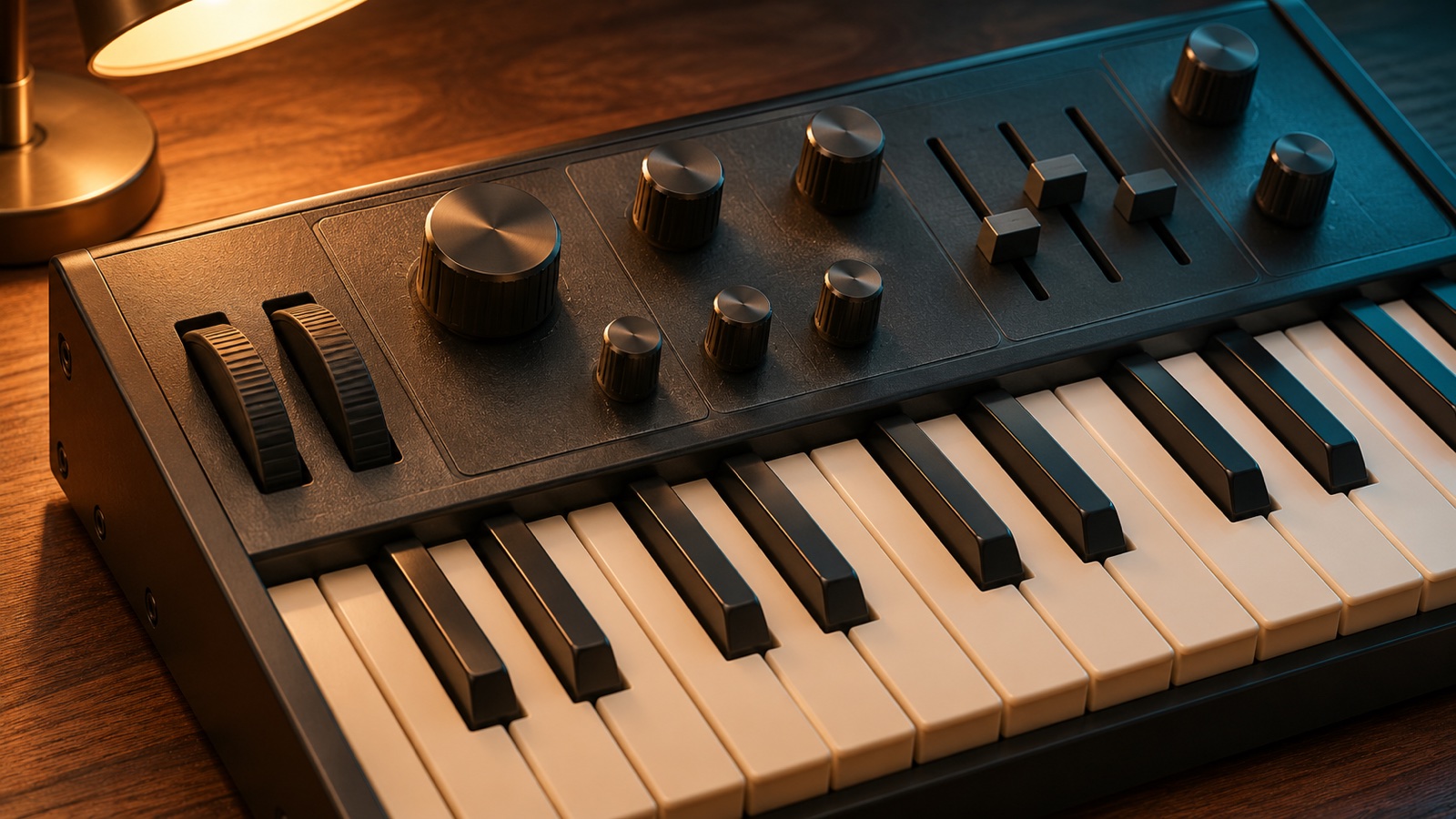
A synthesizer is an electronic instrument that creates a raw sound and combines changes in brightness and volume over time. On models with keys, the keyboard you touch and the sound engine that creates the sound are housed in the same instrument. Pressing a key sends the sound engine instructions about pitch and when the note should begin.
Imagine one note at a fixed pitch. A sound that starts immediately and fades quickly feels different from one that rises slowly and remains after you release the key. This article follows one example of subtractive synthesis in diagrams and shows where a sound's beginning, brightness, and tail are shaped.
The keyboard sends performance instructions, and the sound engine creates the sound
Pressing a key instructs the instrument which pitch to play and when to begin. On models that support it, the speed of the key press also becomes performance data. Releasing the key signals the instrument to stop the note or begin its tail. The sound engine receives these instructions and creates an electrical or digital signal. Speakers or headphones ultimately turn that signal into vibrations in the air.
The product categories called keyboards and synthesizers sometimes overlap. The word keyboard can refer to the playing surface or to a broad category of keyboard instruments. The word synthesizer highlights the ability to synthesize sound and build timbres. Modular instruments and software sound engines may have no keyboard. When comparing instruments, look at both the keyboard and how much control you have over the raw sound, filter, and volume changes.
Follow one subtractive synthesis path from the raw sound to volume
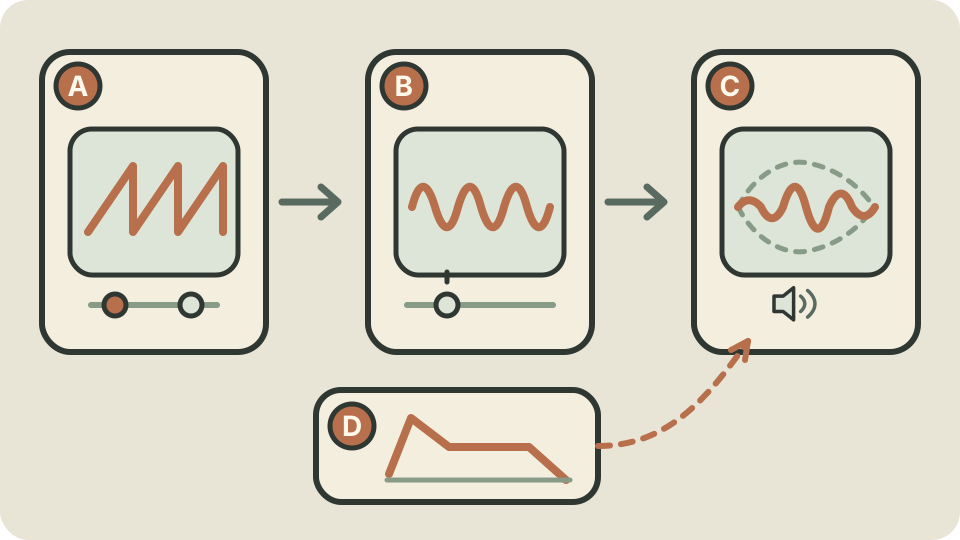
Follow the solid line in Figure 1 from left to right. Oscillator A produces a waveform that repeats at a steady rate. Low-pass filter B reduces high-frequency components. Even at the same pitch, a sound feels brighter when more high frequencies remain and rounder when they are reduced. Amplifier C adjusts the level of the sound sent to the output.
The dashed line from envelope D tells C how to change the volume over time. An envelope can also be applied to a filter so that the timbre becomes brighter or darker after a note is played. The diagram shows one example of subtractive synthesis, which forms a timbre by removing components from a waveform. FM synthesis and sampling use their own sound-making paths.
Use ADSR to hear the beginning and tail of a sound
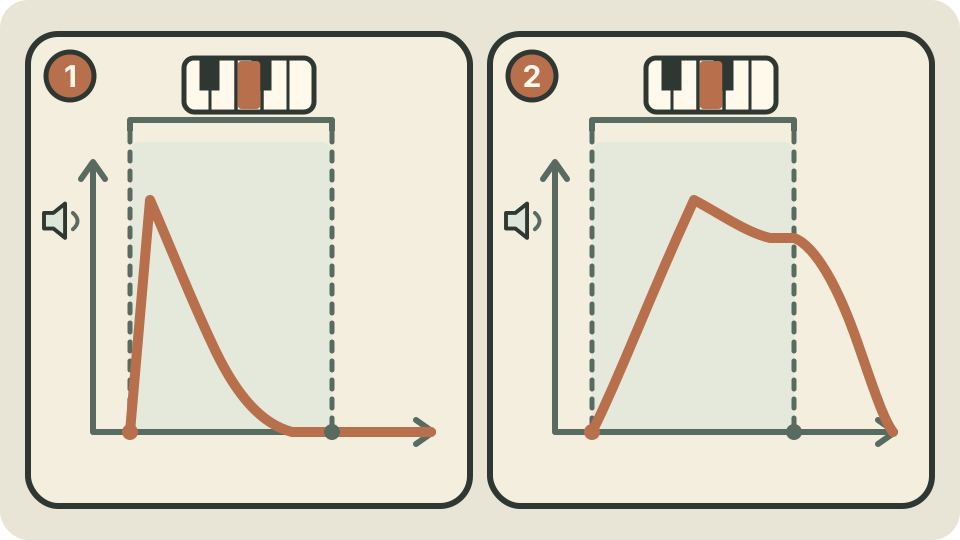
ADSR divides the change from pressing a key through the time after its release into four parts. Attack is the time from the key press until the volume reaches its peak. Decay is the time from that peak until the held level is reached. Sustain is the volume maintained while the key remains down. Release is the time from letting go of the key until the sound disappears. Sustain describes a level, while attack, decay, and release describe time.
Both sides of the diagram show the same key held for the same amount of time. The sound on the left attacks quickly, bounces briefly, and fades. The sound on the right has a longer attack, rises gradually, and leaves a tail. First listen only to the moment after the key press. Then listen to the held portion and finally to what remains after release. The vertical axis shows volume and the horizontal axis shows time. Both examples assume the same pitch.
References
A modular synthesizer lets you choose the signal and control connections
In a modular synthesizer, oscillators, level-control circuits, and other functions are separated into modules. Choosing the parts and their connections lets you create different timbres and changes over time with the same set of equipment. Records from the 1965 workshop also describe workstations with different combinations of filters, noise-generating circuits, and other modules.
In August 1965, R. A. Moog Co. held a three-week Electronic Music Workshop in Trumansburg, New York. According to the archived material, 12 people attended and studied the history of electronic music, principles of sound and electronics, audio processing, and tape techniques. Each workstation used only a small number of modules. One documented photograph shows two oscillators, two VCAs, an ADSR envelope, and two controllers consisting of a keyboard and a slide wire. This is a concrete example of modular operation being taught in 1965.
Analog circuits and digital computation create sound in different ways
An analog sound engine uses circuits to create and process signals whose voltage changes continuously. A digital sound engine represents audio signals with numbers and creates or changes them through computation. Subtractive synthesis can also be implemented digitally. The choice between circuits and computation and the method used to shape a timbre are two separate aspects of a synthesizer.
In 1983, Yamaha released the DX7 with a digital FM sound engine. The manufacturer's design record documents an LCD for displaying parameters, flat membrane switches, and controls for choosing presets and algorithms. Its flat control surface and switch-centered design expressed the operation of a digital sound engine in its appearance.
Comparing the 1965 workshop with the 1983 product record reveals two approaches to operation. One involved connecting modules, and the other involved setting values and algorithms. Today, musicians can also explore these forms of sound design on small devices and in computer software.
Listen for a melody, a pad, and short plucked sounds in three modern tracks
Now listen for one synthesizer role at a time in three modern original BGM tracks. The listening notes follow each track's published description. In “A Path of Light for the Birds” (4:45), a soft synth lead carries a long, sustained melody. Start at 17:41 on YouTube, choose one note as it begins, and follow how its length is maintained until the melody moves to the next note.
“Waiting for the Wind” (4:15) is a beatless piece with a glass-harmonica-like synth and slowly swelling pads. From 31:04, listen for the way sounds spread and overlap without abrupt breaks. Recall the right side of Figure 2 and focus on the rise and tail after the initial onset.
“Rainbow After the Rain” (4:30) uses a bouncy pluck synth and bells. From 39:40, follow the beginning and ending of each short sound. Recall the left side of Figure 2 and listen for the attack of each note in the sequence. Switching among all three tracks in short passages at a similar volume makes it easier to compare a sound that carries the melody, a sound that fills the background, and a short plucked sound.
References
Save a track you like and continue with the history of electronic music
The three tracks are royalty-free material that can be used without an additional fee within the usage terms. They are available as free downloads, commercial use is allowed, and credit is not required. Reselling or redistributing the audio by itself and using it to train AI are prohibited. Before using a track, check its page and the audio usage guide for the latest terms.
The synthesizer is one tool used in electronic music. Processed recordings, tape, and computers have also played roles in electronic music production. Continue with the existing electronic music article for a broader history and its relationship with EDM.
- 1
Compare three roles for synth sounds
Follow the melody, listen for the sustained sound behind it, then notice the gaps after the short notes.
These sounds from arcalune
The next time you hear a synthesizer, choose one note at a fixed pitch and divide it into three moments. Listen just after it begins, while it continues, and until it disappears. Thinking through the raw sound, brightness, and volume over time makes even a complex timbre easier to follow.
FAQ
- What is a synthesizer?
A synthesizer is an electronic instrument that creates raw sounds and combines filters, changes in volume over time, and other processes to build timbres. Its methods include subtractive synthesis, FM synthesis, and sampling.
- What is the difference between a synthesizer and a keyboard?
A keyboard can mean the playing surface or a broad category of keyboard instruments. A synthesizer is defined by its ability to synthesize and edit sounds. Product categories can overlap, and some synthesizers have no keyboard.
- What do the oscillator, filter, and amplifier do?
In one example of subtractive synthesis, the oscillator creates the raw sound, the filter shapes the components it contains, and the amplifier sets the output level.
- What does ADSR mean?
Attack is the time for the volume to rise, decay is the time for it to settle from the peak to the held level, sustain is the volume while the key remains down, and release is the time for the sound to fade after the key is released.
- How do analog and digital synthesizers differ?
Analog sound engines use circuits to handle continuously changing electrical signals, while digital sound engines represent audio signals with numbers. Subtractive synthesis can be implemented in either form. The DX7 released in 1983 is an example of digital FM synthesis.
- Can I use the three featured tracks in a monetized video?
The three tracks currently allow commercial use and do not require credit. Reselling or redistributing the audio by itself and using it to train AI are prohibited. Check each track page and the audio usage guide before use.