
What Is Meter in Music? How to Count and Hear 2, 3, and 4 Beats
In music with a beat, meter is the recurring way that beats are grouped. The basic groupings of two, three, and four can be counted as “1, 2 | 1, 2,” “1, 2, 3 | 1, 2, 3,” and “1, 2, 3, 4 | 1, 2, 3, 4.” Each vertical line marks the end of one group and the next “1” begins after it.
Start by clapping at even intervals while changing only the numbers you count. Then listen to a piece and use low notes or changes of harmony as clues to where the count returns to “1.” Keeping this grouping in mind also makes time signatures easier to read in a score.
Use clapping to distinguish beat, meter, tempo, and rhythm
Tap a desk with one finger at even intervals. Each tap is a beat. Meter tells you how many beats form each group. Tempo changes when you shorten or lengthen the interval between taps. If you make a short sound on one beat or hold it for two beats, the sound’s duration and starting point create a rhythm.
In music with a beat, you can keep counting internally even if the sound marking the beat stops for a moment. At first, instead of counting every note in the melody, keep a steady pulse with your foot. Then listen for whether the melody enters before a beat or partway through it. This makes the difference between beat and rhythm easier to hear.
Clap 12 times to compare groups of 2, 3, and 4 beats
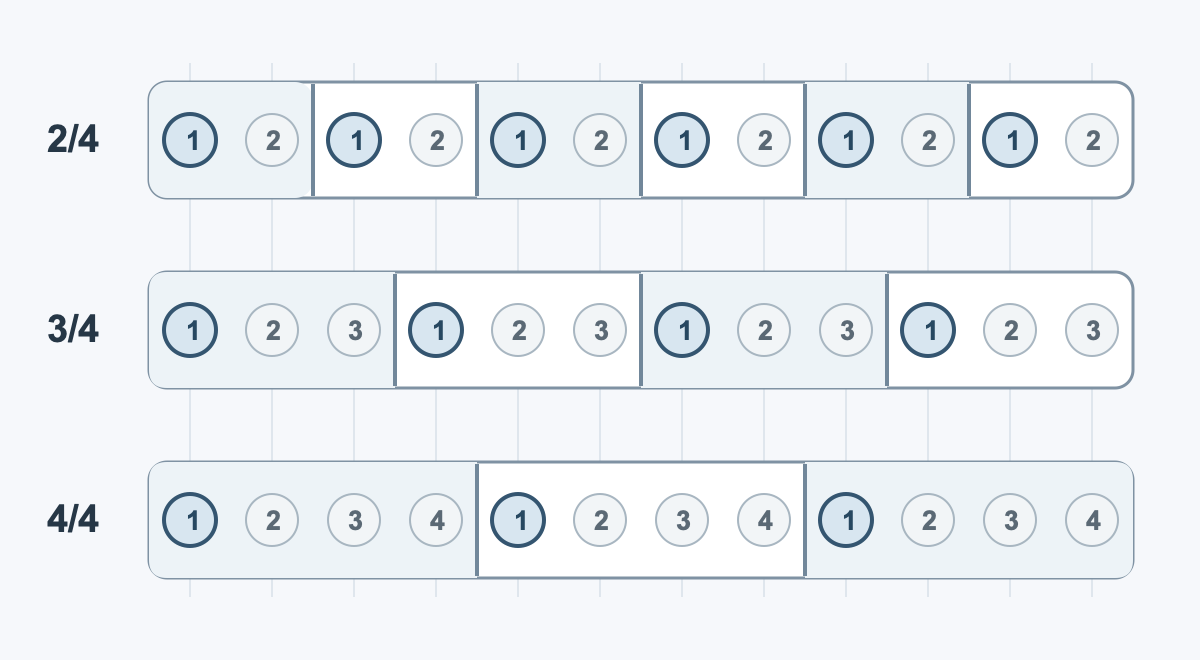
All three rows in the diagram show 12 beats at the same interval. The top row has six groups of “1, 2,” the middle row has four groups of “1, 2, 3,” and the bottom row has three groups of “1, 2, 3, 4.” In every row, one measure runs from a numbered “1” to just before the next “1.”
Keep the clapping speed steady and switch from the top row to the bottom row by changing only the numbers you say. Next, give each “1” a little more vocal emphasis. This makes the groups of two, three, and four easier to feel. In a piece, low notes, changes of harmony, or changes in an accompaniment pattern can help you locate beat one. A strong beat does not always sound louder than the beats around it in a performance.
Read the upper and lower numbers of a 3/4 time signature
Three-four meter is written as 3/4 in a score. The lower 4 represents the quarter note, and the upper 3 shows that one measure lasts for the duration of three quarter notes. The 2/4, 3/4, and 4/4 examples in the diagram are all simple meters. A quarter note is treated as one beat, while the number of beats in each measure changes.
Count the duration of the whole measure even when it contains shorter notes or rests. In 3/4, for example, a quarter note, two eighth notes, and a quarter-note rest each occupy one beat in turn. The final beat is silent.
One measure of 6/8 lasts for six eighth notes and is a compound meter usually felt as two large beats counted “1 and a, 2 and a.” A measure of 3/4 can also contain six eighth notes, but they are grouped in pairs across three beats. By placing six eighth notes in a row, you can compare where you clap the larger beats.
Choose one accompaniment part to find beat one
The first sound is not always beat one. In a piece with an upbeat, the melody enters partway through a measure and the first complete measure follows. If the opening is difficult to count, listen until an accompaniment pattern begins to repeat, then follow either the low notes or the drums.
Some pieces let you count in two or in four without losing the beat. Listen again and decide whether the low notes or harmonies make a larger division every two beats or every four beats. If a score is available, compare the grouping you hear with the bar lines.
Check meters in two, three, and four with scores and performances
For a 2/4 example, use Johann Strauss II’s Tritsch-Tratsch-Polka. In the piano score published by Haslinger, look at the opening 2/4 and the word “POLKA.” In measures where the left hand alternates between a low note and a chord, both the low note and the chord immediately after it are eighth notes. Treat those two sounds as one beat, then count “1, 2” with the accompaniment in the orchestral performance.
For a 3/4 example, use Petzold’s Minuet in G major, BWV Anh. 114. On page 44 of the music notebook, look at the low notes beneath the more active melody. In the harpsichord performance, you can repeat “1, 2, 3” using those lower notes as landmarks while the melody continues.
For a 4/4 example, use Bach’s Prelude in C major, BWV 846, from Book I of The Well-Tempered Clavier. The C-shaped sign at the start of the autograph score represents 4/4. Take the first sound as “1” and count four beats while a similar broken-chord pattern is heard twice. Return to “1” on the first sound of the next harmony, where the new measure begins.
References
Find one beat at a time in contemporary background music
Breakfast Polka, 4 minutes 14 seconds, features a woodwind trio. The piece begins at 4:17 in the official video. Move ahead by about one minute, follow the beats supported by the low notes, and count “1, 2” aloud.
Mop Waltz, 4 minutes 15 seconds, has a violin playing the melody. Move about 20 seconds beyond its 8:34 starting point and look for a place where the low note returns every three beats. Hum the melody while repeating “1, 2, 3” with your foot.
A Path of Light for the Birds, 4 minutes 45 seconds, has a synth melody supported by a four-on-the-floor kick. Move about 25 seconds beyond its 17:41 starting point and count “1, 2, 3, 4” where the kick pulses align. Use changes in the low notes or harmony as clues to “1.”
Save the three practice tracks as free MP3 files
The three tracks from this site are royalty-free materials with no additional fees based on the number of uses or plays. You can save the MP3 files for free and use them in commercial videos, streams, and games within the usage terms. Credit is optional. Redistribution of the audio by itself and use for AI training are prohibited. Check the scores and external performances with their respective publishers.
When you listen to a piece, begin by clapping at even intervals. Keep that interval steady and use changes in low notes or harmony to find “1.” You can then check the meter while continuing to follow the rhythm you hear.
FAQ
- What is meter in music?
In music with a beat, meter is the recurring way that beats are grouped. Basic duple meter counts two beats per measure, triple meter counts three, and quadruple meter counts four. The speed of the music is called tempo.
- When does the count return to 1 in 3/4?
Treat a quarter note as one beat and count 1, 2, 3. Return to 1 on the next beat. Include beats made from two shorter notes and beats that contain only a rest.
- How do 3/4 and 6/8 differ if both contain six eighth notes?
In 3/4, the eighth notes are grouped in three pairs to make three beats. In 6/8, they are generally grouped in two sets of three and counted as two large beats.
- Can I use the practice tracks commercially for free?
Breakfast Polka, Mop Waltz, and A Path of Light for the Birds from this site are royalty-free materials available as free MP3 downloads. They may be used commercially within the usage terms.