
What Is the Habanera? The Rhythm in Carmen and Its Cuban History
The habanera is a dance and song form with two beats to the bar that developed in Cuba. In “Love Is a Rebellious Bird” from Act I of Bizet’s opera Carmen, the low accompaniment repeats before the singer comes in. Start there to hear how the rhythm works.
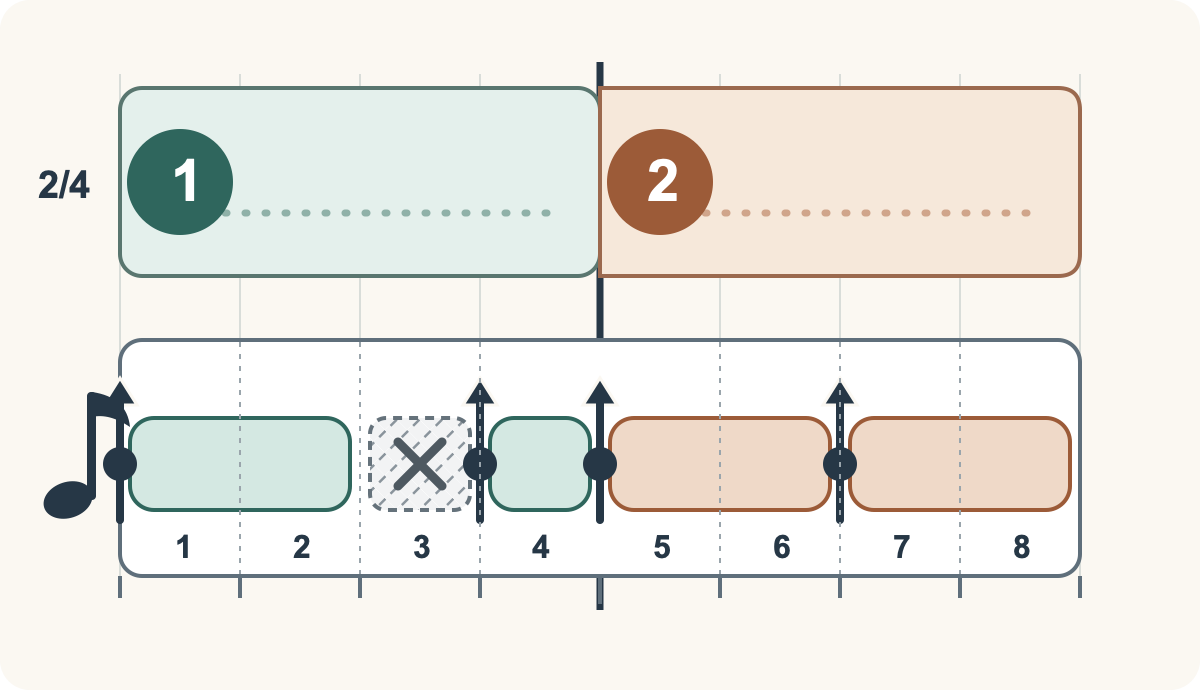
The diagram divides two beats of the score into eight equal slots. Tap the two main beats with your foot, then add the notes played by the bass with your hand. See how Iradier used those positions in his piano writing, then try following the beat in a modern Latin jazz recording.
The habanera developed in 19th-century Cuba
The European contredanse reached Cuba, where it developed into the contradanza through contact with local music and dancing. One form that grew out of it was the danza habanera. Habaneras were also published as songs with piano accompaniment and circulated beyond the dance hall.
A published score of Tú by the Cuban composer Eduardo Sánchez de Fuentes calls the piece a habanera. After the singer enters, look at the bottom piano staff for a bar made up of a dotted eighth note, a sixteenth note and two eighth notes. Compare where those notes begin with the diagram below.
Split two beats into eight and play on 1, 4, 5 and 7
The first published vocal score of Carmen gives the habanera a 2/4 time signature. Each quarter-note beat lasts as long as four sixteenth notes. Count from 1 to 8 at an even pace, reading from left to right. The two places where your foot taps are 1 and 5.
The accompaniment begins notes on 1, 4, 5 and 7. The eighth note on 1 takes up slots 1 and 2. Slot 3 is a sixteenth rest, and a new note starts on 4. The notes on 5 and 7 are eighth notes. Tap the four beginnings with your hand. The gaps from one tap to the next are 3, 1, 2 and 2 slots.
Start with just your foot on 1 and 5. When that feels steady, use both foot and hand on 1 and 5, with your hand alone on 4 and 7. Listen to how close together the notes on 4 and 5 are across the beat boundary.
In Carmen, the accompaniment begins before the voice
Bizet’s Carmen premiered in Paris in 1875. During the Act I habanera, Carmen sings about how love resists our wishes. In the vocal score, the singer rests for the first three bars and comes in partway through bar four.
In the official stage performance, listen for the low accompaniment before the voice enters. The first two attacks have some space between them, and the next attack follows quickly. Keep that grouping with your foot as the singing begins, and listen for places where the voice moves faster than the bass.
Iradier’s habanera was the basis for the song in Carmen
Bizet drew on El arreglito, a song by the Spanish composer Sebastián Iradier. The Bizet catalogue records its appearance in a collection of songs published in Paris in 1864. A footnote in Bizet’s vocal score identifies the borrowing from a Spanish song.
The score linked here is a separate edition published in Barcelona in the 19th century. Near the beginning, the lower piano staff has a two-beat pattern that starts with a dotted eighth note. Its notes start on 1, 4, 5 and 7, in the same places as in the Carmen diagram. In Iradier’s score the first note fills three slots. The Carmen score puts a rest in slot 3. The two scores show how note lengths can change while the notes still start in the same places.
Listen for the low accompaniment in Rooftop Habanera
Rooftop Habanera is a 4-minute, 15-second Latin jazz instrumental with a trumpet melody. It begins at 30:49 in the official YouTube video. Move ahead to around 33:53 and keep “1, 2” with your foot as you listen for the low notes and the short sounds between them. Use this Latin jazz recording to practice finding where foot and hand come together.
Download the habanera from this site as a free MP3
Rooftop Habanera is royalty-free, so there are no additional fees based on the number of uses. The MP3 is free to download and may be used in commercial videos, streams and games under the usage terms. Credit is optional. Standalone redistribution and use for AI training are prohibited. Check the original publishers for the terms on the external scores and performances.
Pick out one part of the low accompaniment and keep the two beats with your foot. Tap the notes that come in between and notice where foot and hand land together and where you hear just one.
FAQ
- What kind of music is the habanera?
The habanera is a dance and song form in two that developed in 19th-century Cuba. Its rhythm can be heard in songs with piano accompaniment and in Bizet’s Carmen.
- How do you count the habanera rhythm in Carmen?
Divide the two beats in a bar into eight equal slots. Tap your foot on 1 and 5 and your hand on 1, 4, 5 and 7 as the accompaniment notes begin. Slot 3 is a sixteenth rest in the first published vocal score.
- What song inspired Bizet’s habanera?
It was El arreglito by the Spanish composer Sebastián Iradier. Bizet adapted it as “Love Is a Rebellious Bird” in Act I.
- Is there free habanera music I can use commercially?
Rooftop Habanera is a royalty-free track available as a free MP3 from this site. You can use it commercially under the usage terms.