
What Is Syncopation? A Visual Guide to Counting Offbeats and Ties
Syncopation is a way of shaping rhythm by drawing attention to beats or parts of a beat that normally feel weak. For example, keep the beat with your foot by counting “1, 2, 3, 4” in 4/4, then start a note between 2 and 3 and sustain it across beat 3. The note can sound as though it has arrived ahead of the next beat.
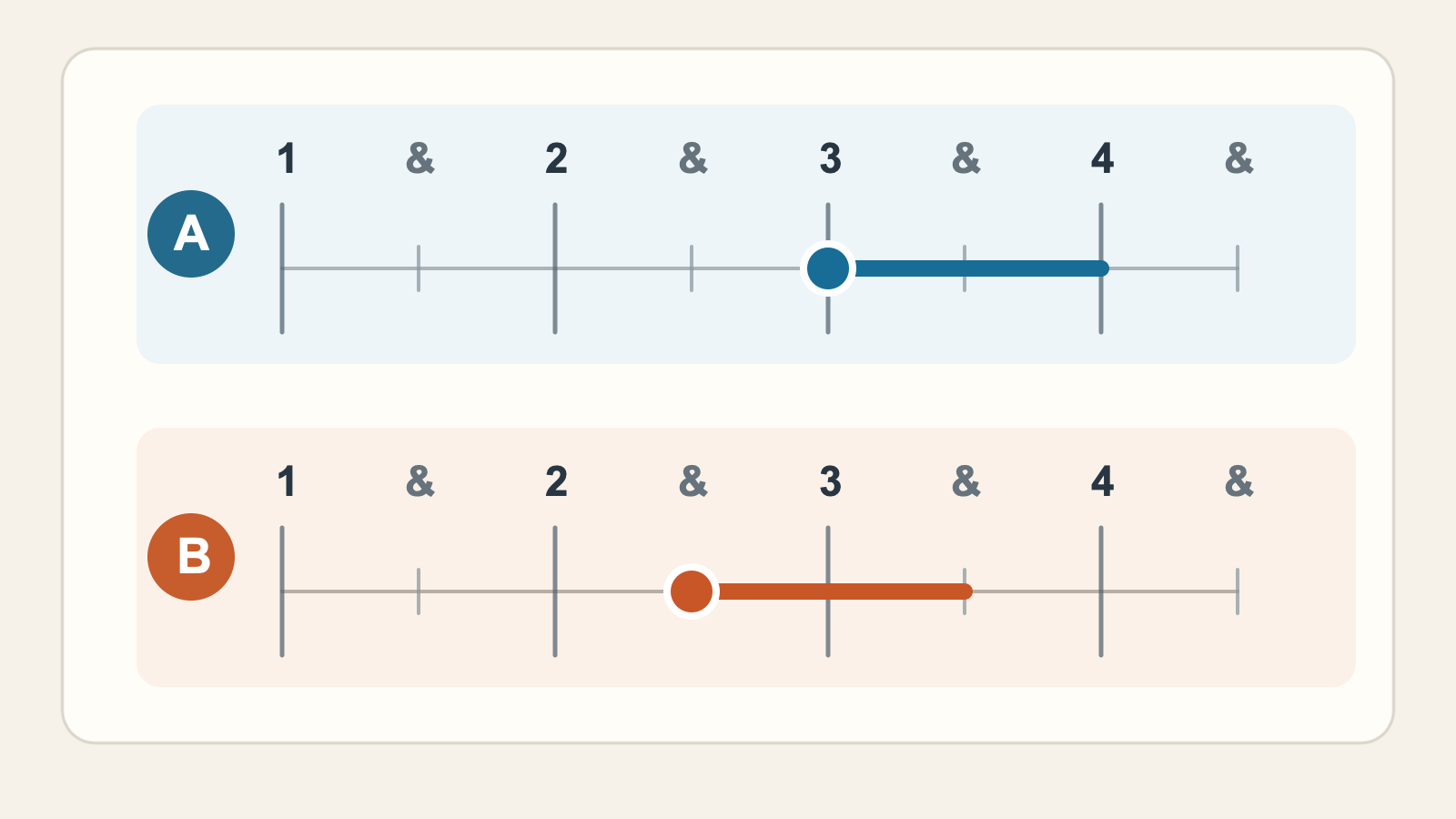
The diagram compares the same one-beat note starting on beat 3 and on the offbeat after beat 2. Keep the pulse steady with your foot and try changing where your hand or voice enters. This makes syncopation easier to find in notation and performance.
The offbeat lies between the beats you mark with your foot
Mark the quarter-note beats in 4/4 with your foot as “1, 2, 3, 4.” Dividing the space between them evenly into eighth notes gives “1 and 2 and 3 and 4 and.” The numbers mark the starts of the beats, or onbeats, while each “and” is an offbeat.
If you keep stepping on the numbers and clap only on each “and,” your foot and hand alternate. Offbeat is the name of a position. To identify syncopation, continue by checking where a sound begins and which position sounds prominent.
Compare the same one-beat note starting on beat 3 and after beat 2
In example A, the note begins at the start of beat 3 and lasts for one beat, up to the start of beat 4. In example B, it begins on the offbeat between beats 2 and 3, crosses beat 3, and lasts for the same one-beat duration until the offbeat after beat 3.
When your foot marks beat 3, the note in A begins at that point. In B, the note that began on the offbeat after beat 2 is still sounding. With the two notes set to the same duration, you can see that their starting points differ by one eighth note.
Notes joined by a tie continue across the beat
To notate example B, place an eighth note on the offbeat after beat 2 and tie it to an eighth note of the same pitch at the start of beat 3. Begin playing on the first note and sustain the sound through the value of the second note. The duration is two eighth notes, but there is only one onset.
When the start of a beat is a rest and the sound begins on the offbeat, that offbeat can stand out. Another method is to play on both the onbeat and offbeat but accent only the offbeat. After locating the sounds, check how rests, ties, and accents change which position stands out.
Keep the beat with your foot and move the clap half a beat earlier
First, step evenly on 1, 2, 3, and 4, and clap once on 3. In the next measure, clap on the “and” after 2. After the clap, keep stepping on 3 as usual.
To practice the duration as well, use your voice instead of a clap. In example A, sustain “taa” from 3 to 4. In example B, sustain it from the offbeat after 2 to the offbeat after 3. At beat 3 in example B, step with your foot only and keep your voice continuous without starting the sound again.
If your foot speeds up with your hand, repeat only the four beats with your foot. Then add the offbeat positions with your voice. Finally, switch between the two examples while keeping the same steady pulse with your foot.
Listen for note spacing in swing and for emphasis placement in syncopation
In syncopation, listen for whether a normally weak position within the beat becomes prominent. With swung eighth notes, listen for how the two notes within one beat follow each other with a longer and a shorter spacing.
Example B shows that syncopation can be created by sustaining a note from an offbeat even when each beat is divided evenly into an onbeat and an offbeat. In performance, the long-short spacing of swing and the shifted emphasis of syncopation can occur at the same time.
In video editing, mark the beats and try placing cuts on offbeats
First, place markers on the beats you can follow with your foot. Then add markers between them wherever a prominent sound begins. With the same footage, you can compare a scene change aligned with the start of a beat against an action or text appearance aligned with that sound.
At a steady tempo, the time between beat starts is 60 ÷ BPM seconds. Divide each beat in half to mark an approximate offbeat, then use the waveform and playback to confirm where the audible sound actually begins.
Follow the note onsets in two tracks led by trombone and guitar
The published descriptions of the following two tracks mention syncopation. Their track pages let you preview and download each track separately, while the YouTube links start at the beginning of each track within its video.
“Under the Grey Spires” (2:36) is game-style background music led by trombone. First keep the beat with your foot, then listen for whether prominent notes in the melody begin at the start of a beat or between beats.
“They Are Not Waiting For Orders” (3:29) is game-style background music led by guitar. Keep the pulse with your foot and follow where the guitar begins in relation to the next beat.
The two featured tracks are royalty-free and available for commercial use
Both tracks are free to download and may be used in monetized videos, live streams, and games within the terms of the media usage guide. There is no per-use royalty, and credit is optional. Reselling or redistributing the audio as a standalone file and using it for AI training are prohibited. Check the media usage guide for the latest terms before use.
References
- 1
Two tracks to hear syncopation
Tap the beat and listen for where the trombone and guitar notes begin.
Use it forTrombone, Guitar
These sounds from arcalune
Begin by keeping a steady pulse with your foot, then follow where each sound starts. After practicing a sustained voice from an offbeat, listen to the two tracks and compare where your foot marks the beat with where the prominent sounds occur.
FAQ
- What is syncopation?
Syncopation is a way of shaping rhythm by drawing attention to beats or parts of a beat that normally feel weak. It can involve sustaining a note from an offbeat or changing which position sounds prominent through rests or accents.
- What is the difference between an offbeat and syncopation?
An offbeat is a position between beats. Syncopation is a rhythmic effect that brings attention to a normally weak position, such as an offbeat.
- How do you play two notes joined by a tie?
When notes of the same pitch are joined by a tie, begin the sound only on the first note and sustain it through the duration of the second note.
- How can I practice syncopation?
Keep 1, 2, 3, and 4 with your foot. Clap first on 3, then clap between 2 and 3. To practice duration, replace the clap with your voice and sustain it from the offbeat after 2 to the offbeat after 3.
- What is the difference between swing and syncopation?
With swung eighth notes, the two notes within a beat begin with a longer and a shorter spacing. Syncopation makes a normally weak position sound prominent. Both can occur in the same performance.