
What Is 6/8 Time? A Visual Guide to Counting It and Comparing It with 3/4
In 6/8 time, each measure holds the equivalent of six eighth notes. When three eighth notes make one main beat, you can count the measure as two groups: “1-2-3 | 4-5-6.”
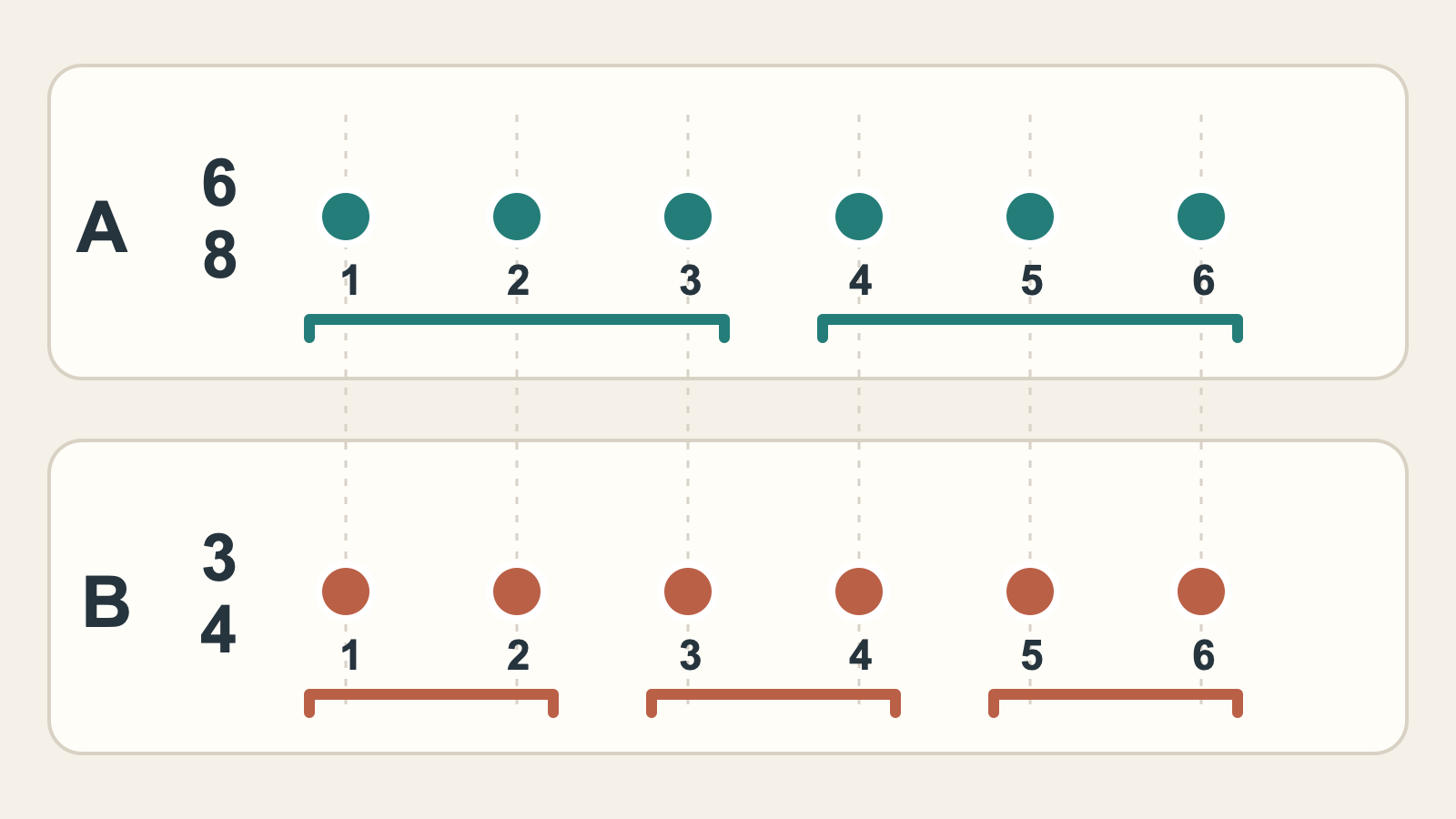
A measure of 3/4 also holds the equivalent of six eighth notes, but they form three beats of two. The diagram shows how the positions where you tap your foot change across the same six subdivisions.
Count in threes in 6/8 and in twos in 3/4
In Figure A, the six eighth-note positions in 6/8 are grouped as 3+3 because three eighth notes make one main beat. If you tap the main beats with your foot, tap on positions 1 and 4. Three eighth notes have the same duration as one dotted quarter note.
In Figure B, the six positions in 3/4 are grouped as 2+2+2 because two eighth notes make one beat. Tap your foot on positions 1, 3 and 5. Two eighth notes have the same duration as one quarter note.
The upper 6 is the number of divisions, and the lower 8 denotes eighth notes
The lower 8 in the time signature denotes eighth notes, while the upper 6 means that one measure holds the equivalent of six of them. In 3/4, the lower 4 denotes quarter notes, and the upper 3 means that one measure holds three of them. Even when quarter notes, eighth notes and rests are mixed in a 6/8 measure, their total duration is still equivalent to six eighth notes.
For example, if a measure contains two dotted quarter notes, a sound begins only twice in that measure. You can still tap six quiet subdivisions with your hand while your foot marks two main beats. Separating the number of written notes from the number of beats you tap makes the notation easier to read.
Tap the main beats with your foot and count the inner divisions with your hand
Begin by tapping six slow, evenly spaced positions with your hand. To practise 6/8, tap your foot on positions 1 and 4 while your hand continues “ta-ta-ta | ta-ta-ta.” When you use only your foot, two main beats remain, each three subdivisions apart.
Next, keep your hand at the same speed and tap your foot on positions 1, 3 and 5. Dividing the taps as “ta-ta | ta-ta | ta-ta” gives you the 3/4 pattern. Your hand taps six times in both cases, while your foot changes from two taps to three.
In a slow 6/8 track, first count all six eighth-note positions to establish the smaller subdivisions. Then look for the larger groups that begin on positions 1 and 4. When listening, use the accompaniment or bass as a clue and check where the beat tapped by your foot returns.
Read the beat unit along with the BPM
When the main beat in 6/8 is used as the tempo unit, one dotted quarter note equals one beat. In 3/4, one quarter note equals one beat, so the same tempo number does not produce the same spacing between eighth notes.
In the example shown in the diagram, the eighth notes are evenly spaced at 0.25-second intervals. The main beat in 6/8 lasts 0.75 seconds, which is 80 BPM, while a beat in 3/4 lasts 0.5 seconds, which is 120 BPM. In both cases, a measure lasts 1.5 seconds because it contains the equivalent of six eighth notes.
Find groups of three in a jig score
One version of “The Irish washerwoman” published by the Irish Traditional Music Archive is classified as a jig and marked with a 6/8 time signature. When looking at the score, find the bar lines, then follow the first and fourth eighth-note positions within each measure.
Compare the beats in a jig, an electronica track and game-style BGM
You can preview and save each track on its track page. The YouTube links open at the point where each track begins in its video. Find the groups of three in the first two tracks, then count three main beats in the third.
“Sheets in the Wind” (4:14) is a jig in 6/8 with a flute melody. As you listen to the melody, try counting the smaller notes in groups of three.
“Tea on the Rope Walk” (4:15) is electronica in 6/8 featuring a metallophone. Even at its relaxed pace, look for the point where three smaller intervals form one main beat.
“Ledger of the Company” (3:00) is game-style BGM in triple meter with a vibraphone carrying the main melody. Following the track description, count “1-2-3” and listen for the interval at which the three beats form one group.
The three featured tracks are royalty-free and available for commercial use
All three tracks are free to download and may be used in monetised videos, livestreams and games within the scope of the media usage guide. There is no per-use royalty, and credit is optional. Reselling or redistributing the audio on its own and using it for AI training are prohibited. Check the media usage guide for the latest terms before use.
References
- 1
Compare 6/8 and triple meter in three tracks
Listen for the beat groupings in a flute jig, electronica with metal bars, and game-style music led by vibraphone.
Use it forJig, Electronica, Game-style music
These sounds from arcalune
If you are unsure, tap six evenly spaced positions with your hand and compare placing your foot on positions 1 and 4 with placing it on positions 1, 3 and 5. This helps you follow the smaller inner divisions and the larger beat groupings separately in a score or a track.
FAQ
- How many beats are there in 6/8 time?
Each measure holds the equivalent of six eighth notes. When they are grouped in threes, the measure has two main beats, each equal to one dotted quarter note.
- What is the difference between 6/8 and 3/4 time?
Both measures hold the equivalent of six eighth notes. In 6/8 they are grouped as two beats of 3+3, while in 3/4 they are grouped as three beats of 2+2+2.
- How do you count 6/8 time?
Begin by counting “1-2-3 | 4-5-6” at even intervals and tap your foot on positions 1 and 4. In a slow track, count all six smaller positions first, then find the two main beats.
- Which note value gets one beat in 6/8 time?
When counting two main beats, each beat is a dotted quarter note, equal to three eighth notes. Read the number in a tempo marking together with the note value shown beside it.
- Must a sound occur six times in every measure of 6/8?
The 6 represents a duration equivalent to six eighth notes. If a measure contains two dotted quarter notes, a sound begins only twice. Rests also count towards the measure's total duration.