What Is a March in Music? Two Beats, Ceremonies, and Dance
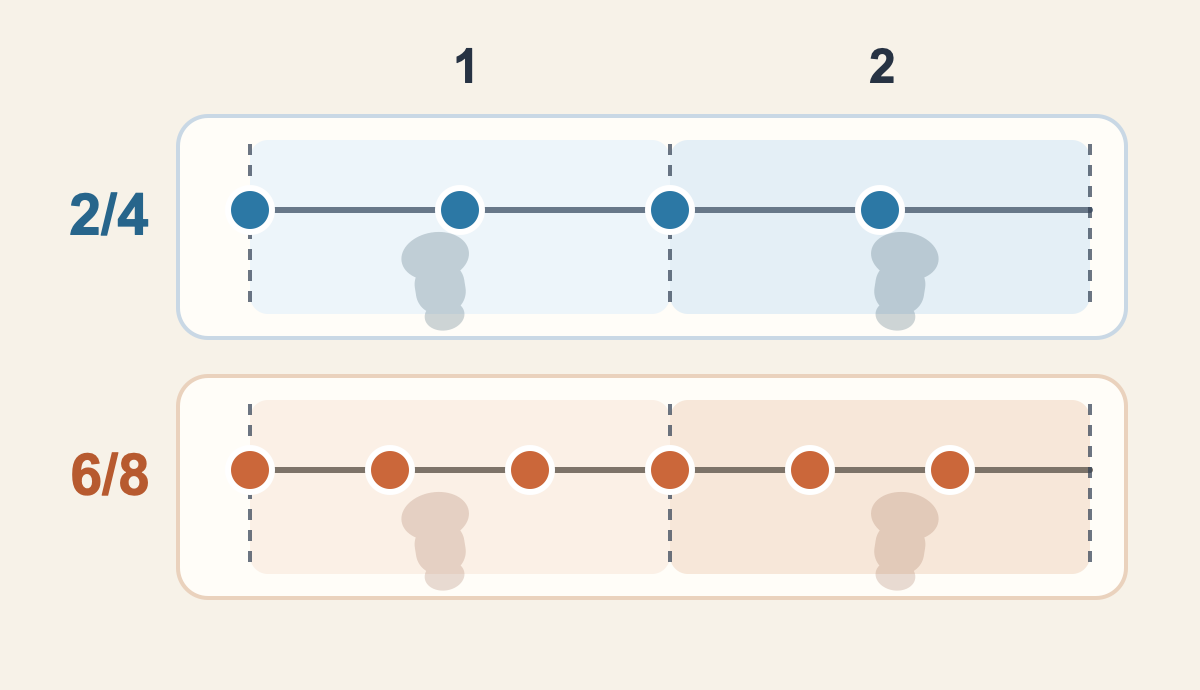
A march has a beat that is easy to match to walking or moving forward. Start by counting the large beats “1, 2.” In 2/4, divide each beat into two equal positions; in 6/8, divide each beat into three.
We will see how beats are used in “The Washington Post,” written for a ceremony and later used for dancing, and in a 2019 All Japan Band Competition test piece. Two royalty-free tracks let you compare how mandolins and trumpet support movement.
Both 2/4 and 6/8 can be counted in two large beats
A measure of 2/4 contains the duration of two quarter notes. Step twice, left and right, and clap twice at equal intervals within each step. This places four eighth-note positions in one measure.
A measure of 6/8 contains the duration of six eighth notes and can be counted as two large beats of three eighth notes each. Keeping your foot at the same speed for this comparison, clap three times at equal intervals within each step. Your feet still take two steps, while your hands change from four claps to six.
The circles in the diagram are positions for counting the smaller subdivisions of the beat. A real piece does not have to sound a note at every position. When listening, first find the large beat that you can follow with your foot, then listen for how the smaller notes fit between those beats.
A march written for an 1889 ceremony was also used for dancing
John Philip Sousa’s “The Washington Post” was written for the award ceremony of a newspaper essay contest for schoolchildren. The U.S. Marine Band premiered it at the ceremony on June 15, 1889. The piece later became associated with the two-step, a dance of the time, and spread more widely.
The score published by the band begins in 6/8. With the band’s performance released in 2016, first count the large beats “1, 2,” then listen to the notes between them. This is one example of a piece written for an award ceremony that was later used for a dance beat.
Concert band music also offers choices within two large beats
Kota Okada’s March “Beyond the Sign” was Test Piece IV for the 2019 All Japan Band Competition. In the association bulletin, the composer explains that he wanted a duple-meter march to be selected as a test piece, so he chose 6/8 and included melodies that performers would find approachable.
To distinguish the motion within a march, find the beat in the low instruments or percussion, then shift your attention to the finer motion of the melody and the accompaniment between beats. Even in music written for the concert stage, following the large beat physically can reveal how the melody and accompaniment overlap.
Hear marches led by mandolins and trumpet
“Tram Line No. 3” is a light two-beat march played by a mandolin ensemble. It runs 4:16 and begins at 4:18 in the official video. For a walking scene, first mark the large beat with your foot, then listen to how the strings’ repeated strokes line up with the steps.
“We Set Out Today” is game BGM that uses a march rhythm, with trumpet carrying the main melody. Its displayed length is 2:38, and it begins at 14:12 in the official video. For a scene of leaving town, compare whether the moment reads more clearly when the melody enters before or after the first step.
Choose a track for walking or setting out
If you want to keep footsteps or the sound of wheels in the video, place each track under the same few seconds and check whether the sound you want remains clear. To announce a departure, move the music and compare whether the scene reads more clearly when the melody enters as a door opens or on the first step.
The two tracks featured here are royalty-free assets from this site. They can be saved for free and used in commercial videos, streams, and games within the terms of use. Credit is optional. Redistributing the audio files on their own and using them for AI training are not permitted.
Even with the same two large beats, the notes within them and the instruments supporting the beat can change the feel of each step. Count only the large beats first, then listen again for the smaller notes and the melody.
FAQ
- What makes a piece of music a march?
A march has a pulse you can often follow in steps. Marches are used in ceremonies, dances, concert band performances, and scenes where a character sets out.
- What time signature does a march use?
Marches can be written in 2/4 or 6/8, among other meters. A 2/4 measure contains the duration of two quarter notes. In 6/8, grouping the six eighth notes into two sets of three creates two large beats. Check the meter of each piece.
- Why is 6/8 counted in two large beats?
Because the six eighth-note positions can be divided into the first three and the next three. Marking the start of each group with your foot gives two large beats per measure.
- Can I use the featured free BGM in commercial videos?
Yes. “Tram Line No. 3” and “We Set Out Today” are royalty-free assets that may be used in commercial videos within the terms of use. “Tram Line No. 3” is available as a free MP3, and “We Set Out Today” as a free WAV.