
What Types of Brass Instruments Are There? Five Main Types and How They Produce Sound
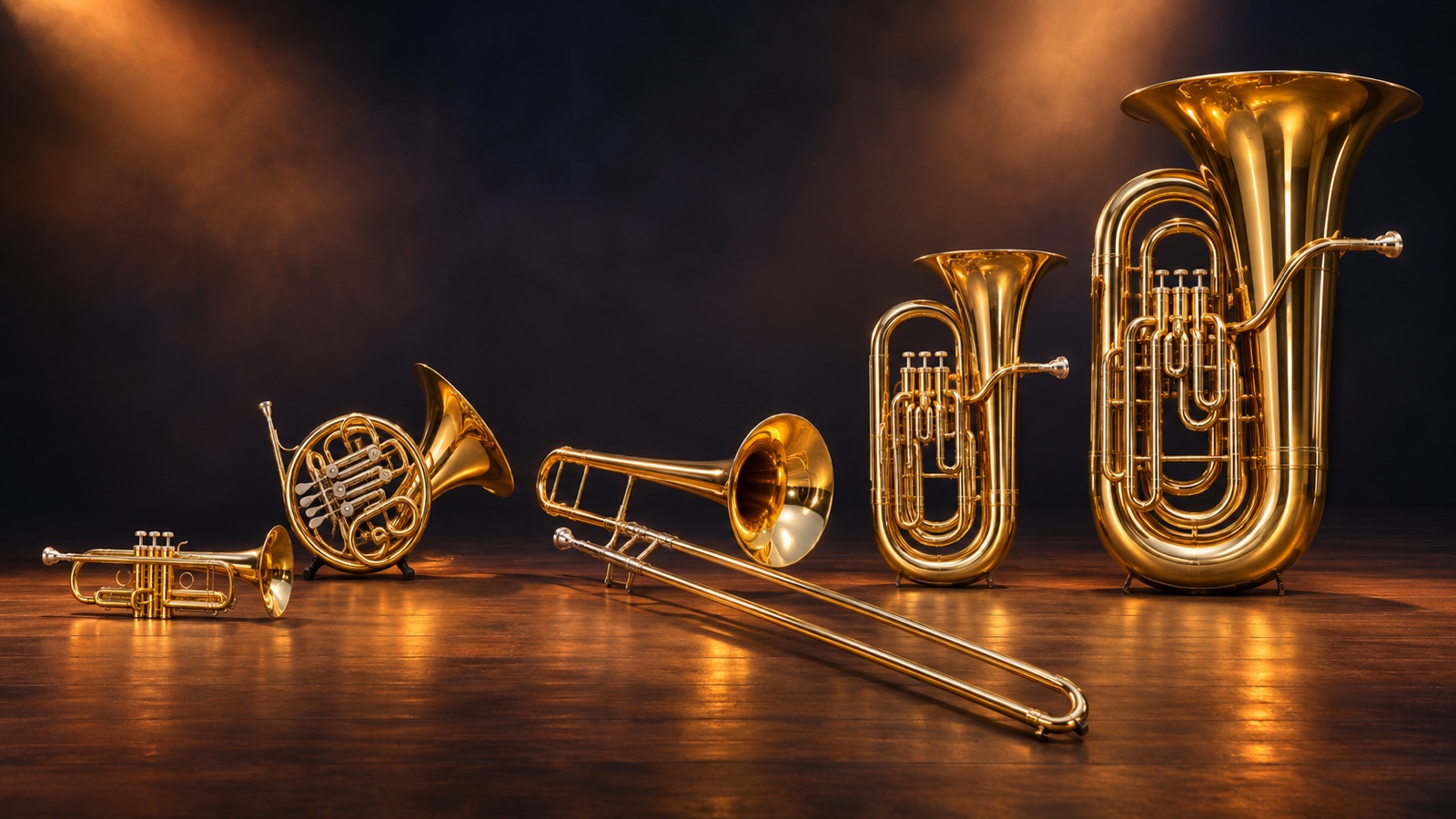
Five representative brass instruments are the trumpet, horn, trombone, euphonium, and tuba. Their shapes and ranges vary, but they all rely on the player vibrating their lips against a mouthpiece and using that motion to set the air inside the tube in motion.
To tell the instruments apart, look at the mouthpiece, the shape of the tubing, and the parts used to change pitch. We will compare valves and slides in a diagram, examine a surviving instrument from 1790, and then listen for each instrument's phrases in five tracks.
Tell brass and woodwind instruments apart by how sound begins
On a brass instrument, the player blows while vibrating their lips inside the mouthpiece. Those vibrations make the air in the tube resonate, and the sound travels out through the flared bell.
Woodwind instruments use either an air stream directed at an edge, as on a flute, or a thin vibrating strip called a reed. A saxophone is a woodwind even though it is made of metal because it uses a single reed. The cor anglais is also a double-reed member of the oboe family. Its sound-producing method differs from that of the brass horn with its coiled tube.
Choose different notes from the harmonic series at one tube length
Even without pressing a valve, a trumpet can produce notes of different pitches when the player changes lip tension and airflow. The sequence of pitches at which a tube of that length readily resonates is called the harmonic series. The higher the harmonics, the narrower the intervals between neighboring notes become.
A trombone can also produce several notes from the same slide position. The player selects a harmonic with the lips and breath, then lengthens or shortens the tube to change the available series of notes itself.
Valves redirect the air path, while a slide lengthens the tube
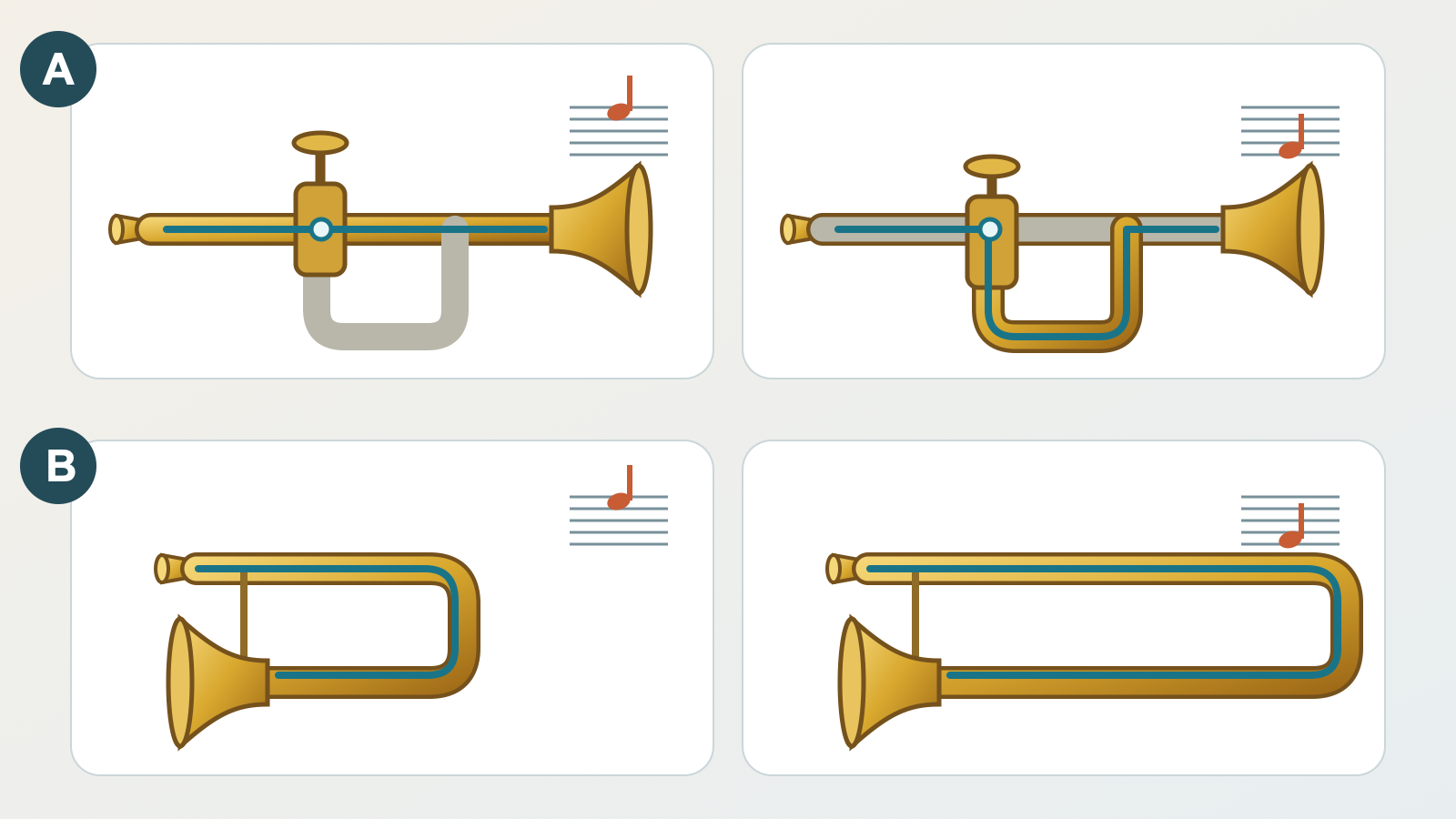
Diagram A is a simplified view of the valves used on a trumpet and similar instruments. On the left, no valve is pressed, so the air follows a short path from the mouthpiece to the bell. On the right, a valve is pressed, sending the air through extra tubing and making the path longer.
Diagram B shows a trombone. On the right, the slide is extended, lengthening both sides of the folded path. Because the slide moves continuously, it can also be used to change pitch smoothly while keeping the same harmonic.
When the same harmonic is compared, a longer tube produces a lower pitch in both systems. Some instruments, including tenor-bass trombones, also have an F attachment that a lever engages to extend the lower range in addition to the slide.
Recognize five main types by their tubing and bell shapes
The trumpet is relatively small, is held horizontally, and has a forward-facing bell. The usual form has three valves. Closely related instruments include the cornet and flugelhorn.
The horn has a long tube wound into a circle and is held with the right hand inside the bell. Double horns that switch between F and B-flat tubing are widely used, and the right hand also helps adjust tone and intonation.
The trombone is easy to recognize by its U-shaped slide extending forward. At each of the seven basic positions, the player uses the lips and breath to produce several different pitches.
The euphonium is a brass instrument in the middle and lower register. Many models have compact coiled tubing and an upward-facing bell, and the instrument may also play melodies in concert bands and brass bands.
The tuba is large, with a broad bell, and often supports the low register of an ensemble. Tubas are made in F, E-flat, C, and B-flat, among other keys, and they can also carry a melody.
Compare a B-flat euphonium with a B-flat tuba
In examples of instruments in the same key of B-flat, the tubing used when no valve is pressed is about 2.7 meters long on a euphonium and about 5.4 meters long on a low B-flat tuba. Both use B-flat as a reference, but the tuba's tubing is about twice as long and its reference pitch is one octave lower.
Tubas are also made in other keys, and their practical range varies by model and player. When two instruments look similar, compare both the size of the bell and the register each one covers within the ensemble.
From a natural trumpet made in 1790 to valves
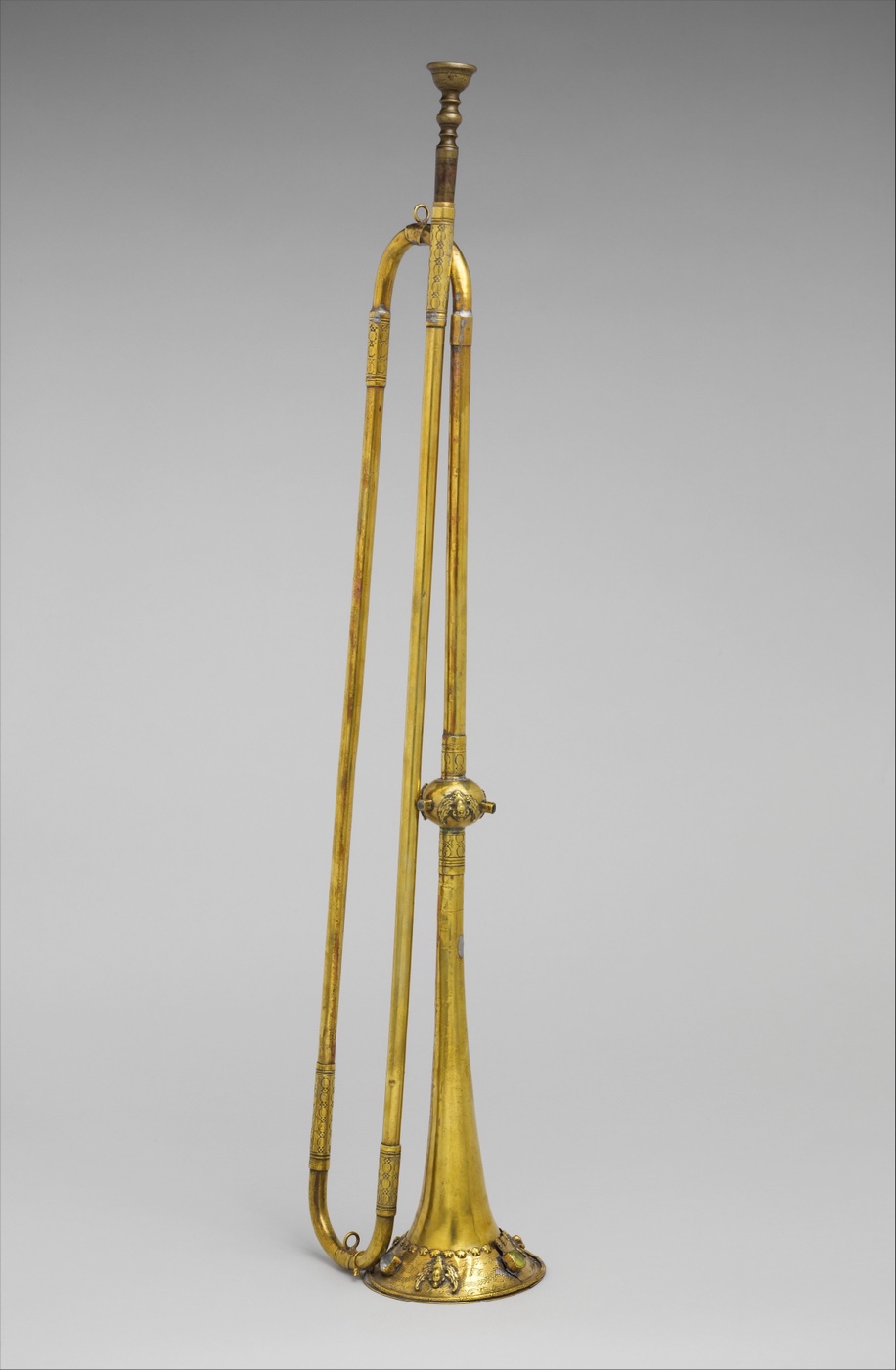
The photograph shows a natural trumpet made by Andreas Naeplaesnigg in 1790. Its long, folded tube leads to the bell, and it has no finger-operated valves. According to the museum record, it was made in C and was shortened in the nineteenth century to raise its pitch.
Valves were devised in the early nineteenth century. Before then, players selected harmonics from a tube of fixed length and connected melodies in the high register, where the intervals between harmonics are narrower. Valves made it possible to change tube length while playing and to fill the spaces between harmonics more readily in semitone steps.
Follow brass phrases in five tracks
The time shown beside each title is the duration of the track itself. The instrument and its role in the piece are based on each track's public description. Each YouTube link points to the position where the track begins within a longer video. The accompaniment differs from one track to another, so listen for the pulse and the way the instrument overlaps with other sounds.
The trumpet example is “A Shadow at the Door” (4:14). Follow the muted-trumpet phrase that colors the opening of a detective story.
In “Across the Green Sea” (3:58), listen for the horn's main melody riding over a march rhythm.
“Under the Grey Spires” (2:36) imagines a castle town. Listen to the trombone's main melody and the displaced accents in the pulse.
In “Struck While Hot” (2:50), set in a blacksmith's workshop, the euphonium carries the main melody over a steady pulse.
In “Something Enormous Sleeps” (3:08), the tuba carries the main melody. Set in a dragon's lair, the piece is an example of a low-register instrument carrying the tune.
References
Use the five tracks as royalty-free music
All five tracks can be downloaded for free and used as material in monetized videos, streams, games, and other projects within the scope of the usage guide. There is no additional fee each time they are used, and credit is optional. Reselling or redistributing the audio itself and using it for AI training are prohibited.
References
- 1
Five tracks featuring brass instruments
Follow the brass melody in each track and listen to how it fits with the accompaniment.
Use it forTrumpet, French horn, Trombone, Euphonium, Tuba
These sounds from arcalune
First identify brass and woodwind instruments by how sound begins, then compare the coiling of the tubing, the direction of the bell, and the valves or slide. In an ensemble, listen once to follow the melody and again to find the brass within the accompaniment. You will notice that the same instrument can take on different roles.
FAQ
- What types of brass instruments are there?
Representative examples include the trumpet, horn, trombone, euphonium, and tuba. The cornet and flugelhorn are also brass instruments.
- What is the difference between brass and woodwind instruments?
Brass players vibrate their lips. Woodwind players either direct air at an edge, as on a flute, or vibrate a reed, as on a saxophone or oboe. The material of the instrument alone does not determine its family.
- Why does moving a valve or slide change the pitch?
A valve adds extra tubing to the path taken by the air, while a slide lengthens or shortens the tube. When the same harmonic is compared, a longer tube produces a lower pitch in both cases.
- What is the difference between a euphonium and a tuba?
For typical instruments in B-flat, the euphonium has about 2.7 meters of tubing and the B-flat tuba about 5.4 meters. These lengths are compared with no valve pressed, and the tuba's reference pitch is one octave lower.
- Can I use the five featured tracks in monetized videos?
Yes. All five can be used within the scope of the usage guide, are available as free downloads, and do not require credit. Reselling or redistributing the audio itself and using it for AI training are prohibited.