
What Is an Orchestra? Instruments, History, and the Difference from a Wind Band
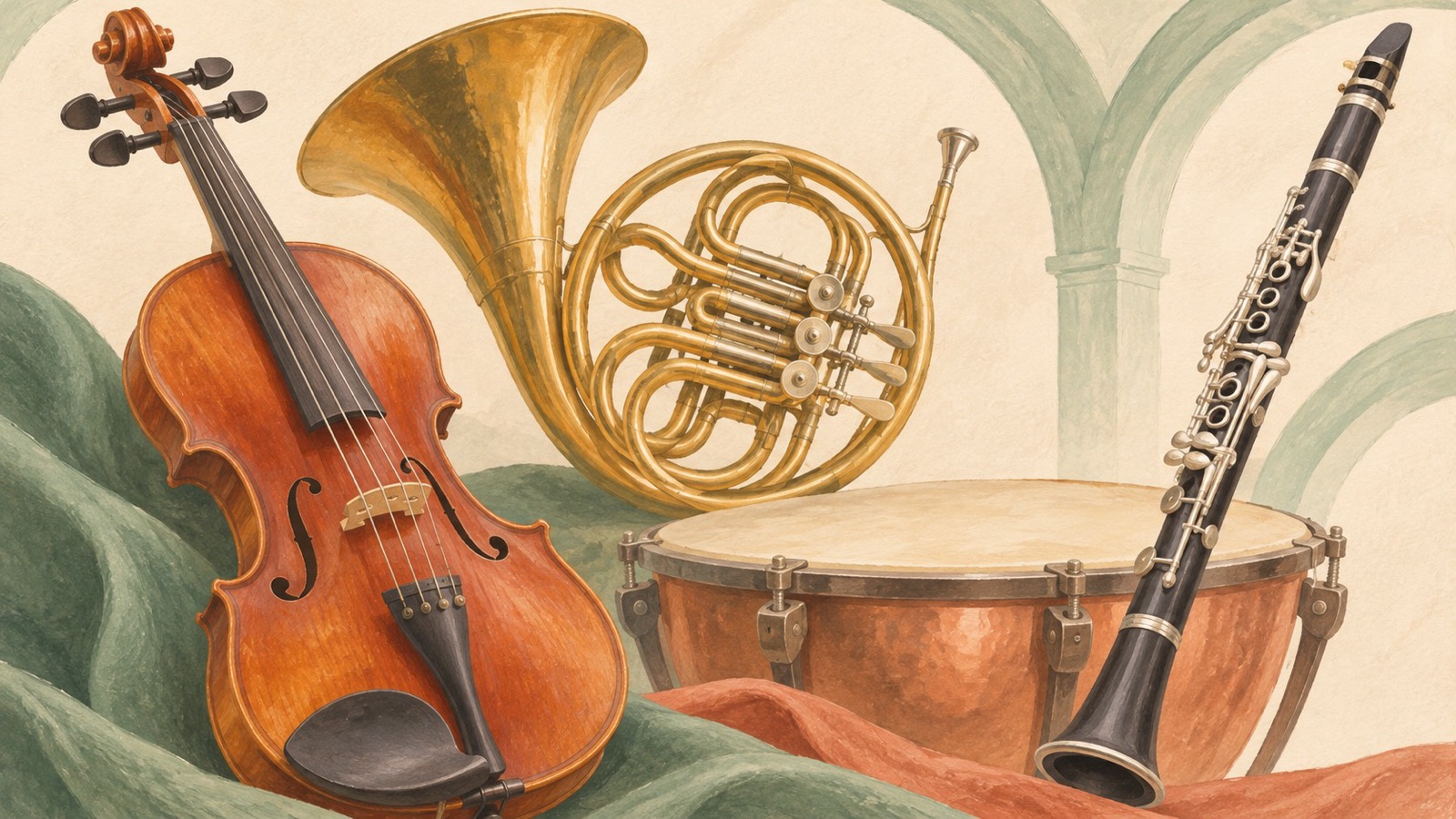
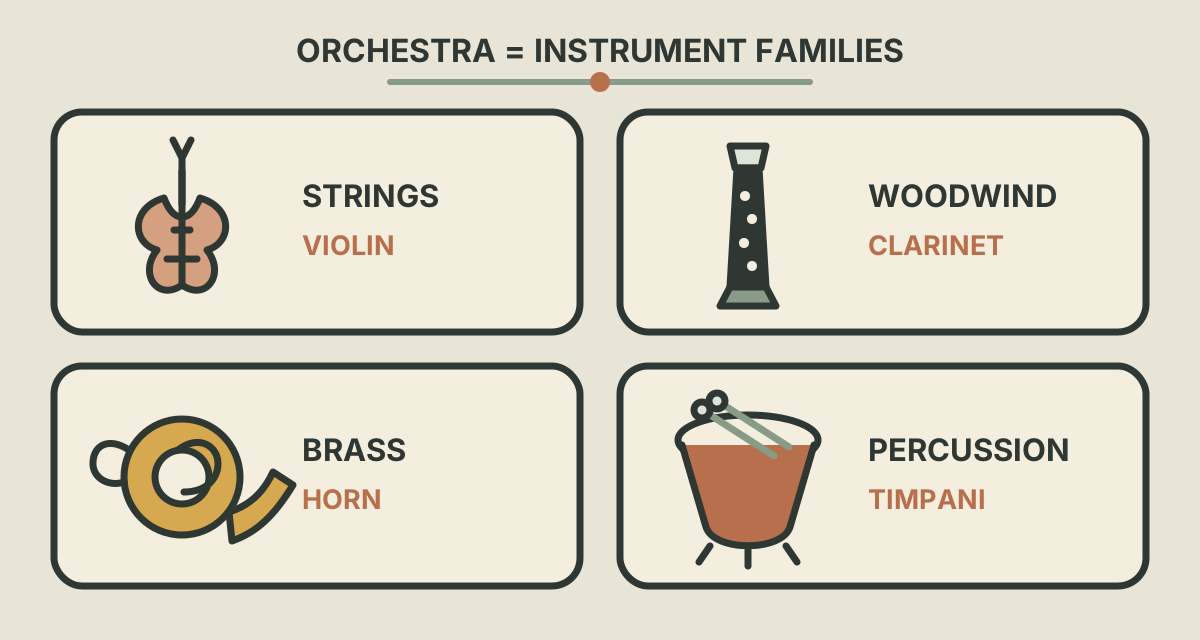
An orchestra is an ensemble that combines instrument families with different roles, including strings, woodwinds, brass, and percussion. A violin, clarinet, horn, and timpani provide a concrete starting point for recognizing the four families.
We begin with those families, then follow examples of an expanding opera orchestra in the eighteenth and nineteenth centuries and compare an orchestra with a wind band. Finally, three modern original tracks can be compared by musical structure, lead instrument, intended scene, and length at their exact positions on YouTube.
How this list was chosen
- Use the violin, clarinet, horn, and timpani to distinguish strings, woodwinds, brass, and percussion.
- Follow two eighteenth- and nineteenth-century examples and compare what stands at the center of an orchestra and a wind band.
- Choose among three modern originals by musical part, lead instrument, scene, and length, then open the exact YouTube start point.
The orchestra’s four main instrument families
The main orchestral instrument families are strings, woodwinds, brass, and percussion. Look at what vibrates to tell them apart. Many modern flutes are metal-bodied woodwinds that sound when air crosses the edge of the embouchure hole. Some works also call for a harp or keyboard. The instruments and number of players vary by work.
When listening, first find the instrument carrying the melody, then follow the point where another instrument takes it over. When several instruments overlap, compare what you hear with the instrument names in a performance video or score. This makes it easier to check which playing technique is producing the sound.
| Family | Representative instruments | How they produce sound |
|---|---|---|
| Strings | Violin, viola, cello, double bass | Set the strings vibrating with a bow or the fingers |
| Woodwinds | Flute, oboe, clarinet, bassoon | Direct air at an edge or into a reed |
| Brass | Horn, trumpet, trombone, tuba | Set the lips vibrating against a mouthpiece |
| Percussion | Timpani, snare drum, cymbals, xylophone | Set a membrane, bars, or other parts vibrating. Some are shaken or scraped |
References
Orchestra describes an ensemble; Baroque describes a period and styles
The word orchestra helps describe the group of instrument families used for performance. Baroque music, by contrast, names a period and a range of styles in Western art music, mainly from about 1600 to 1750. They are not the same kind of classification.
A work can therefore be described both as a Baroque work and as music performed by an orchestra. Separating when and in what style it was written from which instrument families perform it keeps period and ensemble from being confused.
References
How opera orchestras expanded in the eighteenth and nineteenth centuries
Opera history provides concrete examples of instrument combinations changing with the work. The Metropolitan Museum of Art explains that under Rameau and Handel in the eighteenth century, woodwinds, horns, and drums were added to the original strings, expanding the orchestra. It is an example of stage-music ensembles broadening as other families joined the strings.
The same essay notes that Wagner wrote for a large orchestra in the nineteenth century. His conception joined drama, staging, and music, and his works called for a large ensemble and voices able to match it. Placing the eighteenth-century additions beside Wagner's larger forces shows combinations and scale changing with the conception of the work.
These are two cases from eighteenth- and nineteenth-century opera. They do not establish the orchestra's only origin or the full history of every region, but they help us view instrumentation in relation to the music being performed rather than as a finished, fixed list.
Orchestras and wind bands center different instrument families
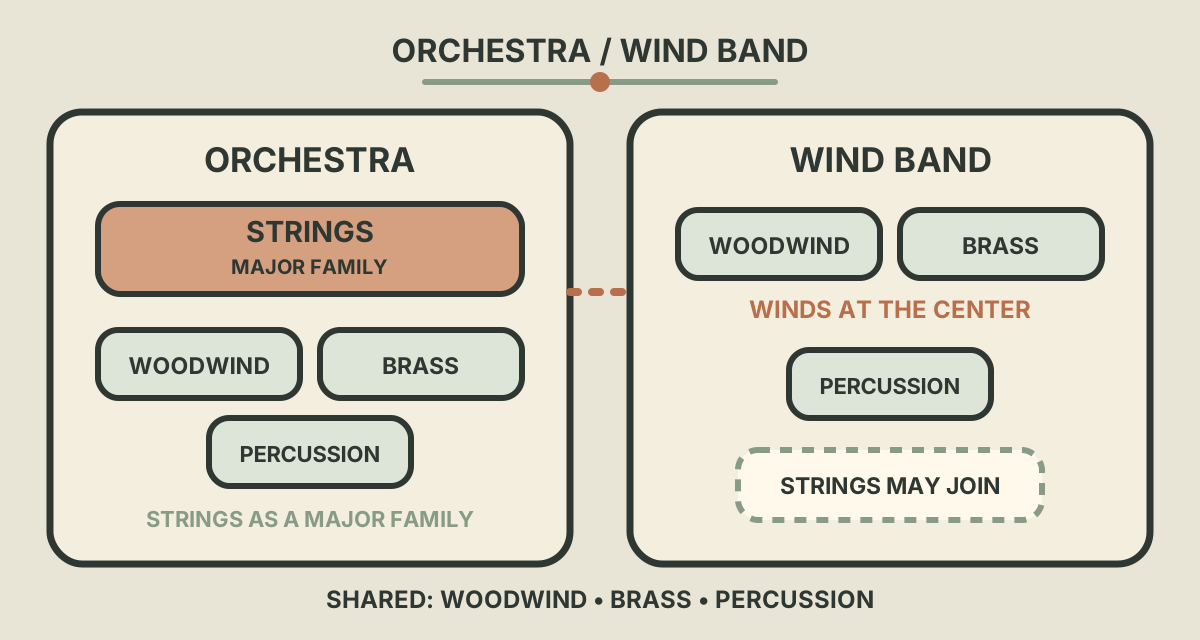
Both orchestras and wind bands may use woodwinds, brass, and percussion. To see the difference, look beyond the shared instruments to what stands at the center of the ensemble. Strings are a major family in an orchestra and combine with woodwinds, brass, and percussion. A wind band is centered on woodwinds and brass with percussion added.
A dictionary description of wind-band instruments lists the clarinet, horn, and timpani as examples of woodwind, brass, and percussion. Yet strings are not absolutely excluded from a wind band. The Nipponica encyclopedia explains that music based on wind instruments may also include percussion and some string instruments.
In Japan, a wind band is sometimes called a brass band, but the ensembles are not necessarily identical. The dictionary distinguishes a wind band, built around woodwinds and brass, from a brass band in its original sense, centered on brass instruments. Checking whether woodwinds are present, whether brass is central, and how strings join avoids confusion based on the name alone.
Wind bands have a history that includes development around military bands, but their activity is not limited to military music. The dictionary also describes their spread into schools and private groups, as well as schools and workplaces in Japan. Along with the instrumentation, these expanding settings help us understand wind bands beyond a single purpose.
References
Choose three modern tracks by musical part, lead instrument, scene, and length
The next three examples are modern original works. They are not historical works or recordings that recreate the lineup of a real orchestra. Instead, use the published descriptions of their structure, lead instrument, and intended scene. Here, a musical part means one line of sound moving alongside other lines. A theme may pass between several parts, while another track may place one instrument on the lead melody.
“Armillary Fugue” runs 4 minutes 30 seconds. Its published description presents it as fugue-like, with a theme passed from one part to another. Find a short melody and follow it as it moves to a different part to focus on the construction. The description suggests it for assembling ideas and other intellectual scenes. Open the track page or listen from 13:08 in the YouTube video.
“Under the Grey Spires” runs 2 minutes 36 seconds. It is published as game-style BGM for a castle town, with trombone on the lead melody. It is the shortest of the three and is a candidate for castle-town scenes, strategy RPG projects, game commentary, streams, and videos. It begins at 34:37 in the YouTube video.
“Grass to the Horizon” runs 4 minutes 2 seconds. It is published as game-style BGM for an advance across open plains, with horn on the lead melody and a marching rhythm. Compared with “Under the Grey Spires,” you can choose by lead instrument, castle town versus open plains, and length. It begins at 1:12:07 in the YouTube video.
Choose “Armillary Fugue” to follow the construction, “Under the Grey Spires” for a short castle-town scene, or “Grass to the Horizon” for a horn-led marching scene. The intended setting and required length narrow the choice.
Use the three tracks in videos, streams, and games within the usage guide
All three tracks can be downloaded free of charge, used commercially or non-commercially, and require no credit. They are candidates for use inside videos, streams, games, and similar projects. Before using one, check the download indication on its track page and the current audio usage guide.
On this site, royalty-free means that no extra fee is charged for each use or play within the usage terms. It does not mean copyright has been waived. Reselling or redistributing the audio on its own and using it as AI-training data are prohibited. These conditions apply to the three tracks introduced here; check the distributor and terms for other audio.
- 1
Orchestral
Compare three modern original tracks by a theme passed between musical parts, a castle-town scene with a trombone-led melody, a march across open plains with a horn-led melody, and the length you need. They are not historical works or recordings that recreate a real orchestra.
Use it forArmillary Fugue (4:30): follow the theme as it passes between parts, Under the Grey Spires (2:36): accompany a castle-town scene with a trombone-led melody, Grass to the Horizon (4:02): accompany a march across open plains with a horn-led melody
These sounds from arcalune
First, use the diagrams to confirm the instrument families and example instruments. Then decide whether you want to follow a theme passed between parts or match a castle-town or marching scene, and compare the lead instrument, intended setting, and length of the three tracks.
FAQ
- What is an orchestra?
It is an ensemble that combines instrument families with different roles, including strings, woodwinds, brass, and percussion.
- How can I tell the main orchestral instrument families apart?
Players bow or pluck strings, blow across an edge or against a reed in woodwinds, and vibrate their lips in brass. Percussionists make parts such as membranes or bars vibrate. Some works also use harps and keyboard instruments.
- What is the difference between an orchestra and a wind band?
They center different families. Strings are a major family in an orchestra and combine with woodwinds, brass, and percussion. A wind band centers woodwinds and brass with percussion, although some strings may also join.
- Are a wind band and a brass band the same?
Not necessarily. In Japan a wind band may be called a brass band, but a wind band centers woodwinds and brass, while brass band in its original sense describes an ensemble centered on brass instruments.
- Are Baroque music and orchestra the same classification?
No. Baroque music describes mainly a period and styles from about 1600 to 1750, while orchestra describes an instrumental ensemble. A work may be both Baroque and written for orchestra.
- Can I use the three tracks in this article in videos or games?
Yes. All three are free to download, may be used commercially or non-commercially, and require no credit. Reselling or redistributing the audio alone and using it for AI training are prohibited, so check each track and the current usage guide first.