
What Is Bolero? Ravel’s Snare Drum, Melodies, Dance, and Song
In Ravel’s Boléro, the melody passes from one instrument to another over a repeating snare rhythm in triple meter. The same tune sounds different on the flute and the clarinet.
Bolero is a name used for a Spanish dance as well as songs rooted in Cuba and Mexico. We trace Ravel’s piece through its creation as a ballet and the opening pages of its score, then look at how the song tradition was passed on.
Ravel’s Boléro was written for a ballet in 1928
Maurice Ravel wrote the music for a Spanish-themed ballet at the request of dancer Ida Rubinstein. It premiered at the Paris Opera in 1928, with choreography by Bronislava Nijinska.
The Bibliothèque nationale de France links the title to an Andalusian dance in triple meter. In the working autograph score, Ravel used repeat signs in places rather than writing out the same bars again and again. Written for the stage, the piece repeats limited material while creating change through different combinations of instruments.
The snare repeats as the melody passes from one instrument to another
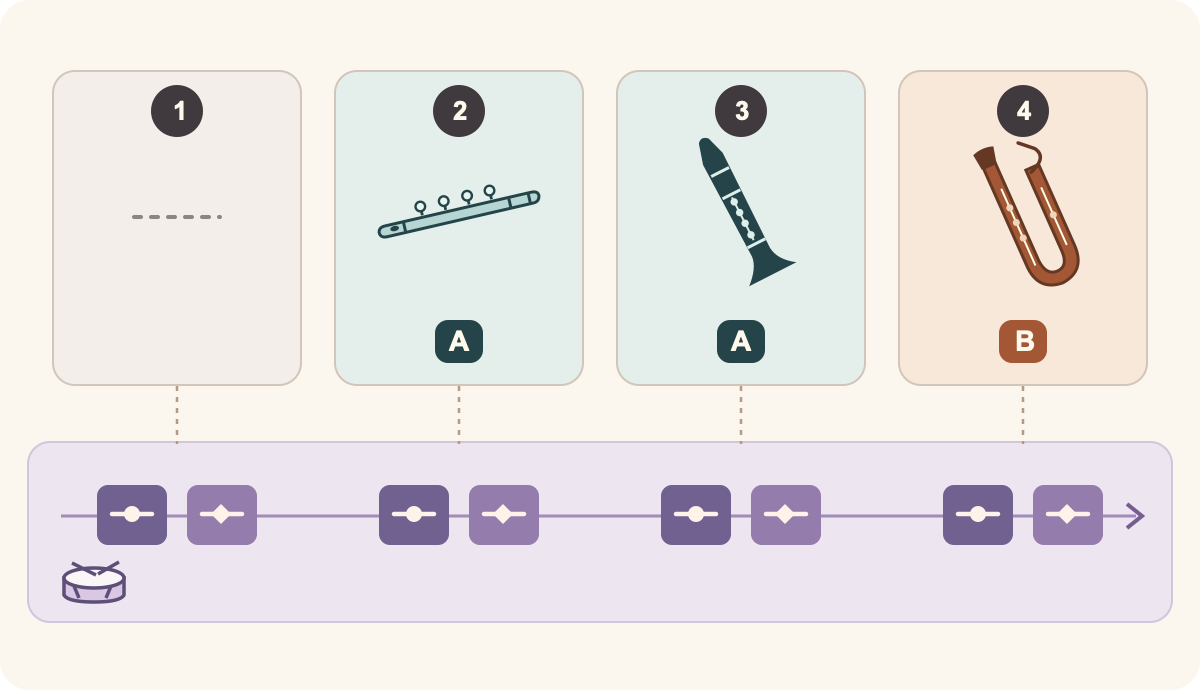
The opening of the 1929 published score is in 3/4. The snare drum repeats a two-bar unit, while the violas and cellos pluck an accompaniment. Try counting “1, 2, 3” repeatedly on your fingers and listen for where the snare’s finer notes fall between the counts.
After the first four bars, the flute plays melody A. The clarinet then takes up the same melody, before the bassoon plays melody B. The upper row of the figure shows this order. The lower row shows the snare beneath it. The flute can still be heard in the accompaniment after it hands over the melody.
In this performance by the Orchestre Philharmonique de Radio France, first follow the snare. On a second listen, find the points where the melody passes from one instrument to another. As more instruments and volume are added, the same rhythm supports an increasingly dense sound.
Bolero song traditions rooted in Cuba and Mexico
Bolero song traditions are rooted in Cuba and Mexico and have conveyed everyday events and feelings through lyrics. A Mexican Ministry of Culture source explains that songs formed in Cuba were carried on across Mexico and spread through regional performance, radio, and film. They are also sung in homes, public squares, and concert halls, while learning songs by listening within families and communities helps sustain the tradition.
One Mexican trio format layers three voices over three guitars, one of them a small requinto. Open Trio Los Panchos’ Sin Ti and listen to how the vocal entrance overlaps with the strings. In 2023, the song practice jointly nominated by Cuba and Mexico was inscribed on UNESCO’s Representative List of the Intangible Cultural Heritage of Humanity.
Hear bolero-style BGM with tenor saxophone and trumpet
Under the Lighthouse is a bolero-style BGM track of about 4:44, with a melody played by tenor saxophone. It begins at 43:57 in the official video. For a quiet harbor or nighttime scene, listen for where its long-breathed notes begin and fade.
The Crowd Wants Blood is a roughly 3:12 game BGM track designed for an arena, with a trumpet melody over a bolero rhythm. It begins at 1:01:48 in the official video. For an entrance scene, try bringing in the melody either when the central figure appears or when the stands come into view.
Place both tracks against the same scene and compare the melody’s entrance
Try the two tracks alternately against a scene in which a door opens. The point where you start the music—and whether you leave footsteps in the soundtrack—will change depending on whether you want to suggest the atmosphere beyond the door first or emphasize the movement of the person who appears.
These two tracks from our site are royalty-free material. You can save them free from their track pages and use them in commercial videos, streams, and games within the usage terms. Credit is optional. You may not redistribute the audio on its own or use it for AI training.
In Ravel’s piece, follow the repeating snare pattern and changing instruments. In bolero song, follow the point where the singing enters over the accompaniment. Each approach reveals a different way to listen.
FAQ
- What is bolero in music?
The name is used for a Spanish dance, the ballet music Ravel wrote in 1928, and song traditions rooted in Cuba and Mexico. Ravel’s Boléro is known for its repeating snare pattern and the changing instruments that play its melodies.
- What time signature is Ravel’s Boléro in?
The opening of the 1929 published score is in 3/4. The snare-drum rhythm repeats as a two-bar unit.
- Which instrument plays the first melody in Boléro?
The flute plays the first melody in Ravel’s Boléro. The clarinet then plays the same melody, followed by the bassoon with the next melody.
- Can I use the featured bolero-style BGM tracks in commercial videos?
Under the Lighthouse and The Crowd Wants Blood are royalty-free tracks from our site that can be used in commercial videos within the usage terms. Under the Lighthouse is available as an MP3, and The Crowd Wants Blood as a WAV, both free to save.