What Types of String Instruments Are There? Violin, Viola, Cello, and Double Bass Compared
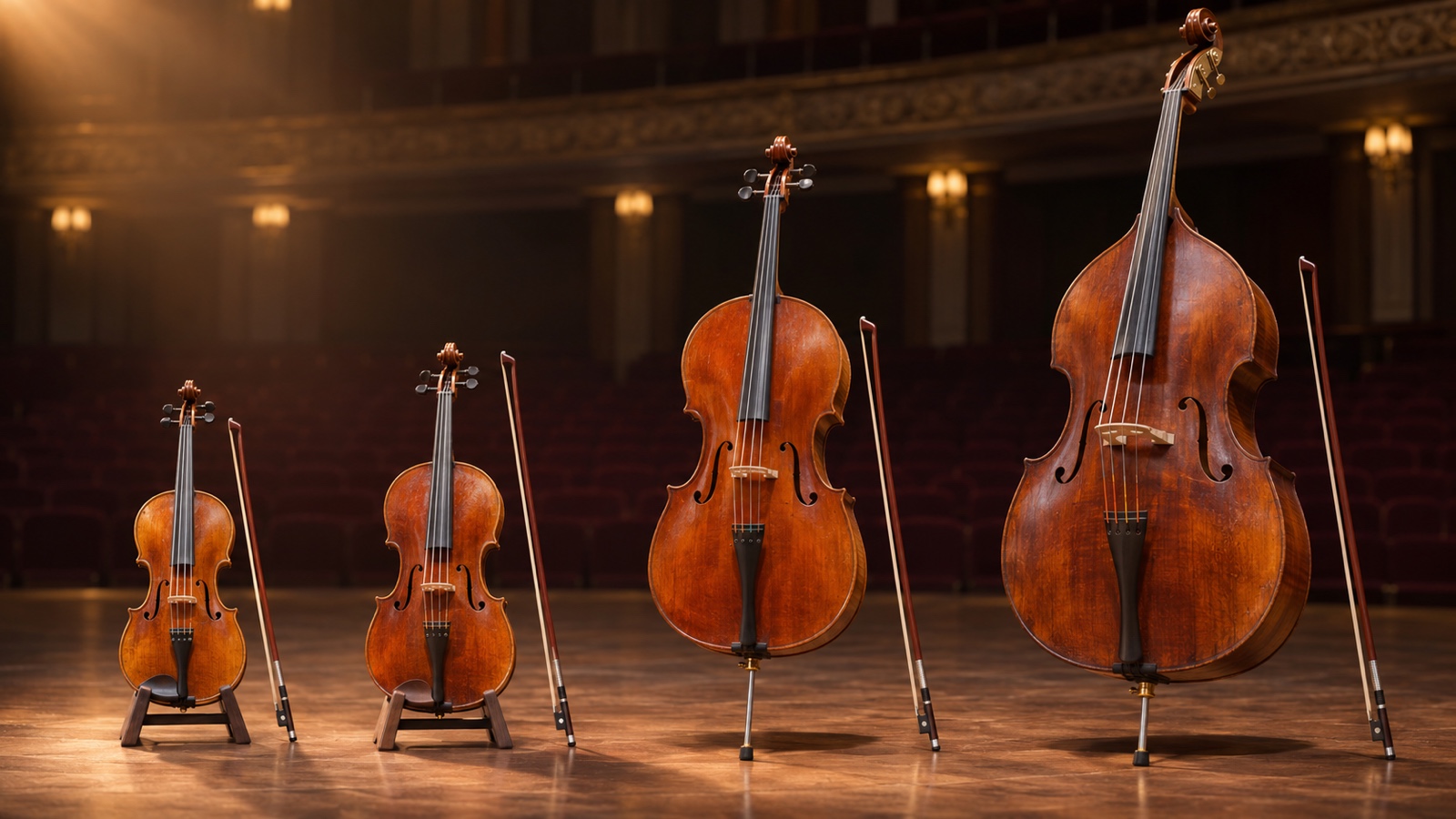
String instruments produce sound by setting stretched strings in motion. They include instruments played with a bow, such as the violin and cello, as well as the guitar, harp, and koto, whose strings are plucked with fingers or a pick. Some, including the piano, use hammers to strike the strings.
This article compares the violin, viola, cello, and double bass used in orchestras. All four can sound their strings with either a bow or the fingers. First, use the diagram to compare how they are held and the pitches of their open strings, which sound without being stopped by a finger. Then listen for the roles they play in music.
Rosin creates the friction that lets a bow set a string in motion
Applying rosin to the bow hair helps it grip the string. As the bow moves, the string is pulled by the hair, then slips and springs back. This cycle repeats, keeping the string in motion for as long as the bow continues to move.
In pizzicato, the player plucks the string with a finger, and its motion gradually fades from the moment it is released. On the same violin, a player can sustain a melody with the bow or place short, plucked notes with a finger.
The bridge carries string vibrations into the body
The bridge receives the string's vibrations and passes them to the top plate. In a violin, the soundpost standing between the top and back plates also transmits vibration. The plates and hollow body set the air in motion, allowing the instrument's sound to spread.
When a string is pressed against the fingerboard, the section from the finger to the bridge is the part that mainly vibrates. Moving the stopping finger closer to the bridge shortens that section and raises the pitch. A note produced without stopping the string is called an open-string note.
Compare the playing positions and open strings of the four instruments
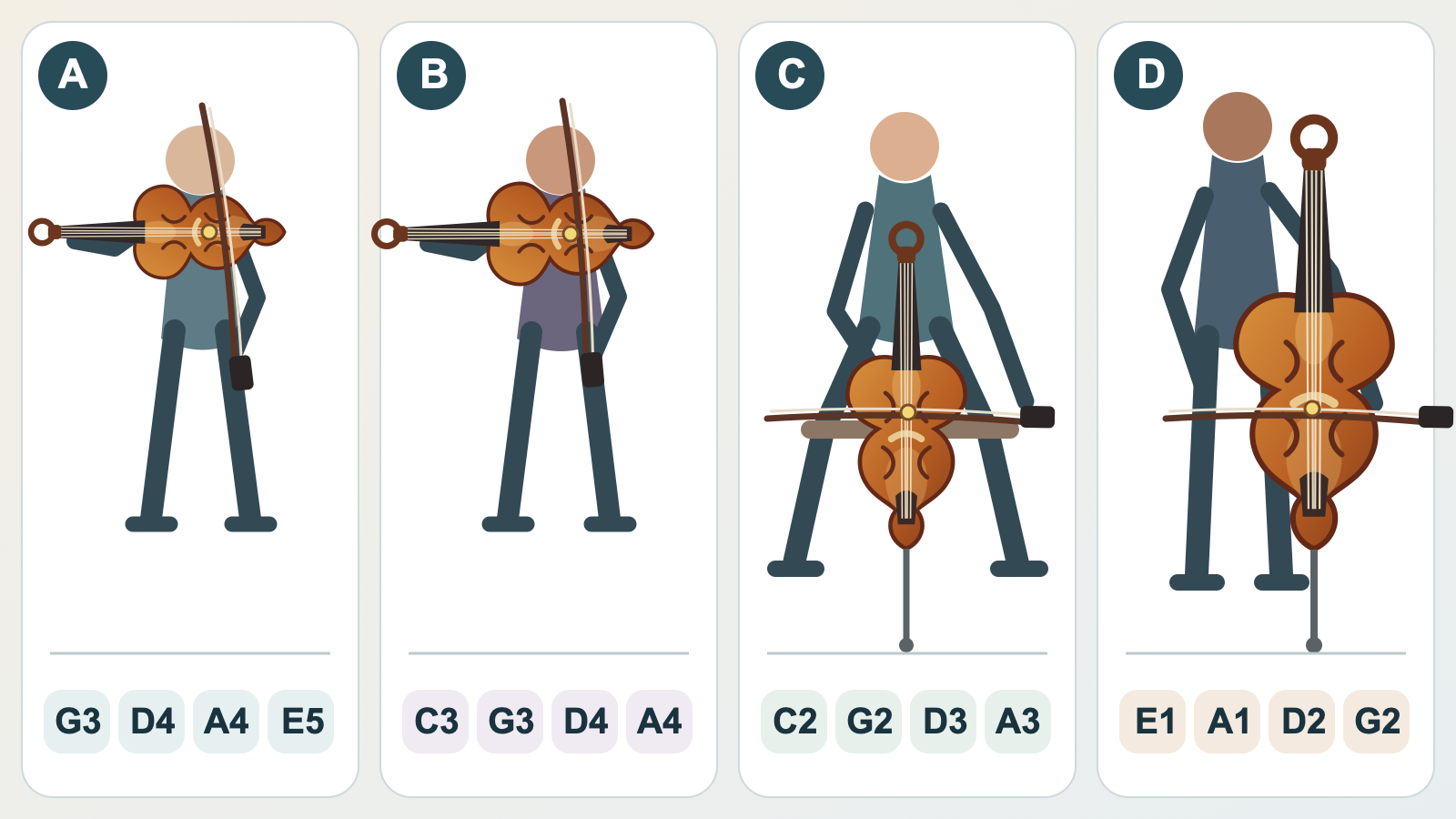
The diagram uses a system in which middle C is C4 and lists the usual four strings from lowest to highest. Open-string pitches provide a guide to an instrument's tuning. In performance, players use both open strings and notes made by stopping the strings with their fingers.
The violin in A is supported between the shoulder and chin, and its open strings are G3–D4–A4–E5. The viola in B is held in much the same way. Its body is generally a little larger, and each of its open strings, C3–G3–D4–A4, is a perfect fifth below the corresponding violin string.
The cello in C is played seated, supported between the legs, with its endpin resting on the floor. Its open strings are C2–G2–D3–A3, using the same note names as the viola but tuned one octave lower.
The double bass in D stands on the floor on its endpin and is played either standing or seated on a high stool. The sounding pitches of its usual four strings are E1–A1–D2–G2. Adjacent open strings are tuned in perfect fifths on the violin, viola, and cello, but in perfect fourths on the double bass.
Double bass music is generally written one octave above the sounding pitch. For example, the open E1 string appears as E2 in the score. Five-string instruments and basses with a low extension can reach below the usual four-string range.
Melody, inner voice, and bass roles can change within an ensemble
In an ensemble, you may hear a high violin melody, a viola inner voice, a low cello melody, and a bass line on the double bass. The inner voice fills out the harmony and movement between the melody and the bass.
In another piece, the viola or double bass may carry the melody. To identify which instrument stands out, first follow the sequence of notes you can hum. On a second listen, shift your attention to the notes continuing underneath and those supporting the pulse.
A violin from around 1560 already shows features that remain today
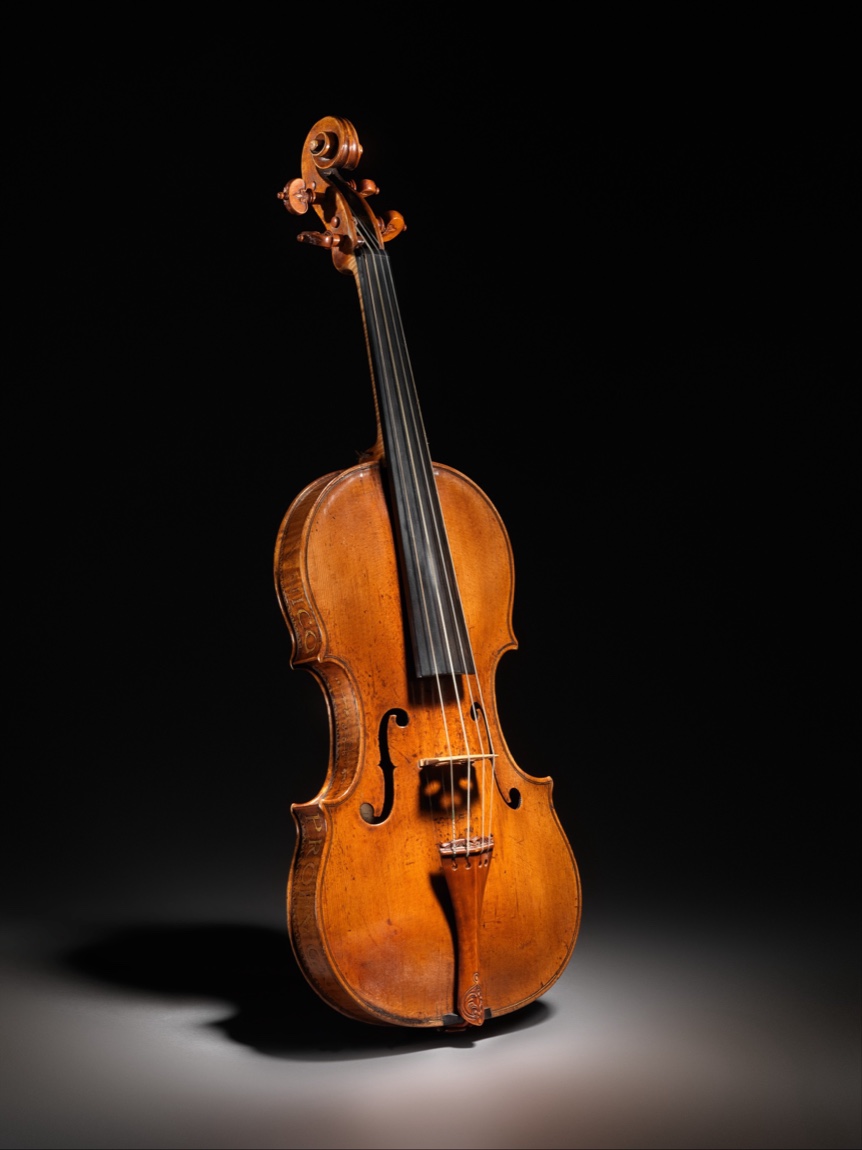
This violin was made by Andrea Amati in Cremona, Italy, around 1560. The f-holes in the top plate and the scroll can still be seen on modern violins. Its museum record notes later replacement parts and alterations to the neck, fingerboard, bridge, and interior of the body.
Amati made violas and cellos as well as violins. The double bass has a history connected to the violone, a bass instrument of the viola da gamba family, and both its number of strings and its form varied by time and region. Although all four instruments now sit together as the orchestral string section, their histories of construction are not identical.
Hear the strings carry the melody in four existing tracks
All four tracks are original background music from this site. Their instrumentation and accompaniment differ. Listen for the instrument carrying the melody in each piece to revisit the ensemble roles described above.
“Mop Waltz” (4:15) is a string waltz with an active violin line. Follow the string melody while keeping the groups of three beats in mind. On YouTube, the track starts at 8:34.
“The King Does Not Look Up” (3:29) gives the main melody to the viola. Feel the march-like pulse and follow the melody above it. On YouTube, the track starts at 52:27.
“We Were Wrong About the Ford” (3:37) is in 12/8 and gives the main melody to the cello. First follow the phrases of the melody, then focus on the accompaniment's pulse on a second listen. On YouTube, the track starts at 2:13:26.
“Count the Days on the Wall” (2:48) gives the main melody to the double bass. Try listening separately to the sparse pulse and the low-register melody. On YouTube, the track starts at 55:52.
References
Use the four tracks as royalty-free music
All four tracks can be downloaded for free and used commercially in videos, streams, games, and other projects within the scope of the usage guide. There is no additional fee each time you use them, and credit is optional. Reselling or redistributing the audio itself and using it for AI training are prohibited.
References
- 1
Four tracks with violin, viola, cello and double bass
Follow the melody in each track, then listen for how the accompaniment supports the beat and harmony.
Use it forViolin, Viola, Cello, Double bass
These sounds from arcalune
To tell these instruments apart, first look at whether the instrument is supported at the shoulder or rests on the floor, then compare the open-string pitches. In an ensemble, follow the melody first and shift your attention to the inner voices and bass on a second listen. You will notice that the same instrument can do a different job from one piece to another.
FAQ
- What types of string instruments are there?
They include instruments played with a bow, such as the violin, instruments plucked with fingers or a pick, such as the guitar and koto, and instruments whose strings are struck with hammers, such as the piano.
- What is the difference between a violin and a viola?
They are held in similar ways. A viola is usually a little larger, and its open strings, C3–G3–D4–A4, are each tuned a perfect fifth below the violin's G3–D4–A4–E5.
- What is the difference between a cello and a double bass?
A cello is played seated and supported between the legs, with strings tuned to C2–G2–D3–A3. A usual four-string double bass is supported while the player stands or sits on a high stool, and its sounding pitches are E1–A1–D2–G2.
- Why do players apply rosin to bow hair?
Rosin creates friction between the hair and the string, allowing the bow to repeat a cycle of gripping and releasing the string. That cycle keeps the string in motion.
- Can I use the four featured tracks commercially?
Yes. They can be used commercially within the scope of the usage guide and downloaded for free. Credit is optional. Reselling or redistributing the audio itself and using it for AI training are prohibited.