
What Is Chamber Music? String Quartets and Piano Quintets
Chamber music is music for a small group of instrumentalists, usually with one player to a part. A string quartet has two violinists, a violist and a cellist. A typical piano quintet adds a pianist to those four players.
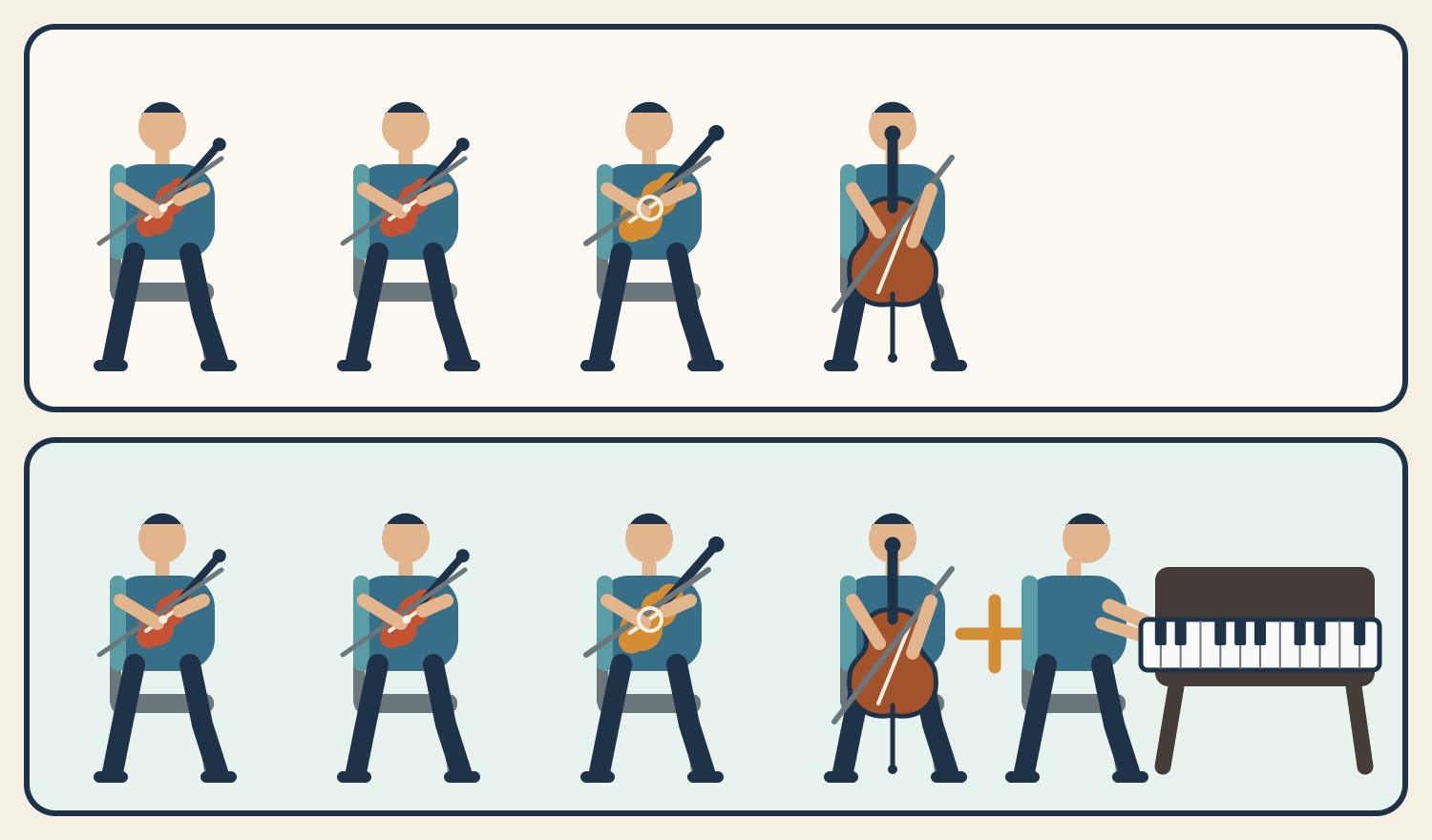
To understand how chamber music differs from an orchestra, look at how many musicians play from the same part. Use the diagram to identify the instruments, then trace the history through the manuscript of Mozart’s quartets dedicated to Haydn.
Compare a string quartet and a piano quintet
The first and second violinists play different parts on the same type of instrument. The viola is slightly larger than a violin and can play lower notes. The cellist supports the cello between the legs with its endpin on the floor. The cello reaches the lowest notes of the four parts.
One common piano quintet lineup is one piano and a string quartet. The piano can carry the melody or support the strings with chords. Schubert’s Trout Quintet uses one violin and includes a double bass. For any particular piece, check the instrumentation in the score or concert program.
Chamber music and orchestras assign parts differently
In a string quartet, one player takes the first violin part. In an orchestra, several violinists typically play that part together. The same label, first violin, can therefore refer to one player or an entire section.
String quartets usually play without a conductor. The musicians can cue each other with a breath or a movement of the bow. A quartet with one player to a part is still chamber music in a large hall.
Trace chamber music through scores and instrument lineups
From the 17th century to the mid-18th century, the trio sonata was common in Europe. It combined two melodic lines with a basso continuo part. When a bass instrument and a keyboard shared the continuo, four musicians could play the three parts.
In the later 18th century, Haydn and other composers developed the string quartet. The British Library holds the autograph manuscript of six string quartets Mozart dedicated to Haydn. The catalogue dates the manuscript from 1782 to 1785 and lists it as Add MS 37763. The first quartet in the manuscript, in G major, K. 387, is dated 31 December 1782.
A 19th-century example is Brahms’s Piano Quintet in F minor, Op. 34, completed in 1864. It went through versions for string quintet and two pianos before taking shape for piano and string quartet. In the 20th century, Bartók found new sounds for the same quartet lineup. In his String Quartet No. 4, players pull and release a string so it snaps against the fingerboard, a technique known as Bartók pizzicato.
Hear how the instruments fit together in three modern tracks
These original background tracks draw on the ensembles and sounds of chamber music. Use “Dusting the Study” to pick out the short, plucked harpsichord notes and the lower sound of the cello. Follow the higher sound first, then listen again for the low line.
“Rain on the Washing” is a fast string quartet with darting violin lines. Follow the violin once, then listen again for the other strings. “Flowers for the Guest Room” is a piano quintet for piano and strings. Listen for the piano and then the strings to hear what the keyboard adds to the ensemble.
The links below take you to the start of each track or to its free download page. The YouTube links open different points in the same video.
References
Find a piece’s period and check how a track can be used
The words quartet and quintet tell you about the ensemble. If you want to know when a piece was written, the periods of classical music can help you compare composers and works.
The three tracks above are royalty-free background music available as free downloads from their track pages. You can use them commercially in videos and streams without credit. Redistribution or sale of the audio on its own and use for AI training are prohibited. For a historical work, check the terms for the specific recording you plan to use.
- 1
Three tracks for comparing chamber ensembles
Hear harpsichord and cello, a string quartet and a piano quintet in that order.
These sounds from arcalune
FAQ
- How many musicians play chamber music?
It depends on the piece. A trio has three players, a string quartet has four and a typical piano quintet has five. Chamber music usually has one player to each part.
- What instruments are in a string quartet?
First violin, second violin, viola and cello. The two violinists each play a different part.
- What instruments are in a piano quintet?
A common lineup is one piano, two violins, a viola and a cello. The instruments can vary from one piece to another.
- How can I tell chamber music and orchestral music apart?
Check how many musicians play one string part. In a string quartet, one person plays it. In an orchestra’s string section, several players usually share a part.
- Can I use these chamber music tracks in commercial videos?
Yes. The three original tracks can be used commercially under the usage guide. They are free to download, with no credit required. Redistribution or sale of the audio on its own and use for AI training are prohibited.