
What Is Classical Music? The Classical Period, Historical Eras, and Ensembles Explained
In its broad sense, classical music does not mean only the Classical period. It is used as an umbrella term covering several historical periods, including Baroque, the Classical period, Romantic, and modern and contemporary music. Within that broad history, the Classical period is one particular era in music history.
The same word, “classical,” can suggest both the broad body of music and the narrower Classical period, so the two are easily confused. This article traces the main periods from the seventeenth century onward and separates historical periods from performing ensembles such as the orchestra.
How this list was chosen
- We distinguish the broad label “classical music” from the historical “Classical period.”
- Dates are approximate guides that vary among sources, not absolute worldwide boundaries.
- The three featured tracks are modern originals. They are examples chosen by published instrumentation, length, and use—not recordings of historical works or recreations of period performances.
Classical music does not mean only the Classical period
Used broadly, “classical music” is an umbrella term for Western art music with a long history. Even when we limit the view to the seventeenth century onward, it includes several periods: Baroque, the Classical period, Romantic, and modern and contemporary. Baroque and Romantic music therefore both fall within classical music in this broad sense.
The Classical period, by contrast, is one era within that long history. Confusion arises because similar words name both the broad category and one period inside it. “Listening to classical music” may refer to a wide range, while “researching a work from the Classical period” narrows the subject to a more specific time and style.
Broad label, period, and ensemble are separate axes
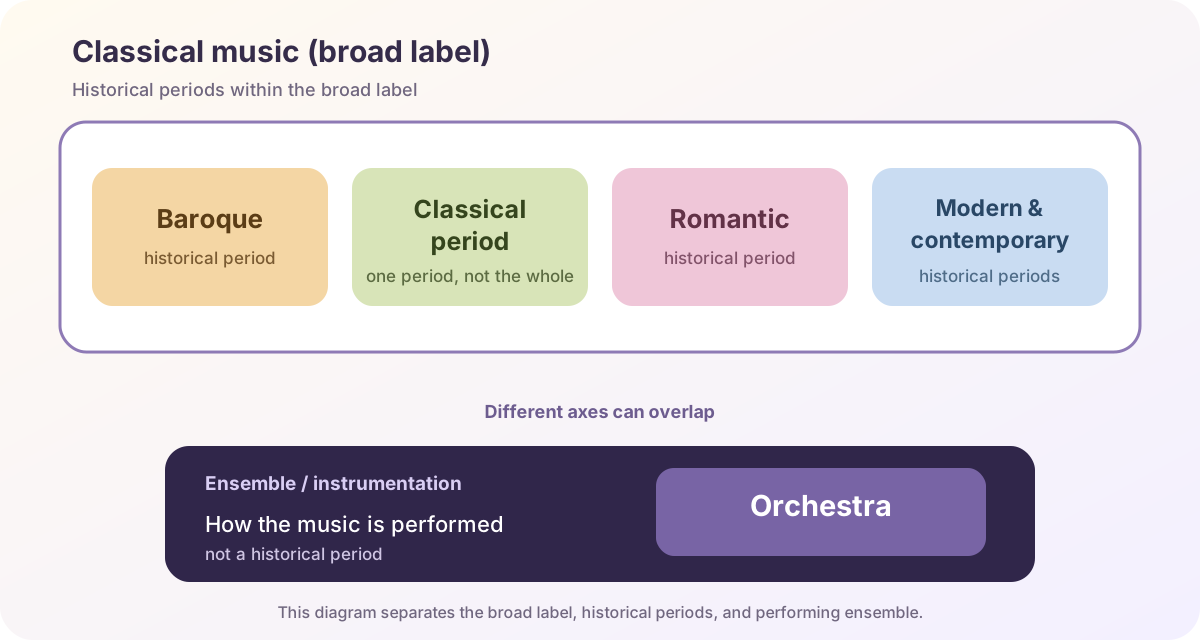
To tell the terms apart, separate three axes: broad label, historical period, and ensemble. Classical music is the broad label; Baroque and the Classical period organize music by when it belongs; orchestra describes the groups of instruments that perform it.
These are not mutually exclusive categories. A work can be described as classical music in the broad sense, a Baroque work, and a work performed by an orchestra. Conversely, the word “orchestra” alone does not determine whether a piece is Baroque, Classical, or Romantic. The upper part of the diagram shows the broad label and its periods; the lower part shows the separate ensemble axis that can overlap them.
The main periods from the seventeenth century show where the Classical period sits
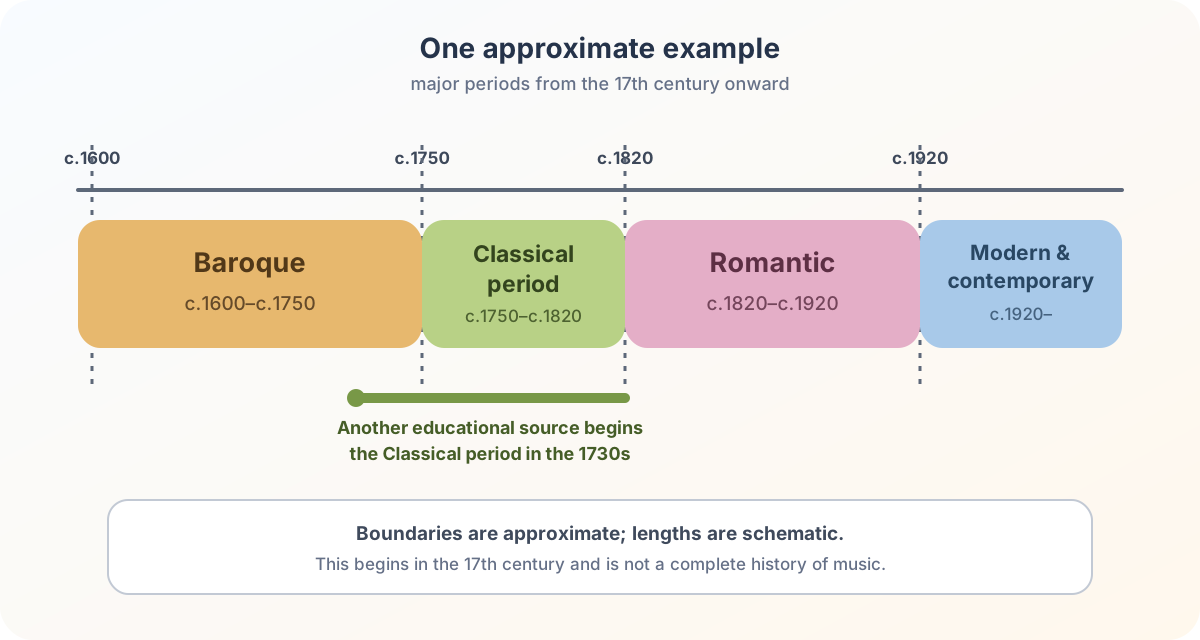
One outline from Senzoku Online School places Baroque at about 1600–1750, the Classical period at about 1750–1820, Romantic at about 1820–1920, and modern and contemporary music from about 1920 onward. In this sequence, the Classical period is not another name for all classical music: it is one era after Baroque and before Romantic.
These boundaries are not lines that mechanically sort every work. The same source notes that the dates are approximate and that music history can be divided in different ways. The diagram is one guide to relationships from the seventeenth century onward; it does not mean that music changed everywhere in the same year or that it covers the whole history of music before the Middle Ages.
Dates, representative composers, and forms of the Classical period
Sources give different ranges for the Classical period. Senzoku Online School uses about 1750–1820, while a Morinaga Angel College educational article uses the 1730s–1820s. Because the starting date varies, neither range should be treated as a single absolute boundary for the whole world.
This difference shows that timelines organize terms for understanding; they do not mean that every way of making music changed when a date turned over. If two articles give slightly different dates, first check what each source includes within the Classical period rather than immediately declaring one wrong.
As entry points to the period, Senzoku names Haydn, Mozart, and Beethoven and explains that large musical forms such as sonata and rondo developed in this era. The important distinction is that these composers introduce one historical period; they do not stand for the whole of classical music.
Check period and ensemble separately when reading about a work
To classify a work, first ask which period and style its composer or the work itself is placed in. Then ask how it is performed: solo, small ensemble, orchestra, or another combination of instruments. Checking these separately avoids assumptions such as “an orchestra means the Classical period” or “a harpsichord means it is not classical music.”
For more detail on Baroque history, features, and instruments, continue to “What Is Baroque Music?” For string, woodwind, brass, and percussion families and the difference from a wind band, see “What Is an Orchestra?” This article stops at distinguishing broad label, period, and ensemble rather than repeating those details.
Choose three modern tracks by instruments, length, and use
The following three tracks are modern original BGM from this site, compared by instruments or ensemble, length, and intended use. They are not recordings of historical works or reconstructions of period performance. Use their published descriptions—string quartet, woodwinds, and harpsichord—to choose a track for your scene.
“Curtains Up at Seven” is 4:14 and is published as a bright minuet for string quartet. It is a candidate for chores or the start of the day. Open its track page or listen from the beginning of the YouTube video when you need a small string ensemble.
“Breakfast Polka” is also 4:14. It is published as a light polka for flute, clarinet, and bassoon, for cooking or morning chores. Because it is the same length as “Curtains Up at Seven,” compare the published instrumentation—string quartet or three woodwinds—and the scene you need. It begins at 4:17 in the YouTube video.
“Prelude for the Night Shift” is 4:15 and is published as a quiet prelude with broken chords on harpsichord. It is a candidate for beginning study or research and can be heard on its track page or from the start of the YouTube video. Do not arrange these tracks as proof of three historical periods; choose among the published string quartet, woodwind, and harpsichord descriptions and their different uses: morning chores, cooking, or starting work.
The three tracks are royalty-free to use
All three tracks are free to download and may be used in commercial or noncommercial videos, streams, games, and similar projects without required credit. On this site, royalty-free means that no additional charge is due for each use or play when you follow the usage terms.
Royalty-free does not mean copyright has been waived. Selling or redistributing the audio by itself and using it as AI training data are prohibited. Terms can change, so check each track and the current audio usage guide when you download it.
References
- 1
Classical
Compare three modern original BGM tracks by their published descriptions—string quartet, woodwind trio, and harpsichord—as well as length and intended scene. They are not recordings of historical works or recreations of period performances.
Use it forCurtains Up at Seven (4:14): string quartet for chores or the start of the day, Breakfast Polka (4:14): woodwind trio for cooking or morning chores, Prelude for the Night Shift (4:15): harpsichord for starting study or research
These sounds from arcalune
Classical music is not another name for the Classical period alone. Classical music is the broad label, containing periods such as Baroque, Classical, Romantic, and modern and contemporary; orchestra describes an ensemble, not an era. Separating these three ideas clears up the ambiguity around “classical.”
Next time you read about a work, ask one question at a time: Is this the broad label? Which historical period? Which ensemble? When choosing audio for a project, also check the published instruments, length, intended use, and current usage terms rather than relying only on the historical classification.
FAQ
- What is classical music?
In its broad sense, it is an umbrella term for Western art music across periods including Baroque, the Classical period, Romantic, and modern and contemporary. This article focuses on the main periods from the seventeenth century onward.
- Are classical music and the Classical period the same?
No. Classical music can be a broad label, while the Classical period is one historical era within that longer history.
- When was the Classical period?
One outline uses about 1750–1820, while another educational source uses the 1730s–1820s. Treat the dates as approximate guides, not absolute boundaries.
- Is Baroque music part of classical music?
Yes, in the broad sense. Baroque and the Classical period are different historical periods within classical music.
- Does orchestra mean the Classical period?
No. The Classical period is an era; orchestra describes an ensemble of instrument groups. A work can be described by both its period and its ensemble.
- Can I use the three tracks in videos or games?
Yes. All three are free to download, permit commercial and noncommercial use, and do not require credit. Selling or redistributing the audio by itself and AI training use are prohibited, so check the current guide before use.