
What Is a Harp? How Pedal and Lever Harps Work
A harp is a string instrument you play by plucking its strings with your fingers. Vibrations travel from the strings to the soundboard and move the surrounding air. A lever harp changes one string at a time, while a pedal harp changes strings with the same note name together during a performance.
We will first use a diagram to see how sound is produced and how semitone changes work, then examine two 19th-century harps. Finally, we will compare equal-length excerpts from three tracks in which the harp is layered with celesta, guitar, and piano.
The soundboard carries string vibrations into the air
When a string is plucked and released, it vibrates. That vibration travels to the soundboard where the string is anchored. Because the string itself is thin, the soundboard's larger surface can move the surrounding air more efficiently as it vibrates.
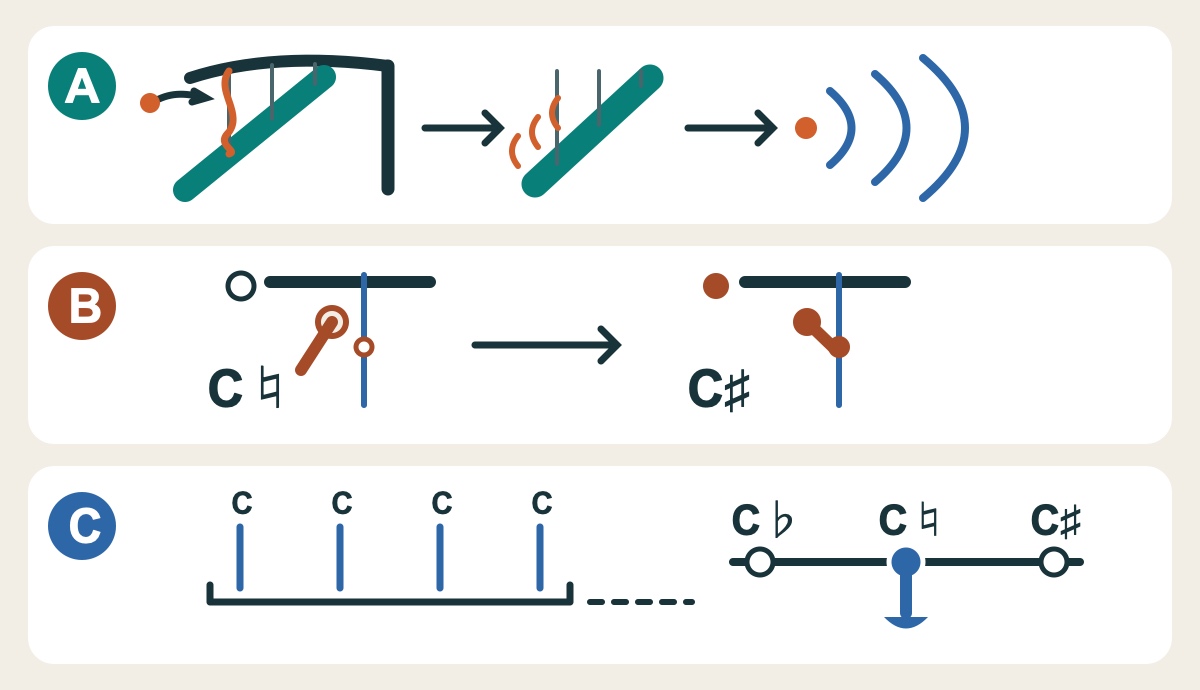
In panel A, the sloping board that holds the strings is the soundboard. The waves spreading at the right represent vibrations passing from the soundboard into the surrounding air. In a real harp, the air inside the soundbox behind the soundboard and the resonance of its openings also contribute to the sound we hear.
A lever changes one string and a pedal changes a group of strings
On a lever harp, the player moves a lever near the top of a string by hand. Engaging it shortens the vibrating length and raises that string's pitch by a semitone. In panel B, a string originally tuned to C natural changes to C sharp. To raise a C in another octave, the lever on that string must also be moved.
A typical double-action pedal harp has seven pedals, one for each note name from C through B. Depressing the C pedal sends motion through the mechanism inside the column and turns discs in the neck, shortening the vibrating lengths of the connected C strings together. The pitch rises by a semitone at each step from the shallow C flat position to C natural in the middle and C sharp in the lowest position.
Panel C places the three positions side by side to show the relationship between the C pedal and several connected strings. The side-by-side arrangement shows the order of the three settings. If both a high C and a low C are connected and need to rise by a semitone, one pedal can change both.
Some 19th-century harps used hand-operated buttons
A portable harp made by John Egan in 1819 has small buttons called ditals inside its column. Pressing a button by hand moves linkages inside the column, causing a pinned disc in the neck to press against a string and change its pitch. The buttons let a player change pitches by hand.
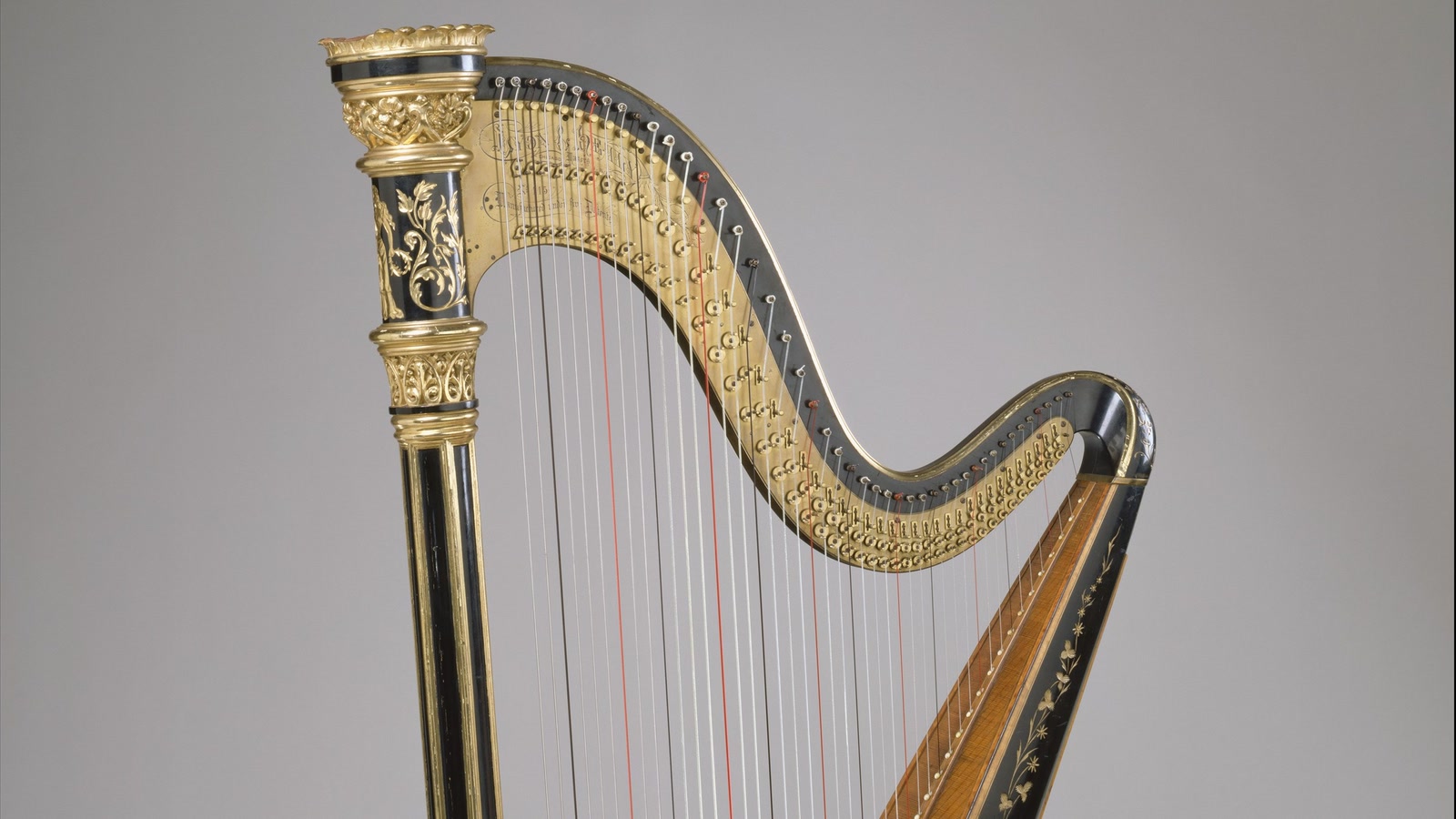
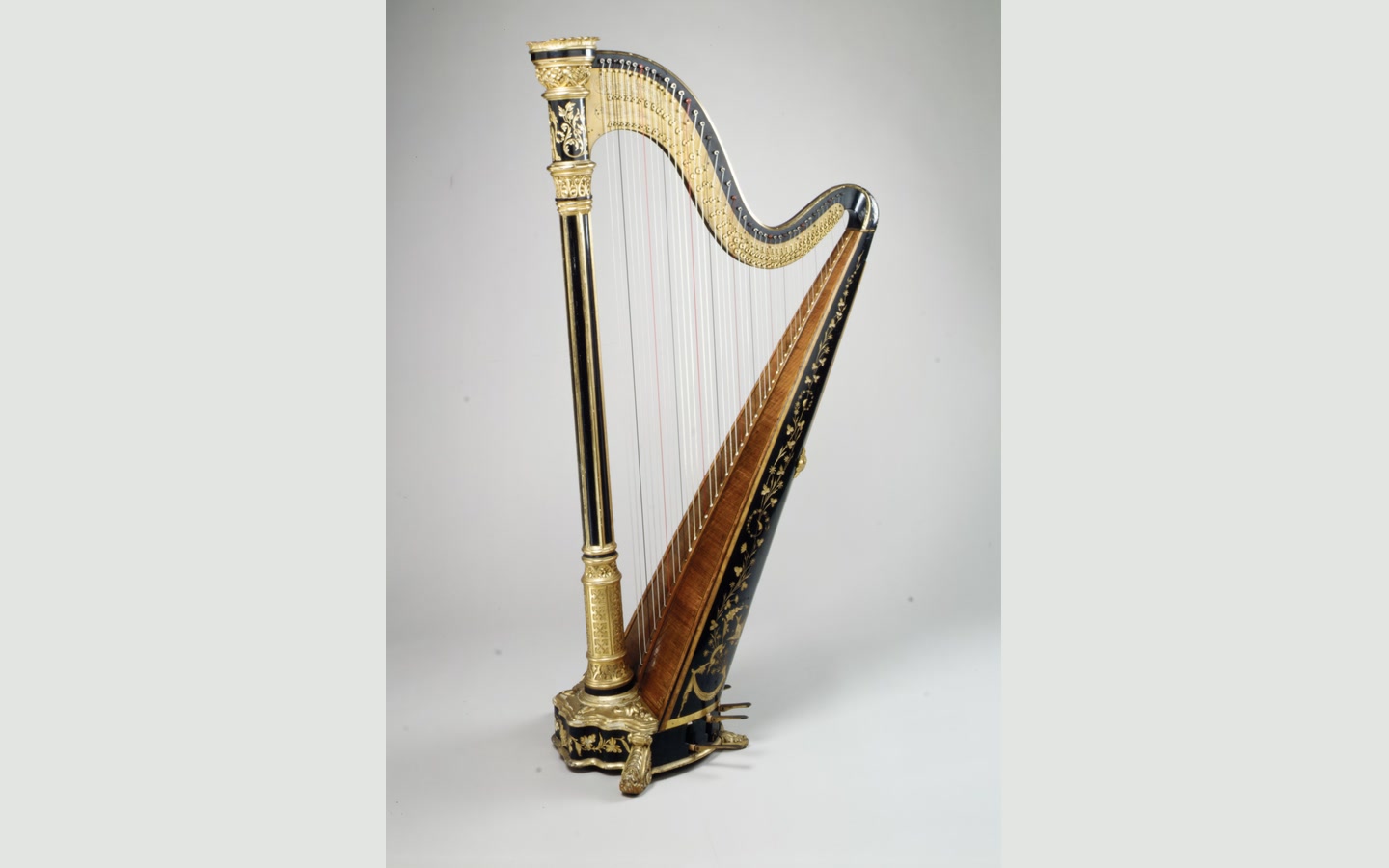
The photograph shows a Lyon & Healy pedal harp made in 1891–95. It has 45 strings and seven double-action pedals that change pitch. The black-and-gold column, the curved neck at the top, and the brown soundboard supporting the strings can all be distinguished in the image.
According to the museum's description, this particular instrument also has an eighth pedal. It operates an opening in the soundbox to change volume. The seven pedals that change pitch and the one that changes volume had separate roles.
Compare how the sound begins and fades in three 20-second excerpts
Listen to 20 seconds from the specified point in each track. First focus on the instant one note begins, then on how it fades. When the next note overlaps it, follow how long the resonance of the earlier plucked note remains audible.
The three tracks introduced here are arrangement examples produced by this site. The accompanying instruments named in each track description can help you locate the harp. To see pedal-harp technique on the instrument itself, you can also refer to the player demonstration linked above.
Hear the harp with celesta, guitar, and felt piano
“Frost on the Orchard Door” is 3:44 long. Its description places celesta alongside the Celtic harp melody. Listen to the first 20 seconds on the official YouTube video and begin with the strings' decay. If you hear the celesta, listen for how it overlaps the harp.
“Waking Above the Sea of Clouds” is 3:45 long. Its description adds fingerpicked acoustic guitar to the Celtic harp melody. Start at the beginning of the official YouTube video, and compare how the two plucked sounds begin if you can hear the guitar too.
“Cloud Shadows on the Page” is 3:47 long. Its description says that the felt piano plays high notes with pauses between them, accompanied by the harp. Listen from 19:00 on the official YouTube video. If you hear both instruments, compare how a piano note fades with how the harp rings.
Save the three tracks you heard as free MP3 files
“Frost on the Orchard Door,” “Waking Above the Sea of Clouds,” and “Cloud Shadows on the Page” can each be saved as a free MP3 from its track page. These three tracks are royalty-free audio from this site and may be used in commercial works such as videos, streams, and games within the usage terms.
Credit is optional. Reselling or redistributing an audio file on its own and using it for AI training are prohibited. Check the usage guide before incorporating a track into your work.
Pedals that change strings with the same note name together require different actions during a performance from levers that handle strings one by one. When listening to the tracks, use the resonance left after each pluck and its overlap with the other instruments as your guides.
FAQ
- How does a harp produce sound?
When a string is plucked with a finger, its vibration travels to the soundboard where the string is anchored. The soundboard vibrates the surrounding air, while the air inside the soundbox and the resonance of its openings also contribute to the sound we hear.
- What is the difference between a lever harp and a pedal harp?
A lever harp uses hand-operated levers to raise the pitch of one string by a semitone. A double-action pedal harp uses foot-operated pedals to switch connected strings with the same note name together among flat, natural, and sharp.
- How many positions does a harp pedal have?
A double-action pedal has three positions. From top to bottom they are flat, natural, and sharp. Each step downward raises the pitches of the connected strings by a semitone.
- How did the 1819 portable harp change pitch?
On the instrument made by John Egan, the player presses buttons called ditals inside the column by hand. Linkages inside the column turn discs in the neck to change the pitch of the selected strings.
- Can I use these harp tracks commercially?
“Frost on the Orchard Door,” “Waking Above the Sea of Clouds,” and “Cloud Shadows on the Page” may be used commercially within the usage terms, and credit is optional. Reselling or redistributing an audio file on its own and using it for AI training are prohibited.