
What Is Four-on-the-Floor? Counting the Beat in 4/4
Four-on-the-floor is a rhythm with a kick on every beat of a 4/4 bar. Count it as 1, 2, 3, 4. The kick is the low thump of a bass drum. In electronic music, that sound can come from a drum machine.
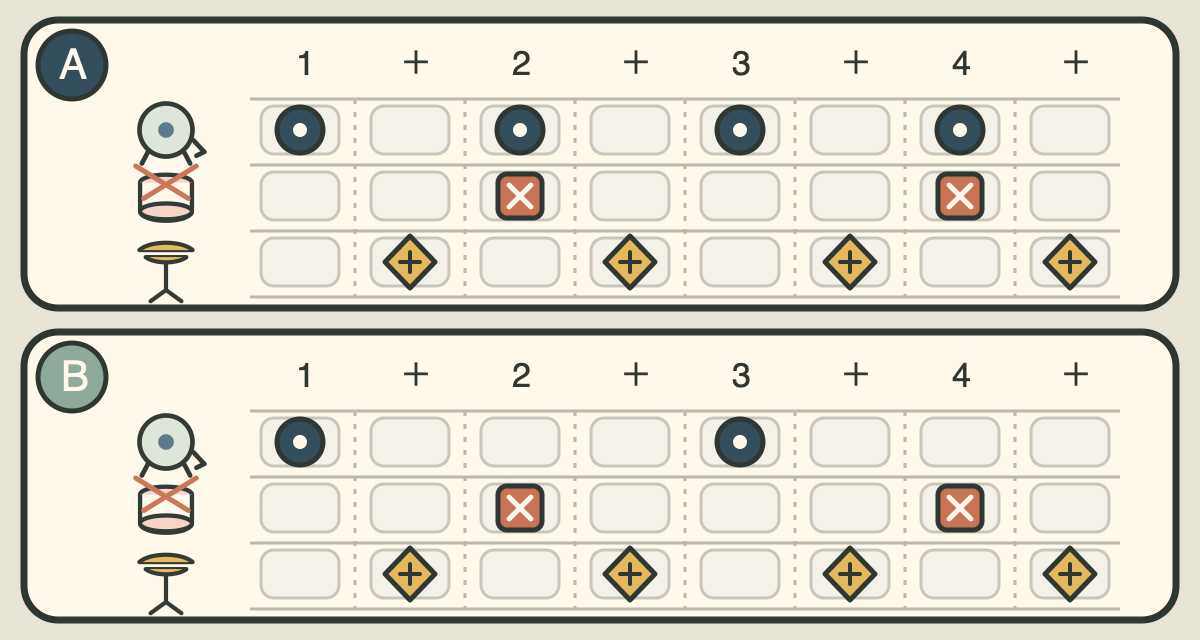
4/4 tells you how a bar is counted. Four-on-the-floor tells you where the kick sounds within those four beats. Compare the kick positions in the diagram below, then count along from the beginning of three tracks.
Compare the kick positions in the same 4/4 time
In 4/4 time, a quarter note counts as one beat and each bar has four beats. Pattern A is four-on-the-floor, with a kick on beats 1, 2, 3, and 4. Pattern B is also in 4/4, but its kick sounds only on beats 1 and 3.
Both examples place the snare on beats 2 and 4 and the hi-hat between the beats. This is one commonly used way to layer the parts. As long as the kick continues on every beat, changing the snare or hi-hat position does not stop the pattern from being four-on-the-floor.
The offbeats are the “ands” in “1 and 2 and 3 and 4 and”
First, say “1, 2, 3, 4” along with the kick. Next, add “and” between each beat. The plus signs in the diagram mark those positions. Step on the numbers and clap on the “ands” to feel the kick and the offbeats separately.
Speed is expressed as BPM, or beats per minute. Whether you count slowly or quickly, the pattern remains the same when the kick sounds on every number.
From 1970s disco to house and techno
Disco, which spread in New York in the early 1970s, brought together elements of soul, gospel, jazz, funk, and other music. A kick on every beat became a common disco rhythm because dancers could follow the pulse easily.
On the 1973 recording “The Love I Lost,” drummer Earl Young layers hi-hat over a kick on every beat. The bass drum keeps the pulse while the cymbals move independently.
In Chicago clubs, house DJs mixed records. In 1980s Detroit techno, artists used drum machines and synthesizers to shape the sound.
House and techno later used a kick on every beat as well, often with drum machines. Even within four-on-the-floor, the character of a track changes with the rhythms, bass, and keyboard parts layered over it. When comparing electronic music, follow the kick first and then listen for what changes above it.
References
Count a slow four-on-the-floor in “A Path of Light for the Birds”
This track is 4:45 long. It layers a sustained synth melody over a slow four-on-the-floor. Follow the low kick first, then listen to the long notes in the melody to separate the two movements. The link opens at the start of the track.
Follow the smaller movements in “The Map Unfolds at Noon”
This track is 4:44 long. A glassy melody and an arpeggio that sounds one note at a time are layered over a light four-on-the-floor. Keep counting 1, 2, 3, 4 while following the faster-moving notes above it.
Hear short synth notes and bells in “Candy Fireworks”
This track is 4:15 long. It is a bright, lively four-on-the-floor layered with short, plucked synth notes and bells. Follow the kick as you did in the previous two tracks, then compare the length and resonance of the sounds above it.
All three tracks are available as royalty-free BGM
All three featured tracks can be downloaded for free and used in monetized videos and streams within the scope of the material usage guide. There is no per-use fee, and credit is optional. Redistributing or selling the audio files on their own and using them for AI training are prohibited.
References
Start by counting 1, 2, 3, 4 with the kick. Once that feels comfortable, follow the snare on beats 2 and 4 and the hi-hat between the beats. The same four-on-the-floor pattern can sound different in every track.
FAQ
- How is four-on-the-floor different from 4/4 time?
4/4 means that a quarter note is one beat and each bar contains four beats. Four-on-the-floor is a rhythm with a kick on all four of those beats. A pattern can still be in 4/4 when the kick sounds only on beats 1 and 3.
- Where are the offbeats in four-on-the-floor?
They are the “ands” when you count “1 and 2 and 3 and 4 and.” Follow the kick on the numbers and count sounds between the beats on the “ands.”
- Which beats should have the snare or clap?
Placing them on beats 2 and 4 creates a commonly used backbeat. The snare or clap positions can change. The defining sign of four-on-the-floor is the kick on every beat.
- Does four-on-the-floor have a fixed BPM?
BPM describes speed, while four-on-the-floor describes kick placement. The tempo can vary from track to track. It remains four-on-the-floor when the kick sounds on all four beats.