
What Are Breakbeats? Compare With Four-on-the-Floor
Breakbeats are beats made by repeating a short passage where drums or percussion come to the foreground, known as a break, as well as rhythms built on that idea. The kick does not have to fall on every beat and may move between the numbered beats.
Compare breakbeats and four-on-the-floor in the same 4/4 meter, then trace a DJ technique used in the Bronx in 1973. Try counting with the diagram and listen to three tracks from their starts on our YouTube channel.
Compare kick placement in the same 4/4 meter
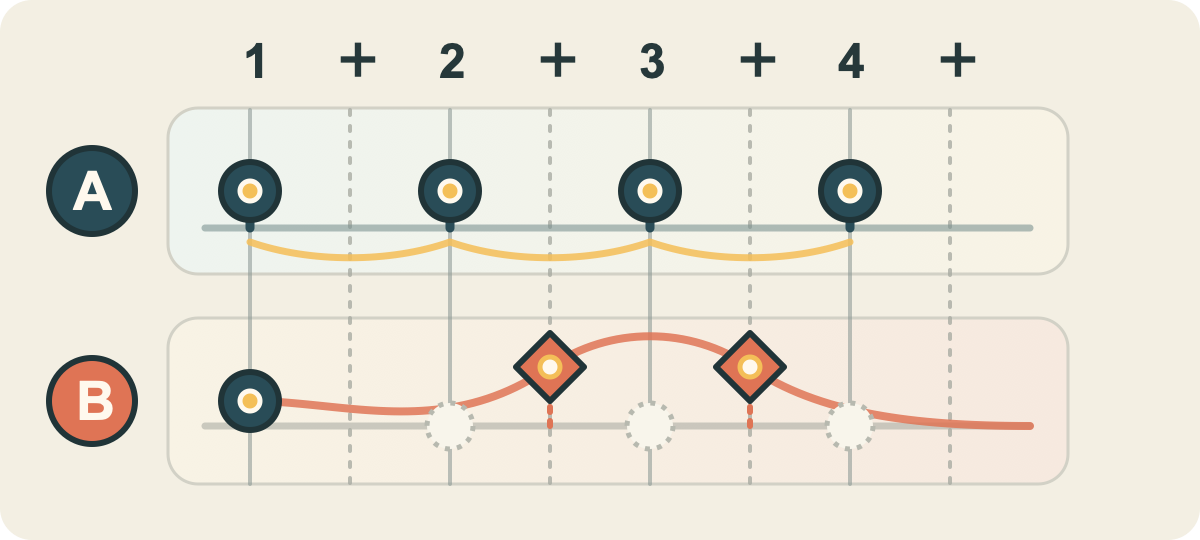
In 4/4 meter, a quarter note is one beat and a bar is counted “1, 2, 3, 4.” The four-on-the-floor pattern in diagram A places a kick on 1, 2, 3, and 4. Diagram B is an invented example for explaining breakbeats, with kicks on beat 1, the offbeat after beat 2, and the offbeat after beat 3.
A and B are both in 4/4 meter. In B, some kicks sound between the numbered beats. The diagram is a fictional pattern for practice. The guide to syncopation also explains how sounds can stand out between beats.
Connect the break across two records to keep it going
Some tracks contain a short passage where the vocals and melody recede and the drums or percussion come forward. A DJ can keep this brief rhythm going by alternating between two copies of the same record. This idea also leads to loops that repeat a recorded passage.
A resource from the U.S. National Archives describes a party held in the Bronx, New York, on August 11, 1973, and DJ Kool Herc's technique of focusing on breaks with two turntables. A resource from The Henry Ford also traces the practice of repeating and extending percussion breaks.
These records describe a practice within Bronx party culture in which a DJ connected rhythms for the people dancing.
Find beat one by following the repeating bar
In a rhythm without a kick on every beat, following only the low hits can make you lose the count of 1, 2, 3, 4. First keep an even pulse with your foot or finger and use the repeating drum pattern as a whole for guidance. Treat the point where the same pattern returns as a candidate for beat one, count four beats from there, and check whether it aligns with the next bar.
You may hear a kick as a short, low hit and a snare as a sharper hit. Bass is also low, but it may move in pitch and sustain for different lengths. Instead of treating every low sound as a kick, follow the start of each sound, how long it lasts, and where it repeats.
Keep the beat with your foot on the first listen, focus on the kick on the second, the snare on the third, and the bass on the fourth. Following one element at a time helps you sort out where the drums and low sounds move over the steady beat.
In drum and bass, listen to the moving drums and low bass
A breakbeat repeats a break or builds a new rhythm on that idea. In drum and bass, listen for the interplay between the drum pattern and the low bass.
Do not identify the genre from BPM alone. Check the published genre label together with the drum movement, bass, and overall structure. Even among tracks that use breakbeats, speed, timbre, and structure differ from one track to another.
References
Follow the light brushes in “Following the Bell Rope”
The track is 4 minutes 14 seconds long. The public catalog describes it as electronica with bell arpeggios and light brushed breakbeats. The track starts at 8:56 in the official video. On the first listen, focus on the drums rather than the bells and try counting the steady beat separately from the positions of the drum hits.
Separate the drums and arpeggio in “The Lens Begins to Turn”
The track is 4 minutes 30 seconds long. The public catalog describes it as electronica with a rotating arpeggio and a soft synth lead over a medium-tempo breakbeat. The track starts at 13:08 in the official video. Keep the beat steady while following the drums and the arpeggio separately.
Follow the beat and arpeggio in “First Updraft”
The track is 4 minutes 15 seconds long. The public catalog describes it as bright electronica with sparkling arpeggios and light breakbeats. The track starts at 4:03 in the official video. Follow only the drums first, then locate where the arpeggio begins over the same beat.
The three featured tracks are available as royalty-free background music
The three featured tracks can be downloaded for free and used in monetized videos, streams, and similar projects within the material usage guide. There is no fee for each use, and credit is optional. Redistributing or selling the audio by itself and using it for AI training are prohibited. Check the latest terms in the material usage guide before use.
References
First keep a steady count of 1, 2, 3, 4, then follow where the kicks fall over it. Compare four-on-the-floor with the fictional example in the diagram, then follow the kick, snare, and bass one at a time to separate the meter from the drum placement. Try the same order with the three featured tracks.
FAQ
- What are breakbeats?
They are beats made by repeating a short passage where drums or percussion come to the foreground, known as a break, as well as rhythms built on that idea. The kick does not have one fixed placement.
- How do breakbeats differ from four-on-the-floor?
Four-on-the-floor places a kick on beats 1, 2, 3, and 4 of each bar. Breakbeats may also place kicks between the numbered beats. The comparison diagram shows one example, not a pattern shared by every breakbeat.
- Are breakbeats and drum and bass the same thing?
No. Breakbeats are beats or rhythms based on repeating breaks. Drum and bass is a genre in which finely moving drums and low bass provide useful listening clues. Check the genre label and the track's structure rather than relying on BPM alone.
- Can I use the three featured tracks in monetized videos?
Yes. You can use them in monetized videos and streams within the material usage guide, and credit is optional. Redistributing or selling the audio by itself and using it for AI training are prohibited. Check the latest terms before use.