What Is Drum and Bass? Its History, Jungle, and How to Listen
Drum and bass is electronic dance music built around intricate drums and low, resonant bass. Even when one drum hit follows another, you can find the rhythm by keeping a broad pulse with your foot and listening for the sounds that fall between those beats.
The genre took shape in the United Kingdom in the early 1990s as it overlapped with jungle. Listen to Goldie’s “Inner City Life” and Roni Size / Reprazent’s “Brown Paper Bag” while following the main pulse, drums, and bass in that order.
Count four main beats, then listen to the drums between them
Start by keeping an even pulse with your foot or finger and count “1, 2, 3, 4” in broad beats. Keep counting at the same rate, then look for short drum sounds that land on or between those beats. Several hits can occur within the time you count one beat, so you can follow the steady pulse separately from the detail you hear.
Next, listen for where the low sounds begin and how long they last. A kick can also be a short low sound. Following not only the start of a low sound but also its sustain and movement in pitch makes a bass phrase easier to find.
See one bar as three layers of pulse, drums, and bass
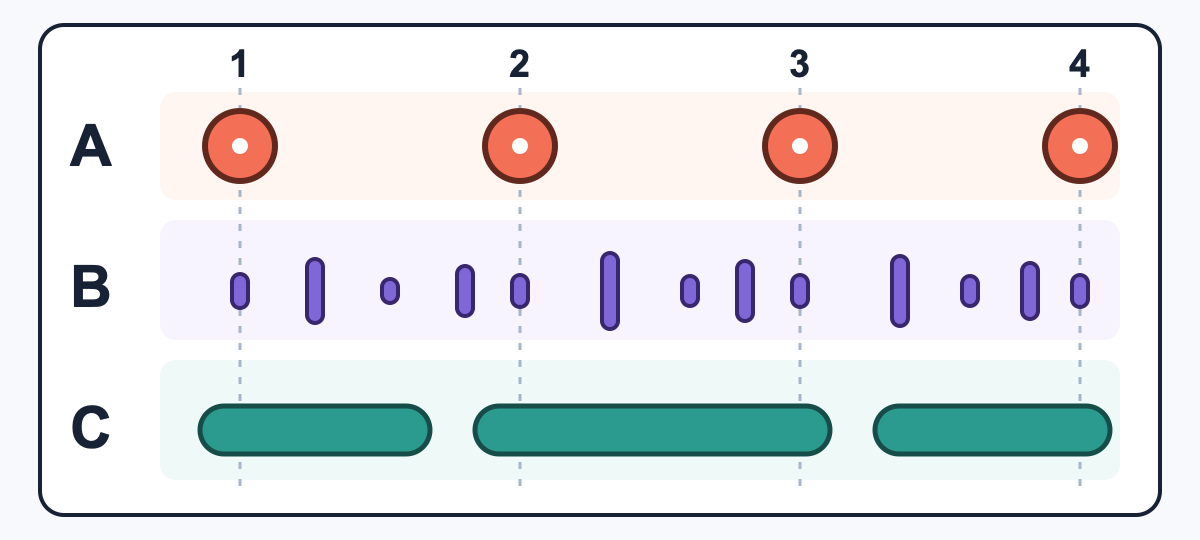
A in the diagram shows the four broad beats you count with your foot. The short marks in B are drum sounds on and between the beats, while the horizontal bars in C are low sounds of different lengths. The vertical dotted lines help you compare which sounds occur at the same point on the shared timeline.
First, count at a steady rate with A. Next, keep your foot moving at that rate while your eyes follow the short marks in B. Finally, trace C and notice where a low sound extends across the next beat.
London in the early 1990s and jungle
Jungle and drum and bass took shape as overlapping movements in London in the early 1990s. A technique of cutting short sections of drums, arranging them into intricate patterns, and playing them faster became widespread. Some recordings layered those drums with deep bass sounds inherited from reggae and dub.
Jungle is a name tied to the British rave and sound-system culture of that period. Drum and bass is also used more broadly for music that puts detailed drums and bass at the front. Some recordings are described by both names, so use their date and the classification given by the artist or label alongside their speed.
Move your attention from the vocal to the drums in Goldie’s “Inner City Life”
The official link is the single version of “Inner City Life” that credits Diane Charlemagne’s vocal performance. Start by keeping the beat with your foot while listening to the vocal, then shift your attention to the short drum sounds underneath it.
This release carries a 1994 phonographic rights notice, while London Records presents Goldie’s debut album “Timeless” as a 1995 work. Keeping the year of the track separate from the year of the album helps you follow the chronology when the same title leads you to a different version.
Separate the drums from the bass in “Brown Paper Bag”
Working with fellow musicians in Bristol, Roni Size / Reprazent released “New Forms” in 1997 and won the Mercury Prize that year. “Brown Paper Bag” is one of the tracks on the album.
Roni Size has said that he recorded bass played by Si John and guitar played by Steve Graham, then assembled the material with a sampler. Open the official recording and listen first to the short drum sounds, then to the pitch and sustain of the bass. Separating the performances helps you follow how the low sound overlaps with the drums.
Continue listening to breakbeats with “The Lens Begins to Turn”
Our track “The Lens Begins to Turn” is electronica that layers a turning arpeggio and a soft synth over a mid-tempo breakbeat. In the four minutes and thirty seconds beginning at 13:08 in the official video, follow the short drum sounds first and then the repeating arpeggio above them.
This track is free to download and is offered royalty-free. Commercial use is allowed within the usage guide, and credit is optional. Standalone redistribution or sale of the audio and its use for AI training are prohibited. Check the track page and the latest usage guide before using it.
Choose either “Inner City Life” or “Brown Paper Bag” and follow the broad pulse, short drum sounds, and bass in that order. If you are unsure where to start counting, use the breakbeat diagram to find the first beat.
FAQ
- What kind of music is drum and bass?
It is electronic dance music that combines intricate drums with low, resonant bass. Keeping the broad pulse while following the short hits and longer low sounds in order makes the layers easier to separate.
- What is the difference between drum and bass and jungle?
Jungle is a name tied to British rave and sound-system culture in the early 1990s. Drum and bass refers more broadly to music built around intricate drums and bass. Some recordings are described by both names depending on the period and source.
- What should I follow first when listening to drum and bass?
First, keep four broad beats with your foot or finger. Then move your attention to the detailed drum sounds, including those between the beats, and finally to the start and length of the low sounds.
- Can I use “The Lens Begins to Turn” in video production?
“The Lens Begins to Turn” is a royalty-free track from our site that is available as a free download. Commercial use is allowed within the usage guide, and credit is optional. Check the conditions before using it in a project.