What Is EDM? History, House and Techno
EDM stands for Electronic Dance Music. In a broad sense, it is an umbrella term for electronic dance music that includes genres such as house and techno. In the United States during the 2010s, the term also became widely used for pop-leaning dance music.
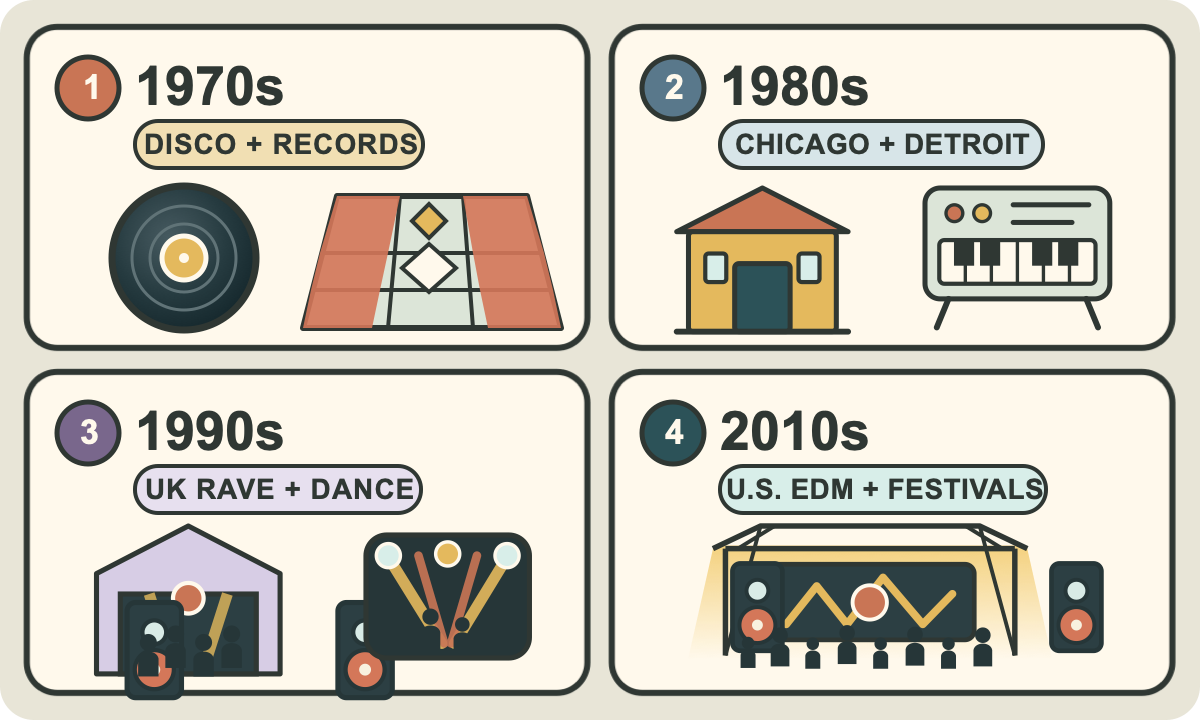
To understand what EDM means, the context in which the term appears provides an important clue. This article traces its history from clubs to festivals in a diagram, then compares three tracks with elements of house, techno, and future bass.
EDM can be an umbrella term or refer to pop-leaning dance music
The research volume “The Cambridge Companion to Electronic Dance Music” uses EDM as a broad label for multiple genres, including house, techno, trance, and drum and bass. In research volumes and explanatory articles, the genres listed in the contents and body reveal what that source includes under EDM.
The same volume notes that, since the early 2010s, EDM has also been used in the United States for pop-leaning dance music. When EDM appears in a festival lineup or pop-music news, look at which tracks or artists the term describes.
Four scenes: disco, clubs, raves, and U.S. festivals
In 1970s disco, spaces developed where DJs blended records and people enjoyed dancing to the music. In 1980s Chicago, house spread through clubs, while in Detroit, techno was produced with electronic instruments and distributed on record.
During the 1990s, dance-music cultures expanded in many places, including UK raves. Around the same time, house was sometimes used as a broad label in the Netherlands, while techno could refer to a wide range of music in Germany. The bottom-right scene in the diagram is an example of the context in which large festivals became prominent in the United States during the 2010s.
Clues for listening to house and techno
When listening to house, which developed in Chicago's clubs, notice how the bass, vocals, and keyboards move over a four-on-the-floor beat. When listening to Detroit techno, follow where hi-hats and synths enter and leave over the repeating beat.
Both genres include tracks that use four-on-the-floor rhythms and electronic instruments. Listening to the rhythm, the way sounds are layered, and the track's overall progression together makes it easier to hear how tracks can differ even when they share the same beat.
How to read the program from Ultra Miami 2016
Ultra Miami's official 2016 announcement presents the main stage alongside A State of Trance, which focuses on trance, and RESISTANCE, which brings together house and techno artists. Reading both the festival overview and the descriptions of its individual stages reveals the range of music available at the event.
To find music you want to hear, look at stage and artist names as well as the festival name. Once you find a performance you like, you can move on to that artist's tracks or to artists who performed on the same stage.
What to check in explainers, track profiles, and music download pages
In an explainer, check when and where it was written and which genres it gives as examples. If you are interested in electronic instruments or the processing of recorded sound itself, follow how electronic music is made to understand how tracks are produced.
If you are looking for a track, think about the sound you want to hear as well as the genre name. For example, if you are interested in spacious drums layered with synth chords, listen for half-time in the future bass article.
When looking for music to use in videos or livestreams, check the track page to see whether you can save it, use it commercially, and whether credit is required.
Hear the beat and layers in three tracks
“The Man with the Machine Gun - Disco House Rework” is a 2-minute-33-second unofficial fan arrangement that starts at 3:38 on the official YouTube channel. Count the four-on-the-floor beat and listen to how the repeating bass overlaps with the kick. This track is available for streaming only and cannot be downloaded or used commercially.
“Last Battle -T260G- - Techno Metal Rock ver.” is a 3-minute-17-second unofficial fan arrangement that starts at 6:58 on the official YouTube channel. Find the programmed beat first, then listen for where the distorted guitar is layered over it. This track is available for streaming only and cannot be downloaded or used commercially.
The original BGM track “Donut Ferris Wheel” is 4 minutes 30 seconds long and starts at 8:51 on the official YouTube channel. Listen in turn to the half-time drums, short plucks, and chords. This royalty-free BGM is free to download and may be used commercially under the current usage guide, with no credit required. Redistributing or selling the audio file on its own and using it for AI training are not permitted.
References
Open the three tracks in order and count the beat first, then shift your attention to the bass, guitar, and synth. When a sound catches your interest, explore the house, techno, or future bass explainer to learn more about how it is made and the background of the music.
FAQ
- What does EDM stand for, and what kind of music is it?
EDM stands for Electronic Dance Music. Some sources use it as a broad umbrella term for multiple electronic dance genres, while others use it in the narrower sense associated with U.S. festivals and the pop market in the 2010s.
- What is the difference between EDM, house, and techno?
House and techno are genre names with their own histories. Some sources include them under EDM in its broad sense, while others list them separately from EDM in its narrower sense. Check the period, region, and what the source groups together.
- Can BPM or a drop alone tell me whether a track is EDM?
No. BPM, four-on-the-floor rhythms, and drops appear in multiple genres. Consider the source's time and place together with the track's description, rhythm, and layers of sound.
- Can I download or use the three featured tracks commercially?
The two unofficial fan arrangements are available for streaming only and cannot be downloaded or used commercially. The original BGM track “Donut Ferris Wheel” is free to download and may be used commercially under the current guide, with no credit required. Redistributing or selling the audio file on its own and using it for AI training are prohibited. Check each track page and the latest usage guide before use.