What Is Disco Music? History, Bands, and Synths
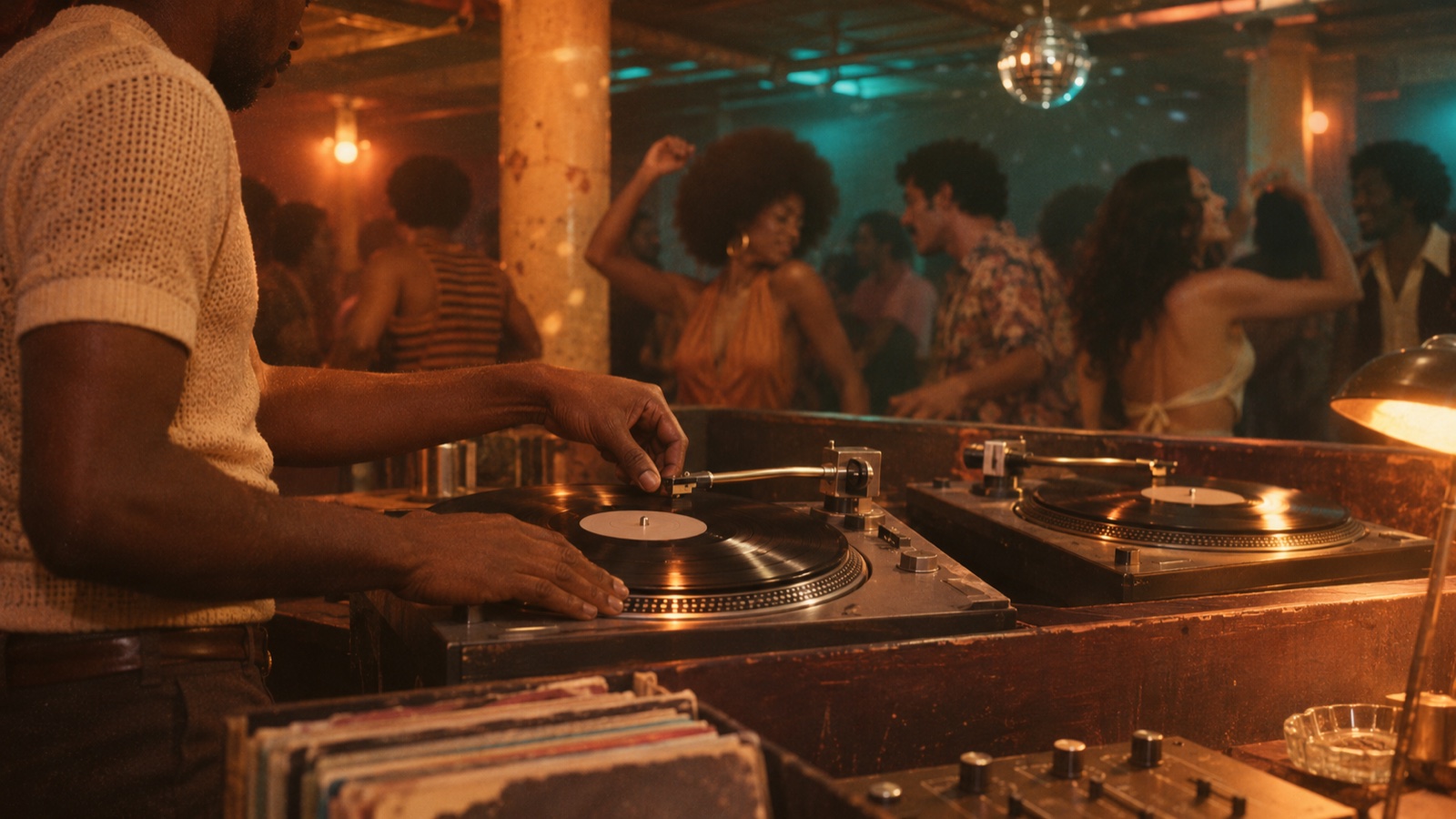
Disco is dance music that grew out of places where DJs selected and mixed records while people danced. In early 1970s New York, clubs and parties attended by Black, Latino, and gay people sustained this culture.
Chic's "Good Times" and Donna Summer's "I Feel Love" layer different sounds over a beat made for dancing. As we follow disco's history, listen closely to the contrast between band instruments and synthesizers.
How DJs mix records for the dance floor
The word "disco" is short for the French discothèque, a place where people dance to recorded music. The term can refer both to the venue and to the music that developed there.
A DJ selects tracks while watching the dance floor. For example, while one record is playing, the DJ can prepare another and layer in the next track so that the beats line up. Dancers can then enjoy the change of track without leaving the flow.
From New York clubs to films and records
In early 1970s New York, DJs played soul, funk, Latin music, and other records at clubs and parties attended by Black, Latino, and gay people. An exhibition by the Philharmonie de Paris explains how these spaces supported minority communities and expression, as well as the influence of Black American music on disco.
By the mid-1970s, extended edits designed to keep people dancing and 12-inch records had also spread. When a track has both a short and a long version, listen to the instrumental passages before and after the vocals to hear how the time available for dancing was expanded.
The film Saturday Night Fever, released in the United States in 1977, and its soundtrack brought disco to a broad audience. The DJ selections and dance culture that had developed in clubs before the film are also an important part of this history.
Use the kick as a guide, then hear the instruments layered above it
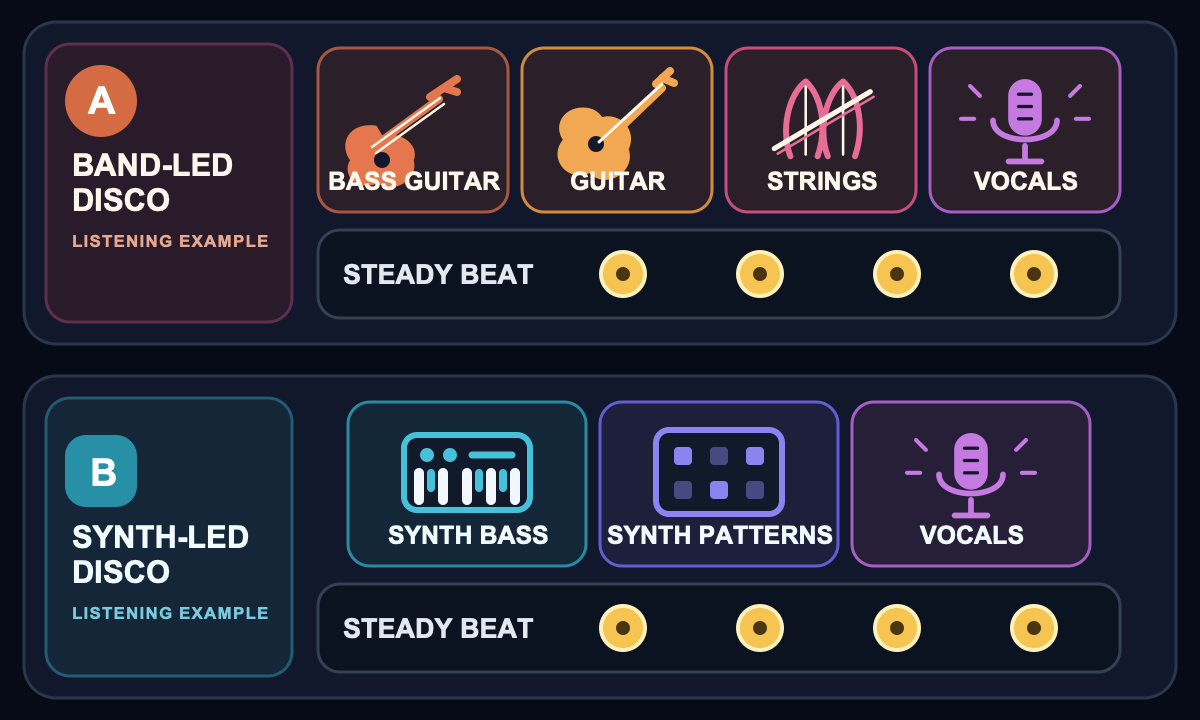
First, count the beat by following the low thump of the kick drum. In a four-on-the-floor pattern, where the kick sounds on all four beats of a bar, you can use that thump as a guide while tracing how the bass moves between the beats.
A in the diagram is a band-led example. Move your attention from the bass line to the guitar's short rhythmic figures and then to the sustained strings. B is a synth-led example. Follow the repeating low electronic sound, then hear how the voice and other electronic sounds layer above it. A and B are two examples of sounds being layered over a beat that supports dancing in a similar way.
Compare Chic's bass with Donna Summer's synths
On Chic's "Good Times" (1979), first follow Bernard Edwards's bass, then compare it with Nile Rodgers's short guitar figures. Once you can distinguish the two, shift your attention to the sustained strings and vocals above them. Carnegie Hall cites the track as an example of disco built on funk.
On Donna Summer's "I Feel Love" (1977), use the repeating low synth sound as a guide and listen to how long the vocal lines continue. The Library of Congress describes it as a synth-centered recording created by Donna Summer, Giorgio Moroder, and Pete Bellotte.
Connections with funk and house
In funk, one listening focus is how the rhythms played by the bass, guitar, and other instruments interlock. Tracks such as "Good Times" combine those performance traits with the steady beat that supports dancing in disco.
Later, in Chicago house, club DJs mixed disco, soul, and other records and carried forward that flow for dancing. Listen for voices and low sounds entering and leaving over a repeating beat to trace the connection with later dance music.
Hear a contemporary disco-house arrangement on our official YouTube channel
Arcalune's "The Man with the Machine Gun - Disco House Rework" runs from 3:38 to 6:11 in the six-track medley on the official YouTube channel, for a total of 2 minutes 33 seconds. The public catalog describes it as an arrangement that retains the original track's driving bass and places it over a four-on-the-floor beat.
In this contemporary arrangement, start by following the kick, then shift your attention to the length and movement of the bass notes. Because it is an unofficial fan arrangement, it is for listening only. It cannot be downloaded or used commercially.
Follow the bass and guitar figures in "Good Times" and the low synth and voice in "I Feel Love" to hear different ways sounds can be layered within disco. When you next hear a disco-house arrangement, use the same approach to check the relationship between the bass and kick.
FAQ
- What is disco music?
It is dance music that grew out of places where DJs selected and mixed records while people danced. In early 1970s New York clubs, it was influenced by soul, funk, Latin music, and other styles.
- What is the difference between disco and funk?
In funk, listen for the interlocking rhythms played by the bass, guitar, and other instruments. In disco, you can focus on the steady beat that supports dancing and the sounds layered above it. Tracks such as Chic's "Good Times" let you hear traits of both.
- How are disco and house connected?
At the clubs where Chicago house developed, DJs mixed disco and soul records. Four-on-the-floor beats and the practice of mixing tracks to maintain the flow of dancing offer clues to the relationship between the two forms of music.
- Can I use the featured tracks as background music in a video?
"Good Times" and "I Feel Love" are references to recordings supplied to YouTube by their labels; Arcalune does not distribute them. "The Man with the Machine Gun - Disco House Rework" is a listening-only fan arrangement and cannot be downloaded or used commercially.