
What Is an Accordion? How the Bellows and Reeds Work
An accordion makes sound by moving air with its bellows and setting metal free reeds into vibration. Pressing a key or button opens a valve; pushing or pulling the bellows then moves air through that open passage.
Piano-style keys and buttons are two different ways to select notes with the fingers. Whether the pitch changes between a push and a pull depends on how the reeds are tuned. After looking at a diagram of the sound mechanism and photographs of 19th-century instruments, compare accordion melodies in a waltz, a swing track, and a piece in 6/8.
The keys open valves, while the bellows move air
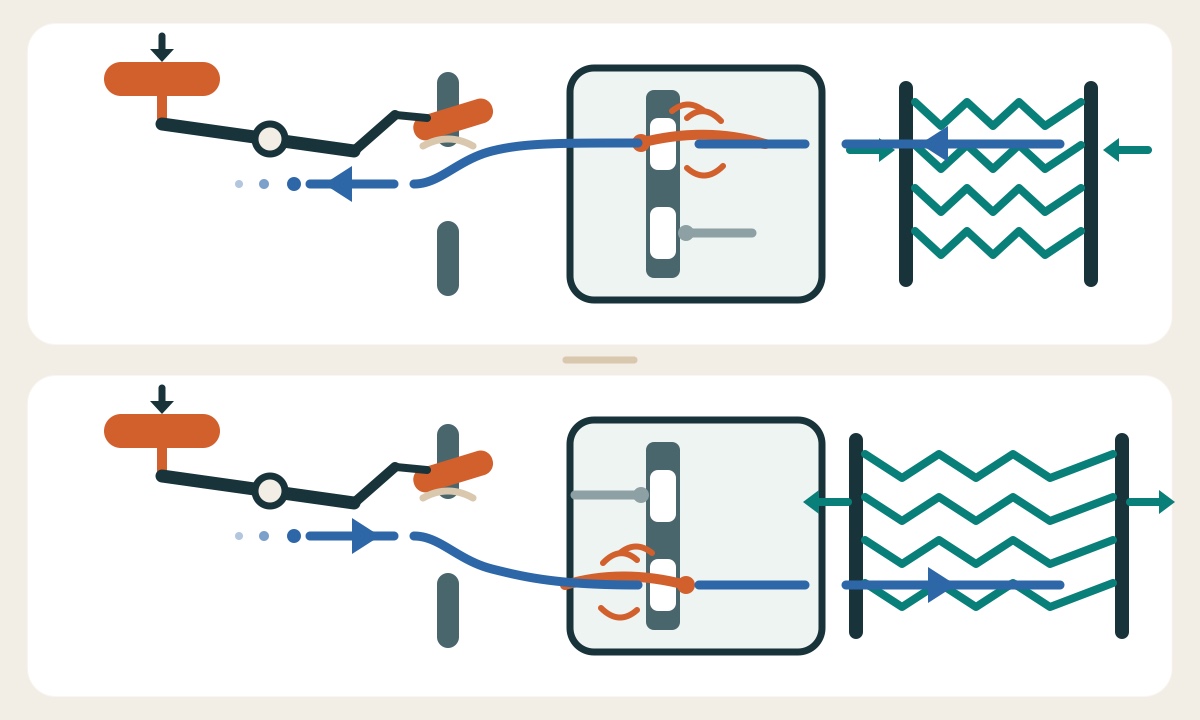
Pressing a key or button moves a lever, opens a valve, and creates an air passage for the selected note. Compressing the bellows pushes air out; expanding them draws air in. When air moves through an open passage, the corresponding reed vibrates and produces a note.
A free reed is a thin metal tongue that vibrates along a narrow slot in a metal reed plate. In a common accordion arrangement, reversing the airflow activates the oppositely mounted reed in a pair. The player can also vary air pressure with the bellows to control the volume.
Hold the same key and reverse the bellows
In a unisonoric system, the reed that sounds on the push and the reed that sounds on the pull are tuned to the same pitch. In a bisonoric system, the two reeds are tuned to different pitches. In both systems, the airflow reverses between pushing and pulling.
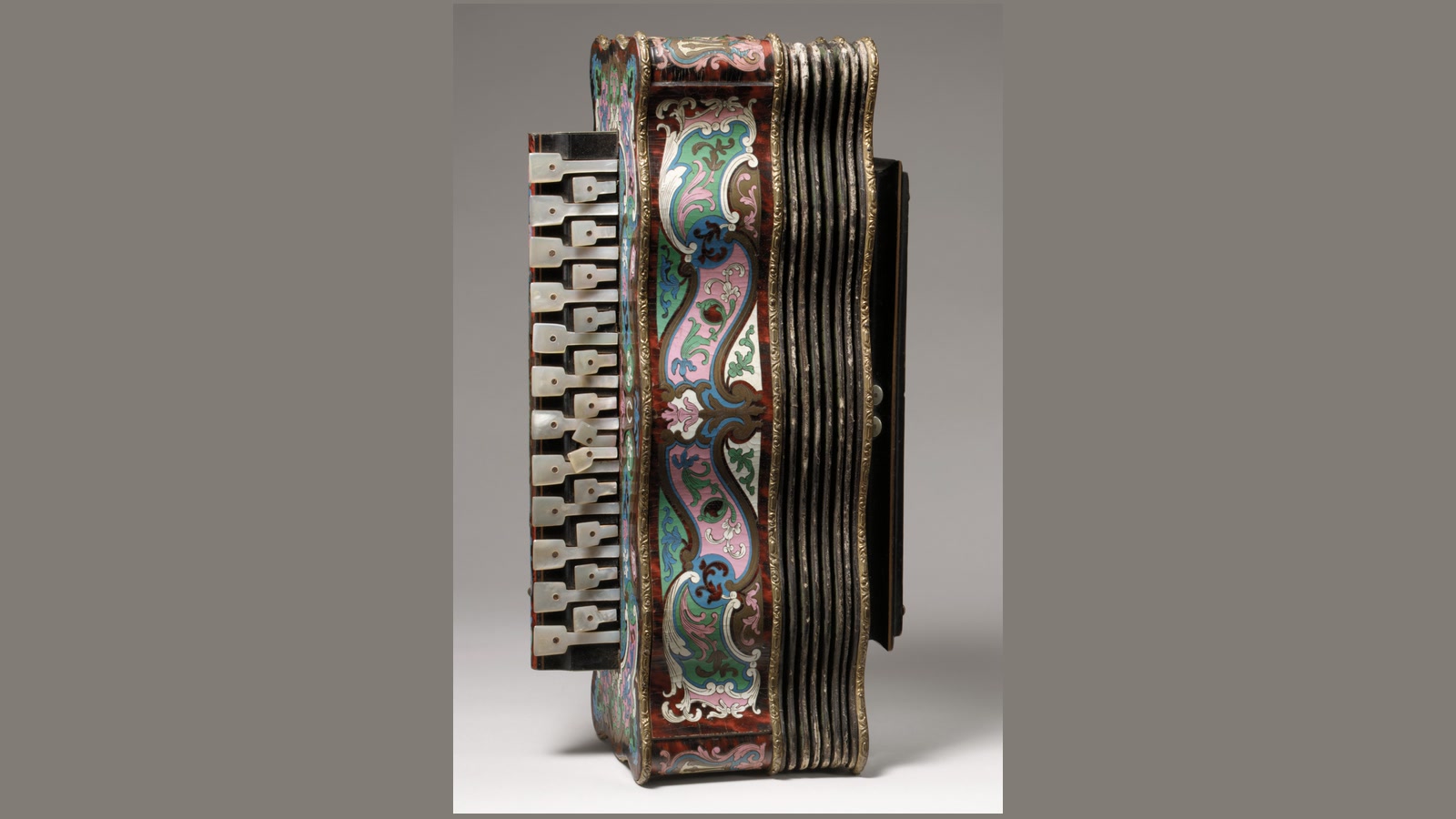
The right-hand side may have piano-style white and black keys or rows of buttons. The shape of the controls and the push-pull pitch relationship must be considered separately. The accordion in the opening photograph was made in Paris around 1850–55. According to the museum record, each of its 24 keys produces a different note on the push and the pull.
| Push the bellows | Pull the bellows | |
|---|---|---|
| Unisonoric | C | C |
| Bisonoric | C | D |
From the 1829 application to Japan's tefūkin
On May 6, 1829, Cyrill Demian and his sons Karl and Guido submitted a description and drawings in Vienna for an instrument they called the “Accordion.” The application documents survive in the TU Wien archive.
According to Berlin's Musical Instrument Museum, mass production began in the mid-19th century. Parts were made separately, assembled in workshops, and sold by dealers, helping this portable instrument spread to concerts, dances, and festivals in many places.
In Japan, the accordion was also known as tefūkin, an old Japanese name meaning roughly “hand-operated wind organ.” The Hamamatsu Museum of Musical Instruments holds a button accordion made in Japan around 1930.
See the bellows and keys on an 1875 flutina
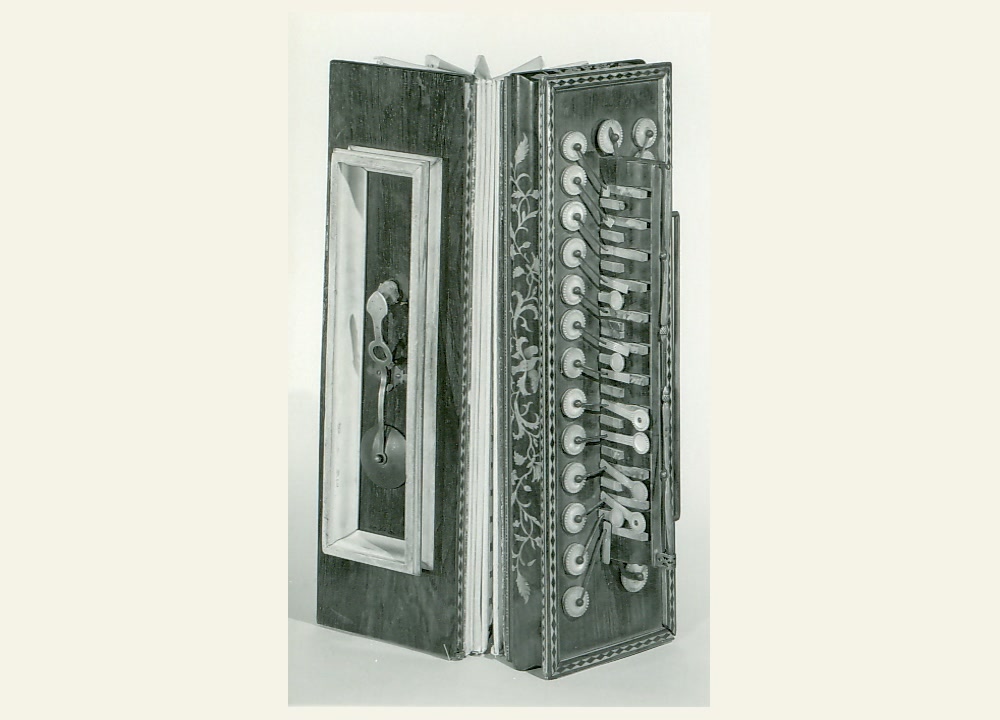
The photograph below shows a flutina made by Frank Colbrun in 1875, possibly in Belgium. Its narrow folded center is the bellows, with a wooden body on each side. Comparing its keys and their arrangement with the opening photograph reveals that 19th-century instruments also varied in form.
Listen to 20 seconds each of waltz, swing, and 6/8
On the official YouTube videos, listen for 20 seconds from the start of each track and compare the melody with the grouping of the beats. The descriptions on our site identify an accordion melody in all three tracks.
For the waltz, start at 39:41. Count “1-2-3” repeatedly and follow where the melodic phrases meet the beats.
For the swing track, start at 31:25. Keep a steady beat and listen for places where shorter notes alternate in a long-short pattern within it.
For the piece in 6/8, start at 24:05. Count “1-2-3, 4-5-6” and compare its two groups of three subdivisions with the waltz.
Save the three tracks and use them in your work
All three tracks are free to save and royalty-free. Within the usage terms, you may use them commercially in videos, streams, and games, and credit is optional.
Redistributing or selling the audio on its own and using it for AI training are prohibited. Check each track page and the usage guide before use.
To identify an instrument, first look at the right-hand controls. Then hold the same key or button and check whether the pitch changes when the bellows reverse direction. In the music examples, count the beats as you follow the beginning and end of each melodic phrase.
FAQ
- How does an accordion produce sound?
A key or button opens a valve while the player pushes or pulls the bellows. Air moving through the open passage makes a metal free reed vibrate and produce a note.
- Do piano-key and button accordions also produce different notes on the push and pull?
Piano-style keys and buttons are two shapes of control used to select notes. Whether the pitch stays the same or changes between a push and a pull depends on how the reeds are tuned.
- What do unisonoric and bisonoric mean?
When the same key or button is held, a unisonoric instrument produces the same pitch on the push and pull, while a bisonoric instrument changes pitch between the two directions.
- Can I use the three featured tracks in videos or games?
All three are free to save and may be used in commercial videos, streams, and games within the usage terms. Credit is optional. Redistributing or selling the audio on its own and using it for AI training are prohibited.