
Japanese Instruments | Koto, Shamisen, Shakuhachi and Taiko
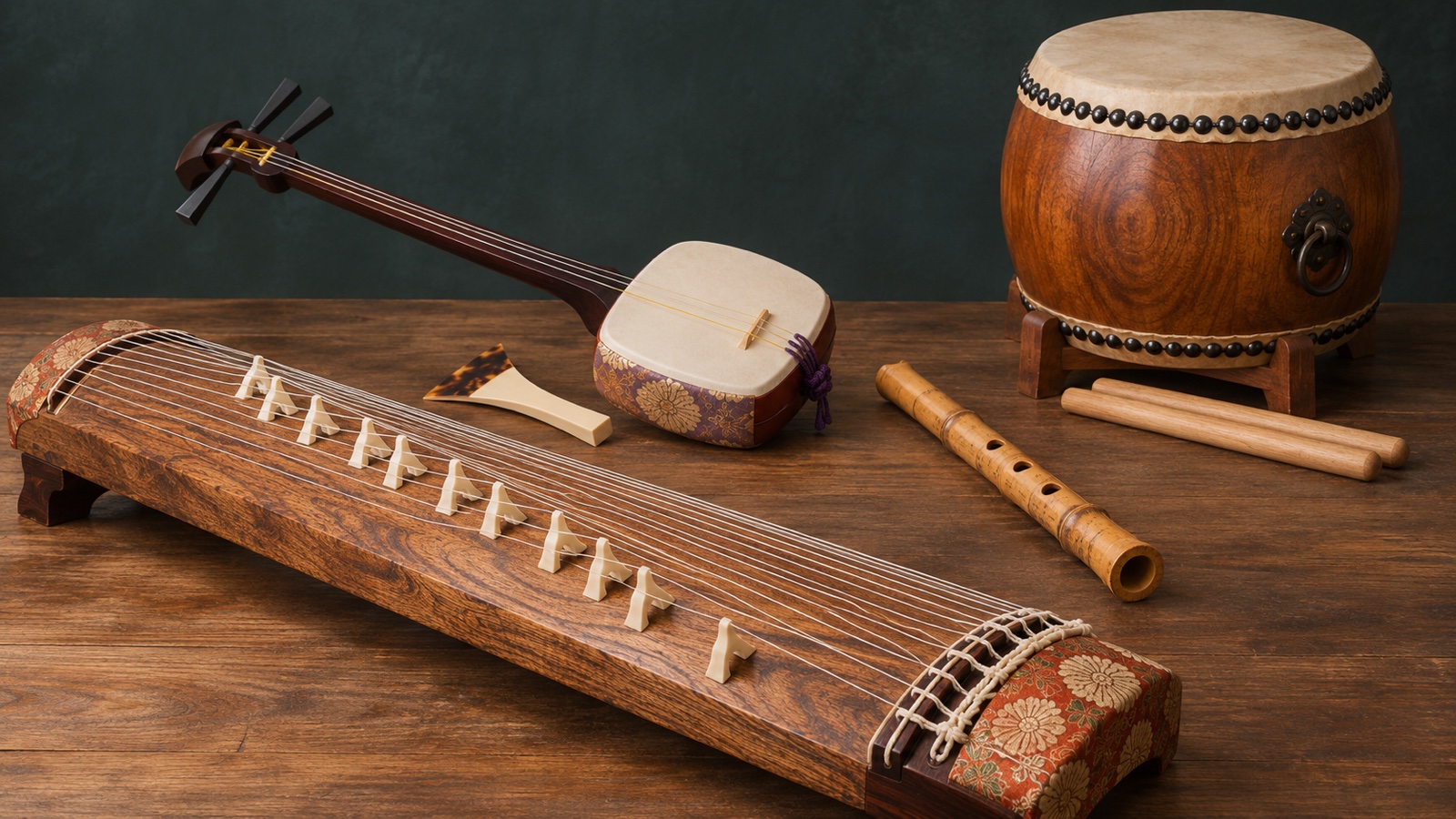
Japanese instruments include strings such as the koto and shamisen, winds such as the shakuhachi and shinobue, and percussion such as taiko, tsuzumi and small metal gongs. Compare four examples by how they make sound and what they play alongside.
String, wind and percussion instruments differ in where their sound begins
The koto is played by plucking strings stretched over a long horizontal body with finger picks. The shamisen has three strings plucked with a bachi plectrum, and its skin-covered body resonates. Both are string instruments, but they use different string supports and playing tools.
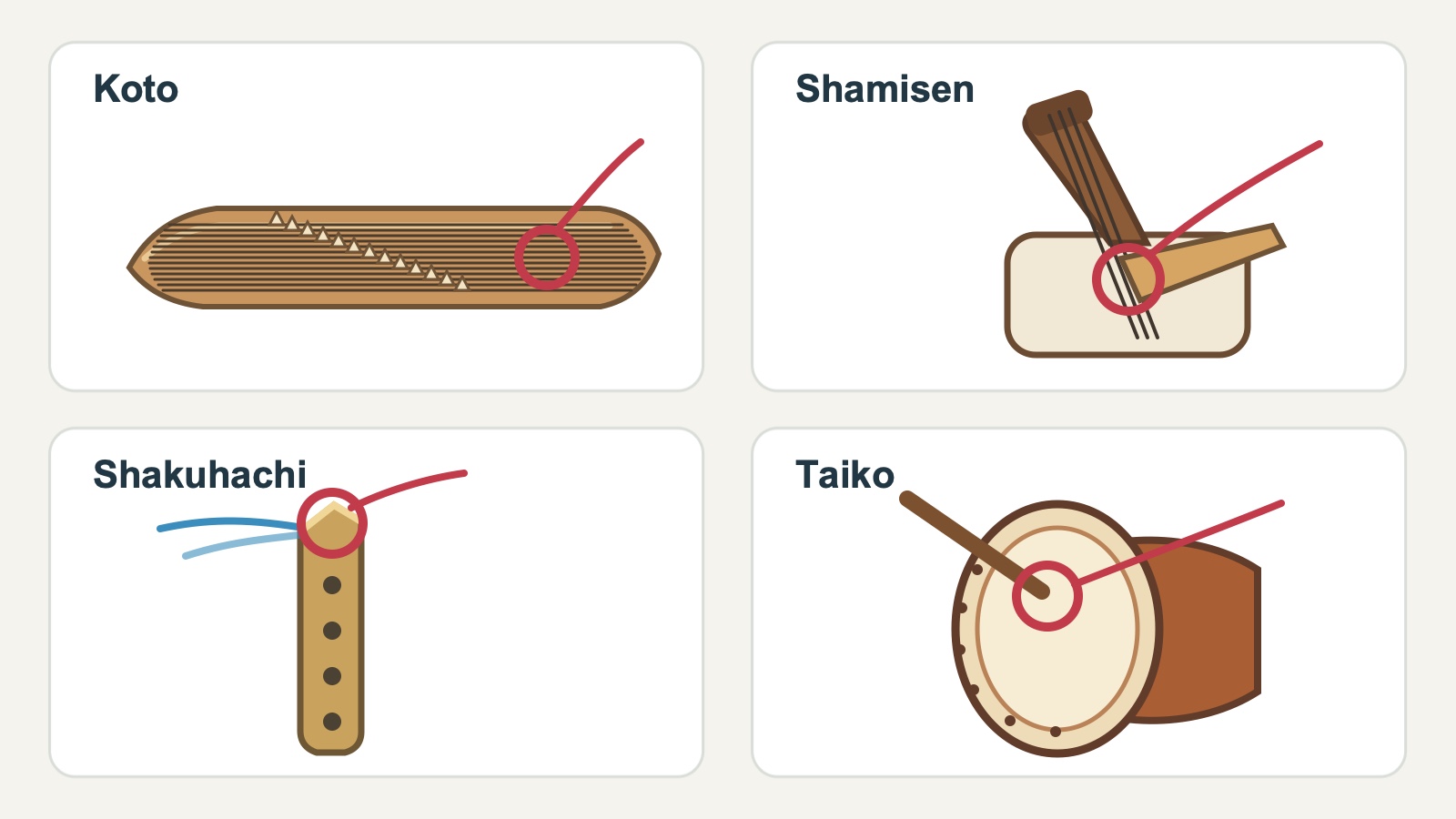
The shakuhachi is held vertically. Blowing across the edge of the utaguchi at the top makes the air inside the tube vibrate. On a taiko, striking the stretched membrane with sticks makes it vibrate. Follow the red marks in the diagram to compare where the sound begins: the strings, the utaguchi or the membrane.
Koto bridges and the shamisen neck
A movable bridge called a kotoji is placed under each koto string and shifted along it to tune the instrument. Moving a bridge toward the plucking side marked in red in the diagram shortens the vibrating part of the string and raises its pitch. Moving it the other way lengthens the string and lowers its pitch. The thirteen-string koto is the standard form, while the seventeen-string koto covers a lower register.
The shamisen's three strings are tuned with pegs. During performance, the player changes the pitch by stopping each string at different points along the neck. Some techniques bring the bachi into contact with the skin, while the distinctive sawari resonance comes from a string lightly touching the neck. The shamisen is used in kabuki, puppet theatre, song accompaniment and folk music, and the shapes of its neck and bachi vary with the music performed.
The shakuhachi’s blowing edge and the skins of Japanese drums
A typical shakuhachi has a slanted utaguchi at one end, with four finger holes on the front and one on the back. Changing the angle at which the breath meets the edge of the utaguchi, or changing how the holes are covered, alters the pitch and resonance.
Taiko bodies and membranes come in several forms. Some skins are tensioned with ropes, some are fixed to the body with studs, and others are mounted on a body assembled from wooden staves. The kotsuzumi also has struck membranes, but it is held at the shoulder and played with the right hand while the left hand adjusts the tension of the cords joining its skins.
Compare the instruments in sankyoku, Noh hayashi and festival hayashi
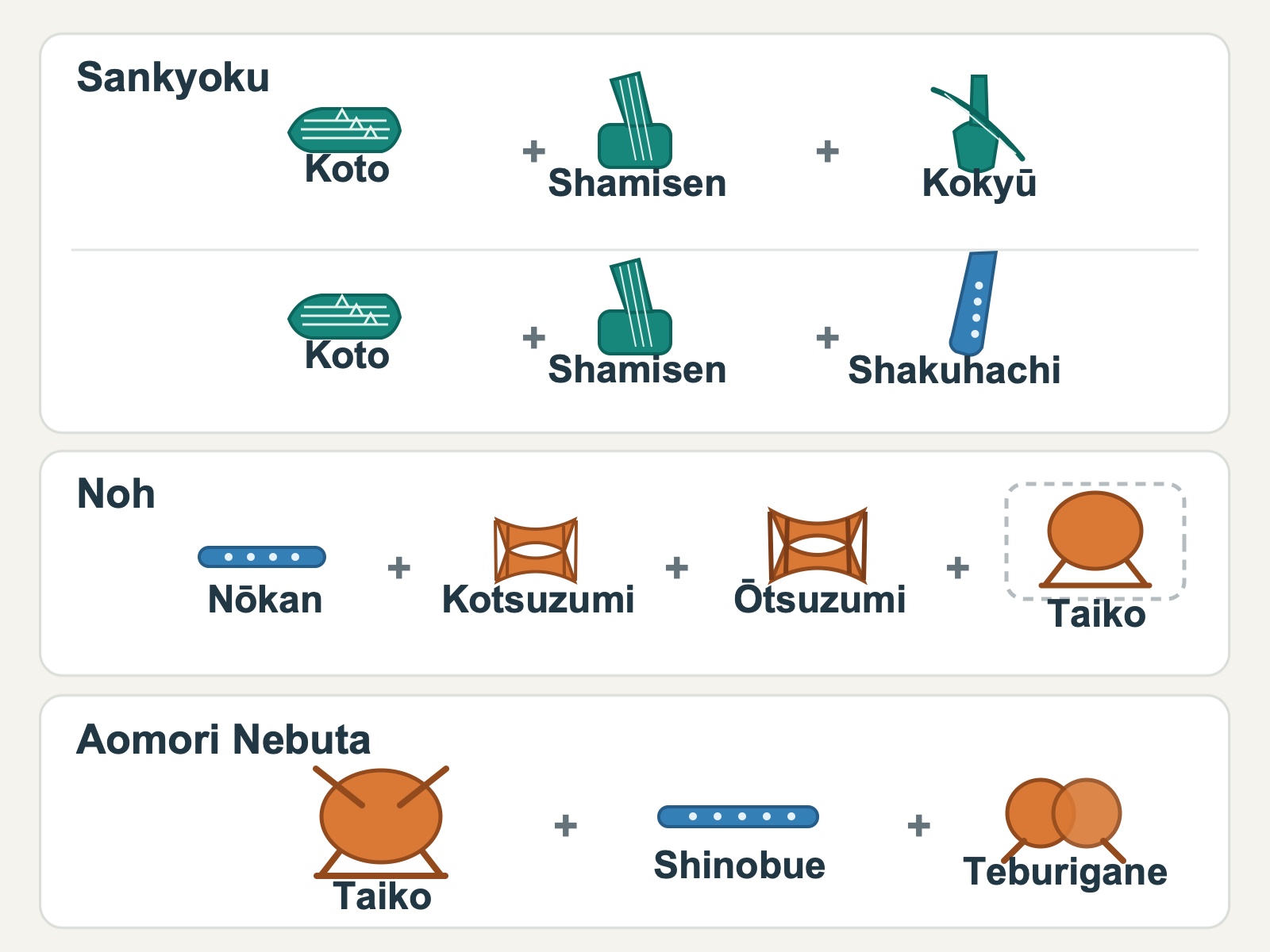
A sankyoku ensemble combines koto and jiuta shamisen with either shakuhachi or kokyū. The kokyū is a bowed string instrument. Ensembles with kokyū were common during the Edo period, while performances with shakuhachi became widespread from the Meiji period onward.
Noh hayashi uses nohkan, kotsuzumi, otsuzumi and taiko. The dashed outline in the diagram marks the taiko, which is included only in certain plays. Pieces with taiko are called taiko-mono, while those without it are called daishō-mono. The kotsuzumi and otsuzumi are played by hand; the Noh taiko is set on a stand and struck with sticks.
In Aomori Nebuta festival hayashi, the taiko provides the rhythm, the shinobue carries the melody, and the teburigane adds a high metallic sound. Festival hayashi instrumentation varies by region and event.
Hear a single koto note, a shamisen response, and taiko with shakuhachi in three tracks
Here are three tracks whose Arcalune Music catalog descriptions mention these instrumental combinations. The description of “Footsteps in the Morning Fog” (4:29) says that a low seventeen-string koto moves forward one note at a time. Listen from 0:00 on the official YouTube video.
The description of “Soda Water at the Café” (4:30) says that the shamisen answers the clarinet. It begins at 21:44 on the official YouTube video. The description of “Rope Bridge” (4:15) says that the shakuhachi is layered over a quiet, heartbeat-like taiko. It begins at 31:03.
These three tracks are royalty-free materials offered as free downloads under the usage guide. They may be used in commercial videos and similar projects within the stated terms, and credit is optional. Selling or redistributing the audio by itself and using it for AI training are prohibited.
References
Look at an instrument's shape, the part that first vibrates, and the instruments paired with it in an ensemble to identify the differences among these four examples.
FAQ
- What types of Japanese instruments are there?
Representative examples include string instruments such as the koto and shamisen, wind instruments such as the shakuhachi and shinobue, and percussion instruments such as taiko, tsuzumi and kane.
- How can you tell a koto from a shamisen?
The koto has a long horizontal body and a bridge under each string. The shamisen has a long neck, a skin-covered body and three strings.
- Where do you blow into a shakuhachi?
Blow across the edge of the utaguchi at the top of the tube to make the air inside vibrate.
- How are taiko and kotsuzumi different?
Both have struck membranes. In Noh, for example, the taiko is set on a stand and struck with sticks, while the kotsuzumi is held at the shoulder and played by hand as its cord tension is adjusted.
- What is an ensemble of koto, shamisen and shakuhachi called?
It is a representative sankyoku ensemble. Another form combines koto and jiuta shamisen with kokyū instead of shakuhachi.