
Music Symbols and Their Meanings | Dynamics, Tempo, Articulation, and Repeats
Notes show pitch and duration. The symbols around them tell you how loudly or quickly to play, how to connect notes, and where to go back. Start by looking at the note or bar beside a symbol, then find the symbol in the table. Below it, two versions of the same two bars let you try changes in dynamics and tempo separately.
Common music symbols at a glance
If you see p or f below the staff, look for a change in dynamics. A note and a number above the staff tell you the tempo. A dot above or below a note affects how you play that note. Two dots beside a barline can tell you where to repeat.
| Symbol | Name | What to do |
|---|---|---|
| p / mf / f | Piano, mezzo forte, forte | Play softly, moderately loudly, or loudly. Judge the level against the surrounding music. |
| cresc. or a hairpin that opens to the right | Crescendo | Get louder gradually over the marked passage. |
| dim. or a hairpin that closes to the right | Diminuendo | Get softer gradually over the marked passage. |
| ♩ = 80 | Metronome mark | Count 80 quarter notes per minute. |
| rit. / a tempo | Ritardando, a tempo | Slow down gradually. At a tempo, go back to the pace before the change. |
| Curve joining two notes of the same pitch | Tie | Play the first note once and hold for the sum of both durations. |
| Curve over a group of notes | Slur | Connect the notes in the group smoothly. |
| Dot above or below a note | Staccato | Make the note short and detached. |
| Dot to the right of a note | Augmentation dot | Add half the note’s original duration. |
| Two dots next to a barline | Repeat sign | At the end repeat sign, go back to the matching start repeat. |
| D.C. / D.S. | Da capo, dal segno | D.C. sends you to the beginning. D.S. sends you to the segno sign. |
| Fine | Fine (FEE-neh) | After going back as directed by al Fine, stop at Fine. |
Compare dynamics and tempo in the same two bars
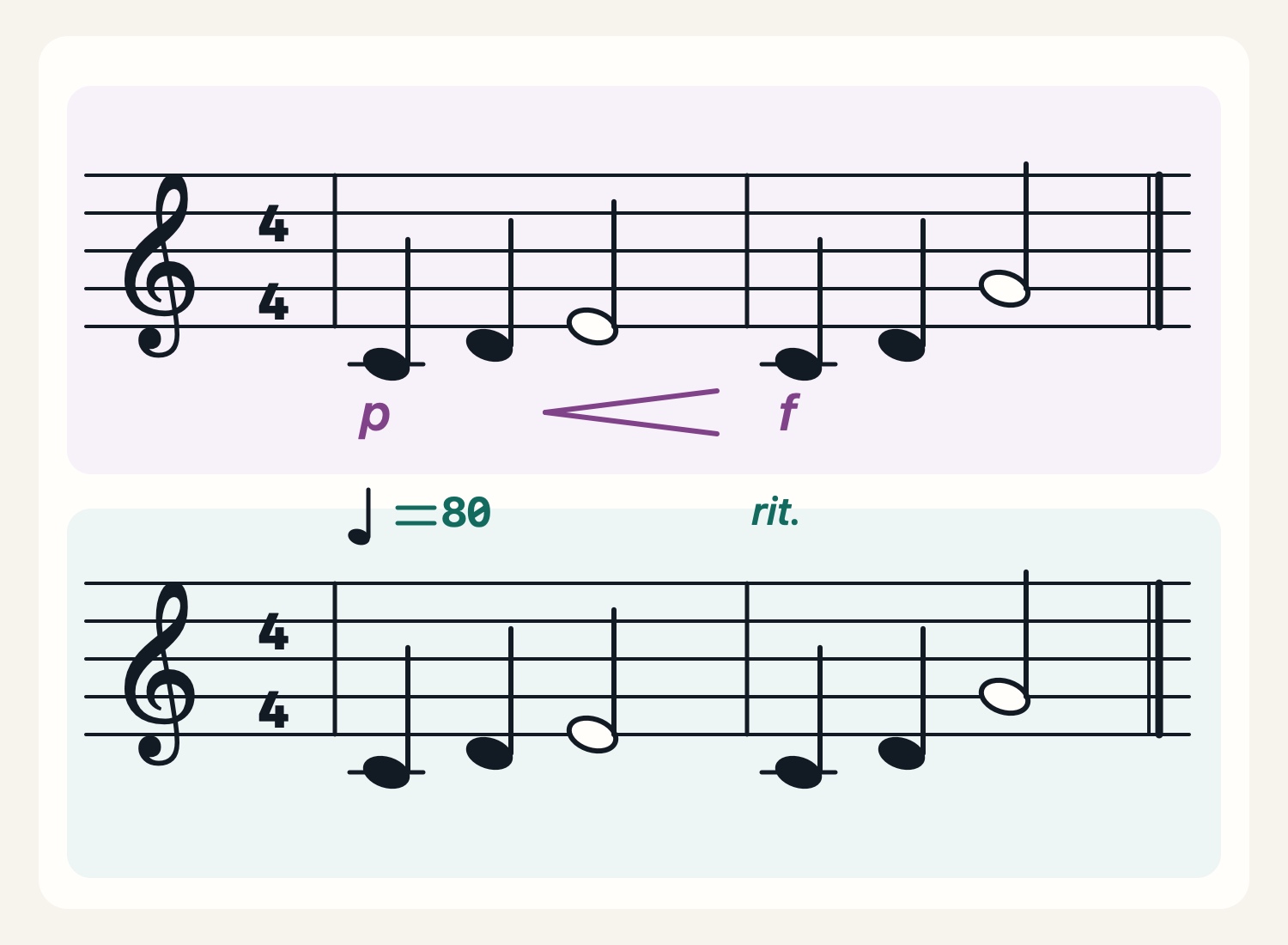
Play C, D, E and then C, D, G in the top example. Start softly at p, get louder through the open hairpin, and play loudly at f in the next bar. Keep the beat steady. How softly or loudly you play each marking depends on the sound around it.
The bottom example has the same notes and the same quarter, quarter, half-note pattern. Start at ♩ = 80 and gradually space the beats farther apart from rit. in bar two. E and G still get two beats each, even when the slower beats make G last longer. Without a keyboard, try varying the loudness of your voice over a steady beat, then try spacing your sounds farther apart at an even loudness.
Check what a curved line connects
When a tie joins two quarter-note Cs, play C once and hold it for two beats. It works the same way across a barline. If a slur spans C, D, and E, play each pitch and connect them smoothly so the gaps are less noticeable.
A staccato dot above or below a note asks you to play it short. The next note still enters where the rhythm puts it. A dot to the right works differently. It adds half the original note length, so a dotted quarter note lasts one and a half beats when the quarter note gets one beat.
Follow D.C. and Fine through four bars
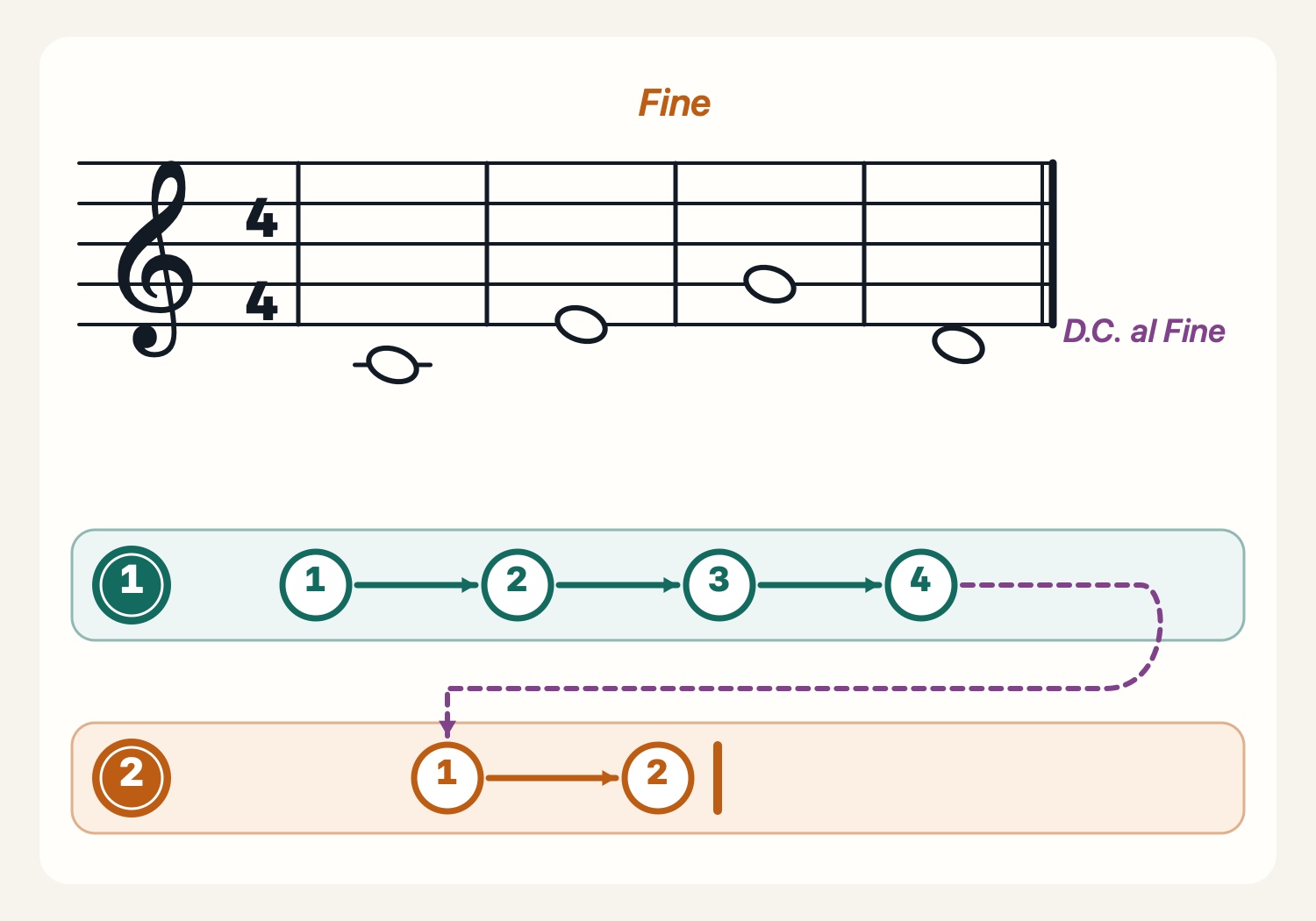
Read bars 1, 2, 3, and 4. Pass the Fine mark in bar two the first time through. At D.C. al Fine in bar four, return to the beginning. This time play bars 1 and 2 and stop at Fine. The order is 1 → 2 → 3 → 4 → 1 → 2. If you lose your place, read the last instruction first, find where to go back, and then locate the stopping point.
D.S. leads back to the segno sign. When a piece uses numbered endings, keep track of whether you are reading the music the first time or after the repeat.
Listen for the beat and how notes connect
Open the two official YouTube links for “The Sun Moves to the Corner.” Count one, two, three, four in the earlier passage and try the same in the later passage. If the piano notes come quickly, listen for the bass or the edges of a phrase to help you keep the beat. Once you can follow the beat, listen to how the loudness changes in the same passage.
“Sepia Summer” uses piano and a synth pad. Listen for the moment a piano note begins and how the background sound continues. The scores above are exercises made for this guide. Both tracks are royalty-free background music under our usage terms. Check each track page for its length and download.
When a symbol looks unfamiliar, see where it sits in relation to the note. Once you know if it changes dynamics, tempo, articulation, or the order of the bars, try playing just the affected bars slowly.
FAQ
- What should I change when a crescendo goes from p to f?
Gradually play louder as the hairpin opens to the right. Keep the beat steady in this exercise.
- How many times do I press the key for two tied quarter notes of the same pitch?
Once. Play the first note and hold it for a total of two beats.
- Which bar do I stop at after going back in the four-bar exercise?
Stop at the Fine mark at the end of bar two.
- How do dots above and to the right of a quarter note change its length?
A staccato dot above the note asks you to play it short. A dot to the right adds half the length of the quarter note.