
How to Read Sheet Music | Middle C and Your First Two Bars
To read piano sheet music, use a note’s position on the staff to find the key and its shape to tell how long to hold it. Start at middle C and work out the notes around it.
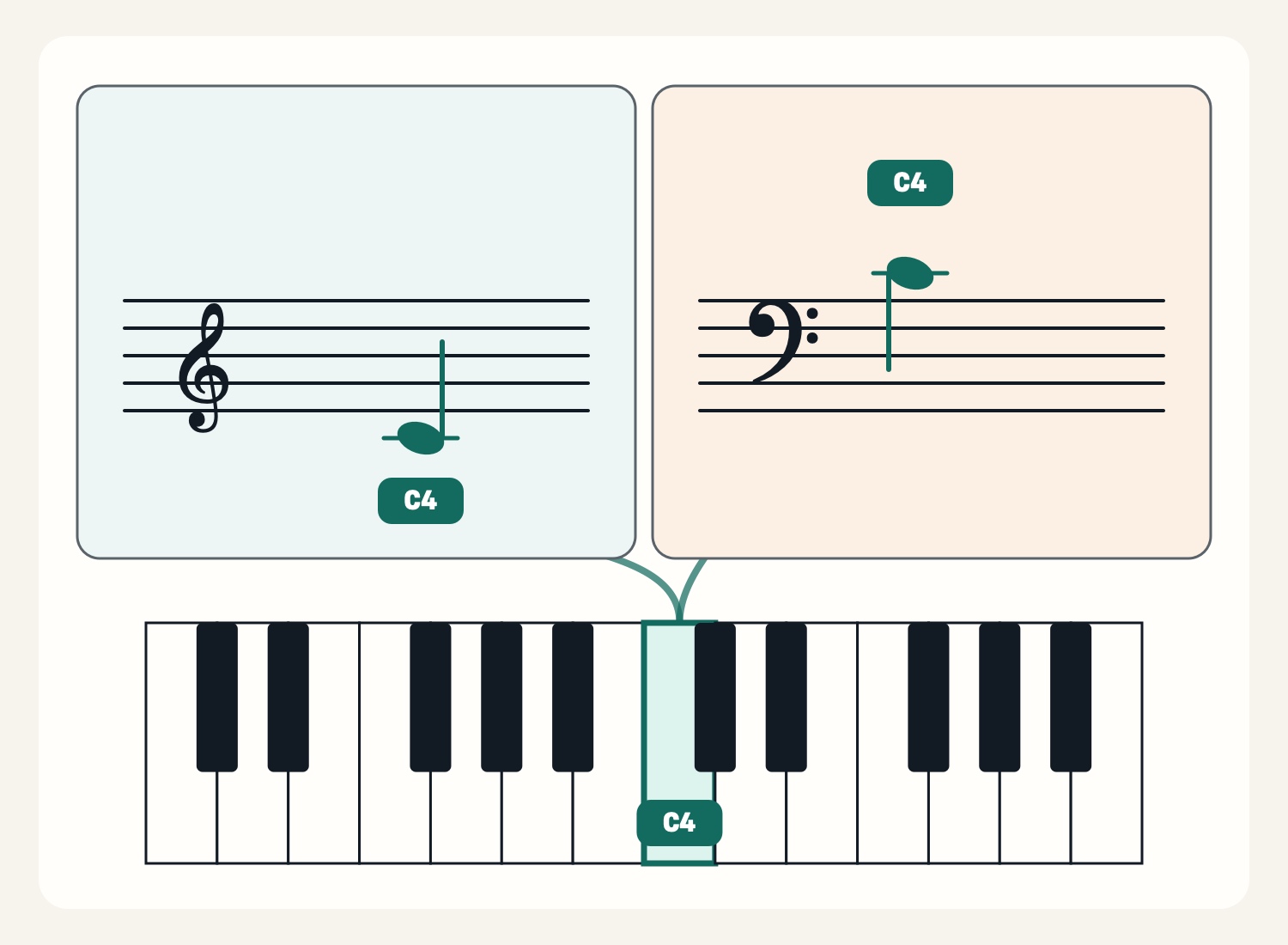
Find middle C in both clefs in the first diagram. Then count “one, two, three, four” and play two short bars slowly.
Read the lines and spaces of the staff
A staff has five horizontal lines. Count the bottom one as line 1 and work upward. First, look at the notehead. It can sit on a line or between two lines. Each step from a line to the space above it, or from a space to the next line, moves up one note name, as in C, D, E.
For notes beyond the staff, add a short line where it is needed. This is called a ledger line. In the next diagram, a single ledger line runs through the middle C notehead.
Find middle C in the treble and bass clefs
Look at the clef on the left first. The curl of the treble clef marks G4 on the second line from the bottom. The two dots of the bass clef surround F3 on the fourth line. On the second line from the bottom, you read G in treble clef and B in bass clef.
Middle C uses the first ledger line below the treble staff or the first one above the bass staff. Both C4s in the diagram lead to the same white key, just left of a pair of black keys. The black-key pattern repeats, so look near the center of the keyboard first.
Count one beat for a quarter note and two for a half note
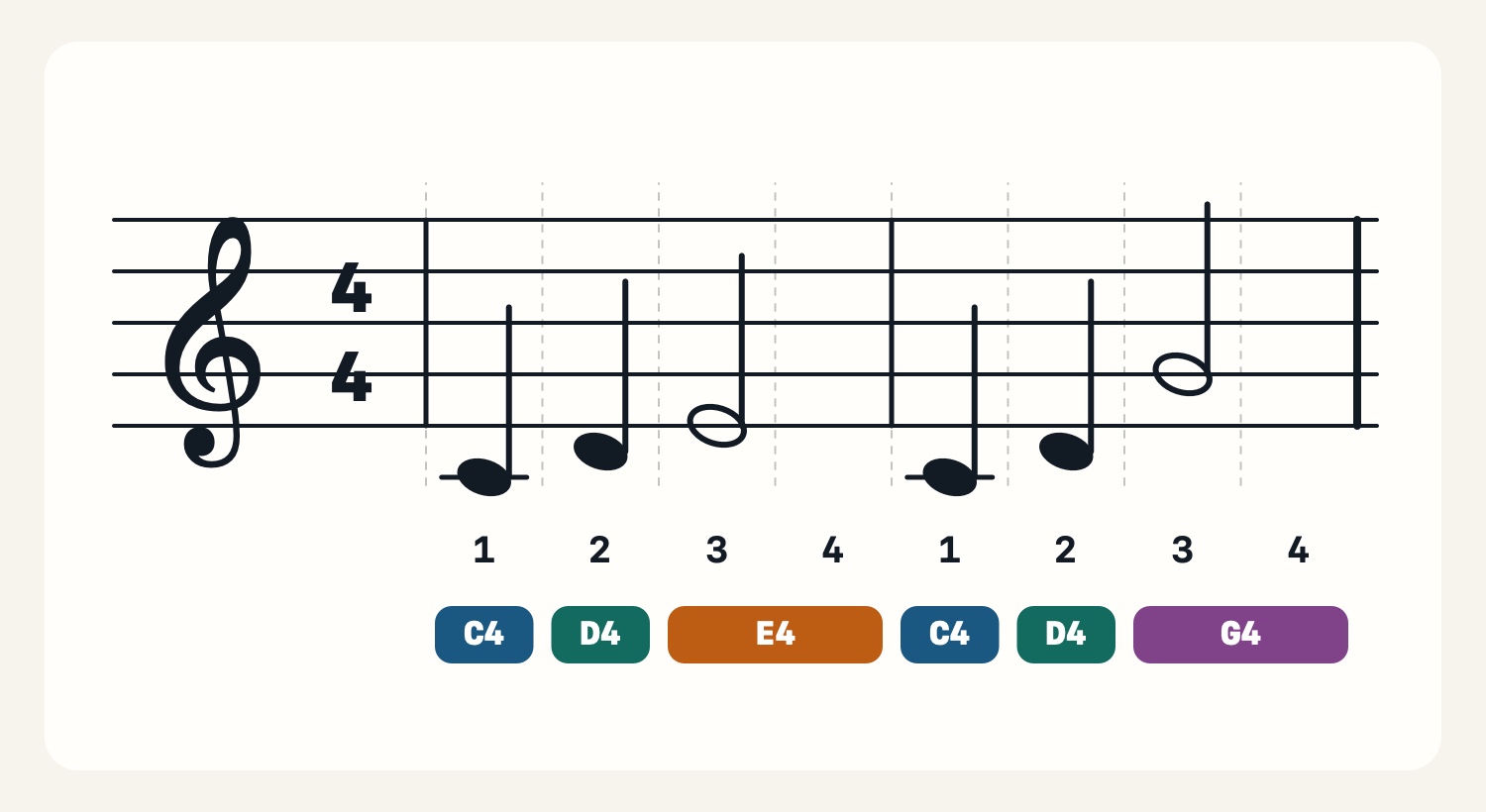
This exercise is in 4/4 time, shown by the two stacked fours. The top four tells you there are four beats in a bar. The bottom four tells you that a quarter note gets one beat. Start counting at one again after each barline.
In the diagram, a filled notehead with a stem is a quarter note. It lasts one beat. An open notehead with a stem is a half note. It lasts two beats. Play a quarter note on beats one and two, then play the half note on beat three. Keep the key down through the end of beat four.
Read the pitches first, then add the beats
Say the note names aloud. In both bars, C is on the ledger line below the staff and D is in the space just below the bottom line. The first bar ends on E, on the bottom line. The second ends on G, on the second line from the bottom.
Find middle C on the keyboard. The next white key to the right is D, followed by E, F, and G. Count slowly and evenly as you play C, D, E in the first bar and C, D, G in the second. If you lose your place on the staff, go back to C. If you lose the rhythm, count the beats first and then play.
Look at the last note in bar two. Which beat does it start on, and how long do you hold it? Play G on beat three and hold it through the end of beat four. These two bars are the first and third bars from How to Write a Melody.
| Bar | Beat 1 | Beat 2 | Beats 3–4 |
|---|---|---|---|
| 1 | C4 | D4 | E4 for two beats |
| 2 | C4 | D4 | G4 for two beats |
Listen to piano melodies on our YouTube channel
“Wiping the Fogged Pane” and “Seven O'Clock Slant” both feature piano melodies. Open each track from the start and listen for when a note begins and how long it rings. The sheet music above is an exercise made for this guide.
Both tracks are royalty-free background music under our usage terms. Open either track page for its full length and download.
Once you can play the two bars in a row, find the first note in another piece of sheet music and follow the notes as they go up or down. Add the beats after you know the pitches.
FAQ
- Is middle C the same key in both clefs?
Yes. It is on the first ledger line below the treble staff and the first ledger line above the bass staff. Both point to the white C just left of a pair of black keys near the center of the keyboard.
- Where is the second line of the staff?
It is the second line from the bottom. The bottom line is line one. In treble clef, the second line is G.
- What do I play on beat four of the exercise?
Keep holding the E you played on beat three in the first bar, or the G in the second bar. Release the key after beat four ends.