
What Is a Fiddle? How It Relates to the Violin and What to Listen For
In Irish and North American traditional music, fiddle often means violin. The same four-string instrument can go by either name depending on the music and setting. The word fiddle also appears in the names of instruments with a different construction, such as the Norwegian Hardanger fiddle.
Start with a drawing of the strings and bow. Then use a 1934 fiddle and guitar recording to hear how a tune and its accompaniment fit together. In two modern tracks, you can compare how a whistle and a guitar each sound alongside the fiddle.
When a violin is called a fiddle
In the Library of Congress’s Henry Reed Collection, fiddle and violin refer to the same four-string instrument. Players such as Reed used both words. When a traditional recording credits a fiddle, the music and setting can help you understand the choice of name.
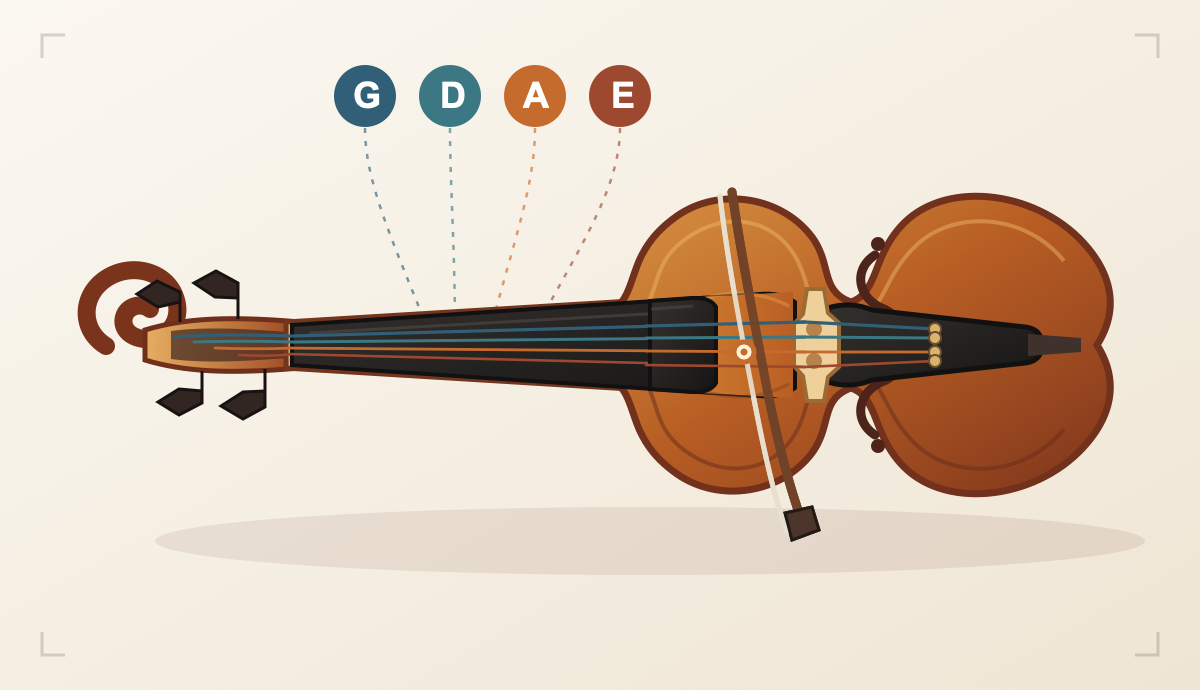
The open strings of a standard violin are G, D, A, and E from lowest to highest. The pegs on the left of the diagram tune the strings. Pressing a string against the fingerboard at different points changes the pitch. Drawing the bow hair across the string sets it vibrating.
The bow meets the string between the end of the fingerboard and the bridge that supports the strings. When listening to a recording, look for notes that connect and passages of short notes. This makes it easier to follow how a player shapes a tune on the same instrument.
Norway’s Hardanger fiddle has sympathetic strings
The Norwegian hardingfele is also called the Hardanger fiddle in English. It has four bowed strings like a standard violin, with four or five sympathetic strings beneath them. When the upper strings sound, the sympathetic strings can vibrate and add their resonance.
A Hardanger fiddle made in 1756 in the Metropolitan Museum of Art collection has four playing strings and four sympathetic strings. The latter pass beneath the fingerboard and are supported at a separate point on the bridge. In the museum’s photographs, look at how the playing strings run above the ones routed underneath.
Hear fiddle and guitar on a recording from 1934
Fiddle player Michael Coleman came from Sligo, Ireland, and made recordings after moving to the United States. A performance recorded in New York in 1934 survives on a 78 rpm disc. Coleman plays two reels in order, “Bonnie Kate” and “Jenny’s Chickens,” with Michael Andrews on guitar.
In the archive’s recording, follow the fiddle first and listen for the change of tune. Then listen again for the guitar. The archive notes how Andrews uses a few chords and supports the melody with his rhythm in the third part of “Jenny’s Chickens.”
The same fiddle and guitar carry both reels. The modern tracks below pair the fiddle with a whistle in one case and a guitar in the other. Listen to how the other instrument changes the way you hear the melody.
Compare whistle and guitar in two modern fiddle tracks
“Market Bell Reel” is a four-minute track with fiddle and whistle carrying the tune. It begins at 26:33 in the official video. For a busy town scene, follow the sound of the bowed strings and then the breath-driven sound of the whistle.
“Lunch at the Old Watchtower” is a waltz in triple meter with solo fiddle and acoustic guitar. It lasts about 3:45 and begins at 22:47 in the official video. If you’re looking for music for a quiet scene, listen to how long the fiddle notes carry over the guitar.
Try both tracks with the same scene
Imagine a character crossing a town square and then sitting down. Try each track under that scene. To highlight people going by or to let the character pause, you might bring the tune in at a different moment or leave more room for footsteps and voices.
Both tracks from our catalogue are royalty-free. You can download them for free and use them in commercial videos, streams, and games under the terms of use. Credit is optional. The terms prohibit redistributing the audio on its own and using it to train AI.
When looking for fiddle music, check the kind of tune and the accompanying instruments. This will help you hear the different sounds a player can draw from the same four strings.
FAQ
- Are a fiddle and a violin the same instrument?
In Irish and North American traditional music, both words can refer to the same four-string instrument. Fiddle also appears in names of instruments with a different construction, such as the Norwegian Hardanger fiddle.
- How many strings does a standard fiddle have?
A standard modern violin has four. The open strings, played without pressing a finger on them, are G, D, A, and E from lowest to highest.
- How can I pick out the fiddle in a recording?
Start with the bowed melody, then listen to the guitar, whistle, or other instruments around it. Pay attention to where the notes stretch out and where you hear a series of short notes.
- Can I use these tracks in a commercial video?
“Market Bell Reel” and “Lunch at the Old Watchtower” are royalty-free tracks from our catalogue. Both are available as free MP3 downloads and may be used in commercial videos under the terms of use.