
What Is Film Music? Scores, Theme Songs and Soundtracks
Film music includes the score that supports a scene, a song associated with the film and music the characters hear on a radio. It covers the music used throughout a film.
A song can play on a character’s radio and return during the credits. To understand what it does in each moment, ask who can hear it and where it enters the film.
What does music draw attention to in a scene?
Where music enters can change what viewers notice. If it begins before a character opens a letter, attention can shift to what is about to happen. If it starts after the character has finished reading, it can draw attention to their expression and what they might do next.
Filmmakers use both newly composed music and music that has already been released. The next time you watch a film, notice one thing that changes in the image or conversation when music begins.
What do score, theme song and soundtrack mean?
A score can underscore a conversation or carry a transition. A theme song represents the film and can appear in its opening, during the story or over the credits. Music with singing can also support a scene.
In film production, the soundtrack includes all the sound in the film, including dialogue, effects and music. A soundtrack album collects music chosen from or associated with the film. It can include score cues, songs heard in the story and a theme song. Its contents and order depend on the release.
References
How silent-film cue sheets linked music to the screen
In the silent era, some screenings used music performed in the theater. The Library of Congress holds scores written for individual films, cue sheets that recommend music for specific moments and accompaniment collections that could serve more than one film.
One cue sheet for The Broadway Gallant, released in 1926, lists the butler appearing at a door, En Chevauchant and a duration of three and a half minutes. A player could see the visual cue, the piece and the suggested length in the same entry.
When silent and sound versions existed side by side
The British Film Institute records both a silent and a sound version of Blackmail (1929). One film could reach audiences in different versions during the transition to sound.
With recorded sound, filmmakers can arrange the points where dialogue, effects and music enter together. A live accompaniment cue sheet and a recorded mix both address the question of where sound belongs in a scene.
Who can hear the music in the room?
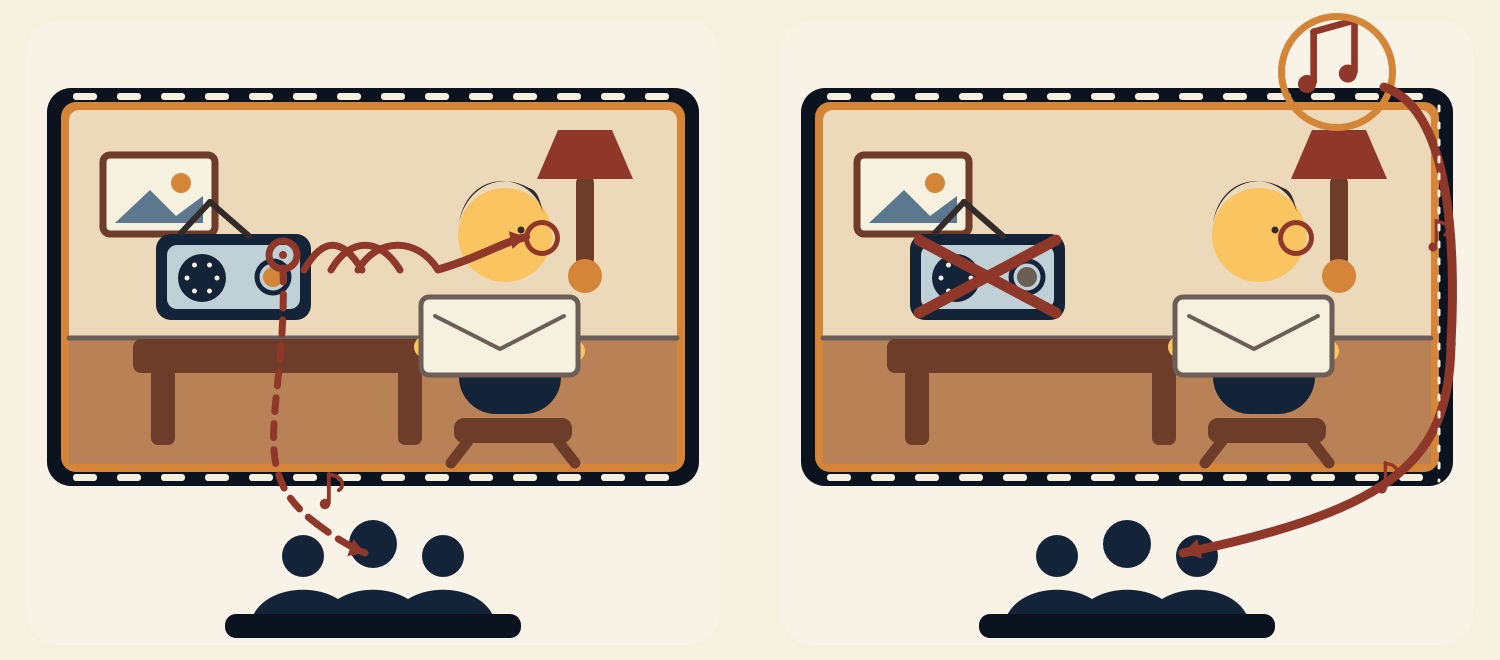
On the left, the character reading the letter can hear music from a radio in the room. The source exists in the story, so it is diegetic sound. A radio in another room can still be part of the story’s sound.
On the right, the radio is off and the audience hears music over the letter-reading scene. This is one example of underscoring. The same piece could be music a character hears or music heard only by the audience, depending on where its source belongs.
Try three tracks for an opening, an exchange and a landscape
These three tracks from our catalog are starting points for trying music against footage. In each scene, listen for where the cue enters and how much room it leaves for dialogue or ambient sound.
Try “Before the Banners Rise” (3:53) on the opening. Put it under the first shot showing the title or location and check whether the audience has enough time to read.
Try “The King Does Not Look Up” (3:29) when characters meet or speak. Compare starting it just before the first line with bringing it in during a pause in the conversation.
Try “The Clear Frozen Fall” (3:45) for a landscape. Start the track just before the cut, right on the cut and shortly afterward to find the entrance that suits your footage.
Using the three tracks in a video
The three featured tracks are free to download and royalty-free. The usage guide allows commercial and noncommercial videos and streams with no credit requirement.
Standalone redistribution or sale and use for AI training are prohibited. Check for the download option on each track page and read the usage guide before using the audio in a video.
References
- 1
Music to try in three scenes
Try one track for an opening, one for an exchange and one for a landscape.
These sounds from arcalune
When adding music to footage, decide who can hear it in the scene. Try changing the entry and exit points one at a time over the same footage.
FAQ
- What is film music?
It is the music used in a film, including the score, a theme song and music from sources inside the story, such as a radio.
- How does a score differ from a theme song?
A score supports scenes or transitions. A theme song represents the film and can also play during a scene to support what happens there.
- Is a soundtrack the same as a soundtrack album?
In production, the soundtrack can refer to all the sound in the film. A soundtrack album collects some of the music and songs for listening.
- Can a radio be diegetic if it is off-screen?
Yes. A radio that is playing within the story is diegetic even if it is outside the shot. The right side of the diagram shows underscoring heard only by the audience.
- Can I use the three tracks in my own film or video?
Yes. The tracks are free and royalty-free for commercial use under the usage guide, with no credit required. Standalone redistribution or sale and AI training use are prohibited.