

What Is Blues? Its History and How to Hear the 12-Bar Form
Blues took shape in African American communities in the southern United States around the end of the 19th century. Listen for the exchange between voice and instrument, notes that bend in pitch, and chord patterns that repeat.
Follow the music from sheet music to records, then count the 12-bar form in groups of four. Two tracks on this site let you compare a minor blues with the sound of a Hammond organ.
How this list was chosen
- Use the 1914 publication and the 1916 recording as landmarks for seeing how blues spread.
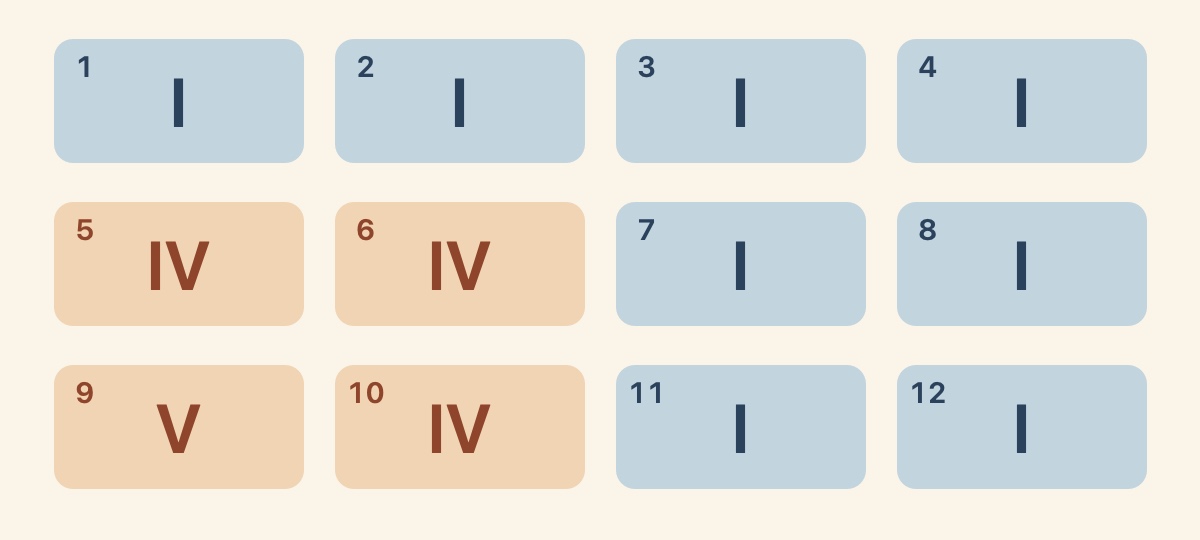
- Use the 12-bar diagram to follow the chord changes in bars 5 and 9 and the return that follows.
Blues grew from singing and performance in the American South
The Library of Congress identifies blues as a form of secular African American music. It took shape around the end of the 19th century in the southern United States, carrying forward expressions found in work songs, field hollers, and spirituals. A call meant to carry across a distance, for example, may stretch the voice while shifting its pitch.
Songs circulated through performance and oral transmission, then spread through sheet music and records in the 20th century. Works with surviving publication years and recording dates give us landmarks for tracing how the music traveled.
References
From sheet-music publication to recordings of singing and electric guitar
W. C. Handy's “St. Louis Blues” was published as sheet music in 1914. Musicians far away could read the score and perform the piece, and on October 19, 1916, the Victor Military Band recorded a medley that included it. Sheet music carried the composition. A record preserved a particular performance.
When Mamie Smith’s recording of “Crazy Blues” became a hit in 1920, record companies began to recognize African American listeners as a market, and recordings by Black blues singers and jazz musicians increased. When comparing it with the 1916 recording, listen for how the words and inflections of the voice sit over the ensemble.
In postwar Chicago, Mississippi-born Muddy Waters played the Delta blues of his home region on electric guitar and contributed to the development of Chicago blues. Listen for the guitar answering the singer, and you can hear an enduring form of expression even as the instruments change.

Hear the voice and instruments answer each other
After a singer finishes a line, a guitar may answer with a short phrase. This exchange is called call and response. Shift your attention to another sound when the voice pauses, and the dialogue becomes easier to follow.
Blue notes can involve lowering notes such as the third degree of the major scale. A guitarist may raise the pitch by pushing a string upward, while a singer may glide up from a lower pitch. Listen to the pitch where the note begins and the pitch it reaches as it is sustained.
Count the 12 bars as three groups of four
In a passage where the same unit repeats, count the bars along with the breaks in the accompaniment. In a song in 4/4, count the beats “1, 2, 3, 4,” then advance one bar on the next “1.” As the diagram shows, you can follow the 12 bars in three groups: 1–4, 5–8, and 9–12.
The I, IV, and V in the diagram are chords whose roots are the first, fourth, and fifth degrees of the key. With C as the tonal center, for example, their roots are C, F, and G. I holds through the first four bars, and the harmony moves to IV in bar 5. It returns to I in bar 7, then moves through V, IV, and I in bars 9–11. Before trying to name the chords, find where the accompaniment changes in bars 5 and 9.
Bar 12 in the diagram is I. In some recordings, a short progression in the last one or two bars leads into the next cycle, and bar 12 may use V. This link is called a turnaround. After counting to 12, return your attention to bar 1 of the next group and confirm the repetition.
Follow the three AAB lines in four-bar groups
In vocal blues, three lines in an AAB pattern may correspond to the three groups of the 12-bar form. The first idea is stated over four bars, repeated or slightly varied over the next four, and answered with different material over the final four. Even without memorizing the lyrics, you can use the return of the same wording as a guide.
In a performance where an instrument answers after each sung line, you can follow both the AAB lyric pattern and the exchange between voice and instrument. First notice which words repeat. Then, when the voice rests, listen to what the instrument plays. You can also hear short melodic phrases being passed back and forth in an instrumental track.
What changes in 16-bar, minor, and jazz blues?
A 16-bar blues has four groups of four bars. In a minor blues, minor chords are used in places corresponding to I and IV in the basic form. Even when you continue following the same four-bar groups, for example, the sound of the opening chord changes.
Some jazz performances also use blues forms. In a jazz blues built on a 12-bar framework, for example, ii–V–I may replace V–IV–I in the final group. Keep the number of bars in view while listening for the chords the accompaniment passes through on its way home, and the difference becomes easier to hear.
Compare a minor blues with an organ blues
“The Missing Singer” (4:30) is a minor blues that portrays a nighttime story. Starting at 8:50 in the compilation video, listen to the sound of the opening chord and where the melody pauses.
“The Record Shop Clue” (4:14) is a blues featuring the sound of a Hammond organ. Starting at 39:40 in the same video, compare the sustained organ tones and the way the accompaniment changes around them. Use the diagram to practise counting the basic 12-bar form.
Both tracks are free to download and may be used royalty-free under the audio usage guide. For permitted uses, no additional royalty is due each time you use them, and no credit is required in commercial or noncommercial videos and streams. Resale or redistribution of the audio by itself and use for AI training are prohibited.
- 1
Two tracks for comparing shades of blues
Listen in sequence to minor-blues harmony and the sound of a Hammond organ.
These sounds from arcalune
On a first listen, find one sound that answers when the voice or main melody stops. Next, locate where the same unit returns. By following the short phrases and changes in the accompaniment in order, you can begin to hear what distinguishes one track from another.
FAQ
- What kind of music is blues?
Blues is music shaped around the end of the 19th century from African American singing and performance in the southern United States. Call and response between voice and instrument, moving pitch, and repeating chord patterns are commonly heard in it.
- Who created blues, and when?
Blues grew through singing and performance in several parts of the southern United States. The publication of “St. Louis Blues” by W. C. Handy in 1914 shows how music that was already being performed reached more musicians through sheet music.
- Is all blues 12 bars long?
The 12-bar form is representative, but 16-bar blues also exists. Even within 12 bars, the placement of the chords can vary through the use of minor chords or a link into the next cycle in the final one or two bars.
- How do you count a 12-bar blues?
Count it in three groups: 1–4, 5–8, and 9–12. In the basic form, the accompaniment changes in bars 5 and 9, then returns to the beginning after bar 12.
- How are blues and jazz related?
Blues has its own history, and blues forms are also used in jazz performance. In a jazz blues, for example, a ii–V–I progression may be added within the 12-bar framework.
- Can I use the two featured tracks in videos or streams?
Both tracks may be used royalty-free under the audio usage guide. They are free to download, and no credit is required for commercial or noncommercial videos and streams. Resale or redistribution of the audio by itself and use for AI training are prohibited.