
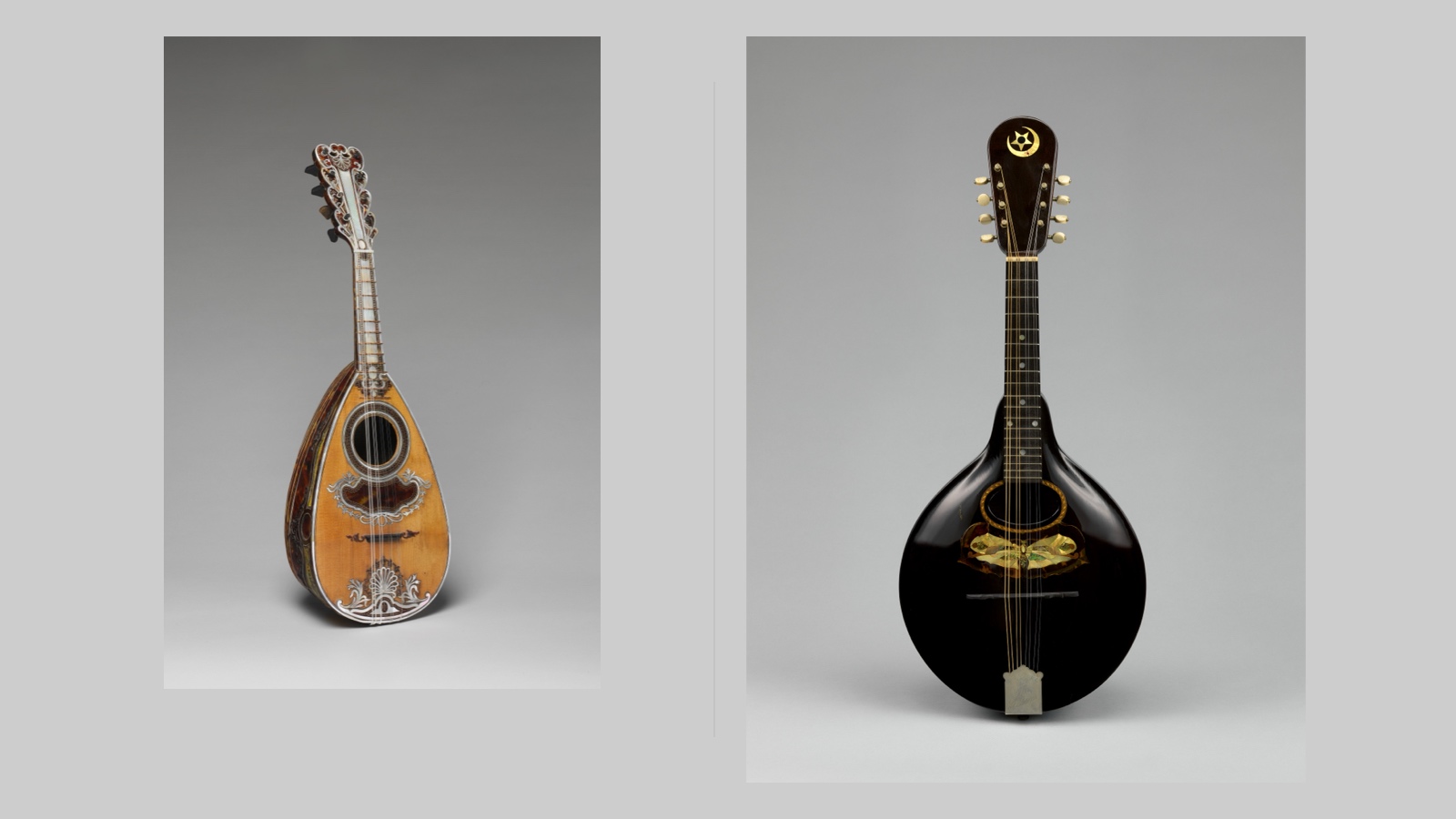
What Is a Mandolin? Eight Strings, Tremolo and Two Body Designs
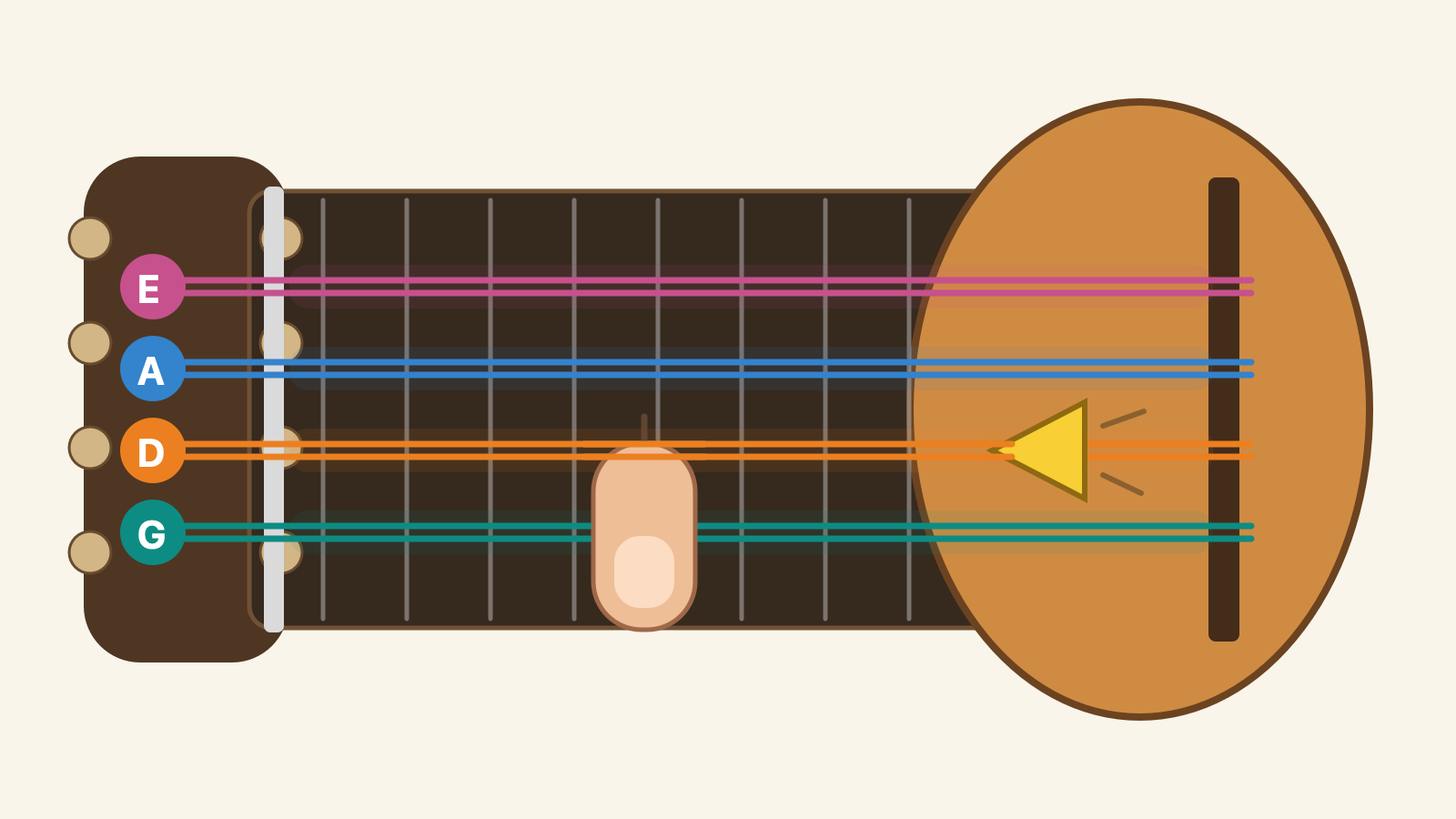
A mandolin is an instrument whose pitch is changed on a fretted fingerboard and whose strings are plucked with a pick. On a standard eight-string mandolin, the strings are arranged in pairs tuned to the same pitch. From low to high, the four pairs are G, D, A, and E. When you play, begin by focusing on one of these two-string pairs.
Playing eight strings as four same-pitch pairs
A pair of strings played together is called a course. In standard tuning, the courses run from low to high as G3, D4, A4, and E5. These are the same pitches as a violin's open strings, but on a mandolin each pitch is sounded by two strings in a course.
Playing without placing a finger on the strings produces an open-string note. When the left hand presses both strings of a course at the same fret, the vibrating length from that point to the bridge becomes shorter, raising the pitch. In a single stroke, the pick in the right hand plucks both strings of that course.
A single pluck and a note sustained with tremolo
A single pluck with the pick gives the note a clear onset, after which it gradually fades. In tremolo, the pick moves rapidly down and up to repeat the same note, making it sound as though it continues. In a slow melody, listen for the closely spaced attacks that overlap while the note seems to be sustained.
A long note can also be plucked only once and left to decay. The choice is not determined by tempo alone: players use the techniques differently depending on whether they want each note to have a distinct outline or the melody to sound connected.
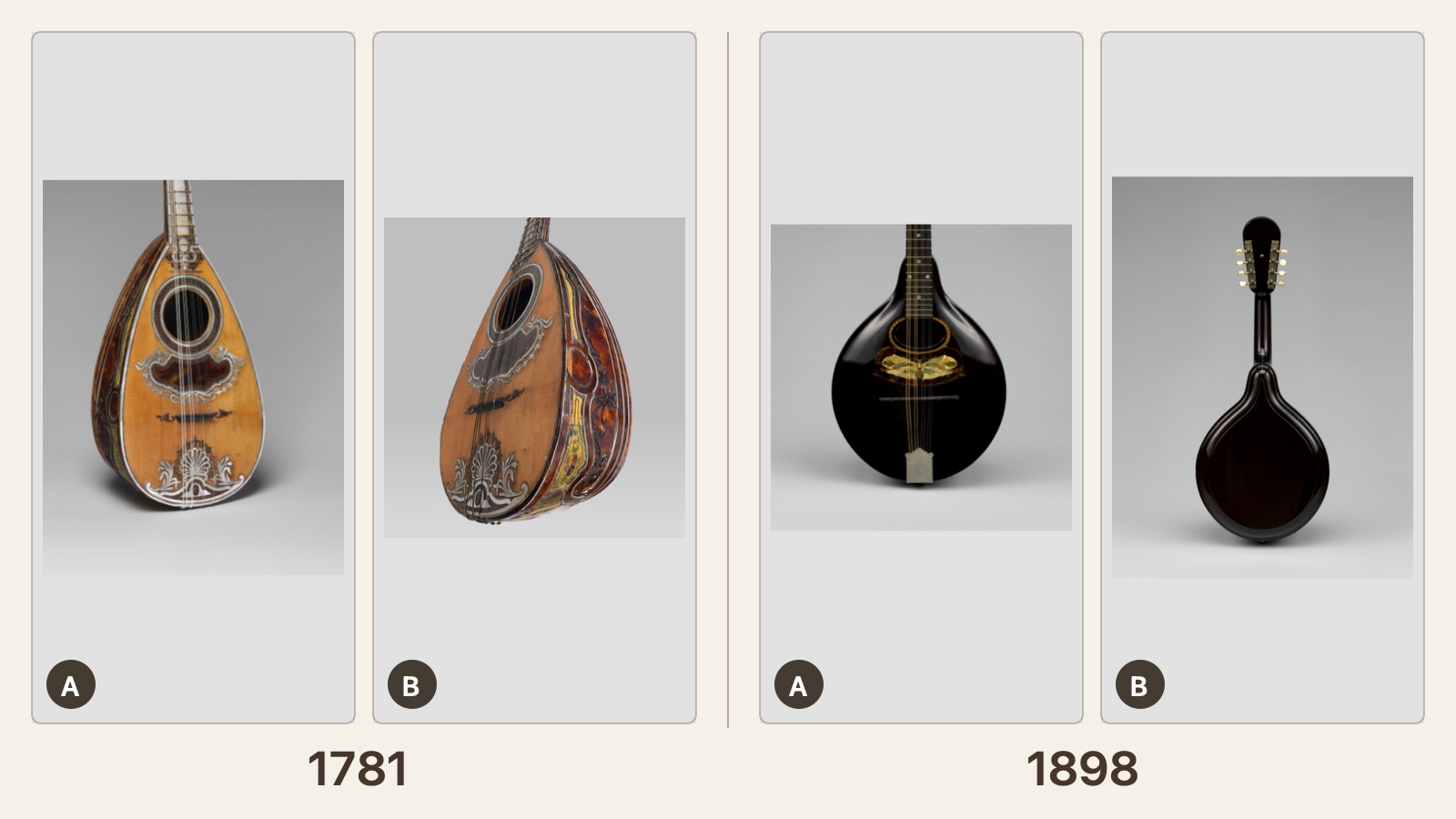
The rounded 1781 body and the carved top and back of 1898
A surviving example made in Naples in 1781 has a bowlback with a rounded, bulging rear. According to the museum record, its bowl is assembled from twenty-three narrow molded pieces of tortoiseshell separated by ivory spacers. The soundboard beneath the strings has a slight bend at the bridge.
On a surviving American example from 1898, both the top and back are carved into convex shapes. A bridge resting on the top supports the strings, which are anchored by a tailpiece at the end of the body. The collection record states that the bridge and tailpiece were replaced during a restoration in the 1970s. Both instruments have eight strings in four courses, yet their bodies are built differently around the same arrangement of strings.
The mandolin's melodic role in an ensemble
The Kansai University Mandolin Club gives one example of a mandolin ensemble. Its first mandolins mainly play the melody and its second mandolins mainly play harmony. Classical guitar usually supplies the accompaniment, and double bass covers the low part.
In the United States, where bluegrass took shape in the 1940s, the mandolin was also combined with string instruments such as the fiddle and banjo. Besides noting the shape of its body, listen for the instruments around the mandolin and the part it is assigned; these features make musical differences easier to follow.
Listen for melody, ensemble playing, and the blend with guitar in three tracks
Use three of our BGM tracks to compare the mandolin's role within a piece. First, from 1:11:06 in “Feeding Time,” follow the prominent melody over the 6/8 meter. Next, from 4:18 in “Tram Line No. 3,” listen to the two-beat march rhythm articulated by the mandolin ensemble.
“The Attic Music Box” begins at 34:51. It is an example of mandolin and guitar appearing in the same piece. What these three modern BGM tracks compare is their instrumentation and the role assigned to the mandolin.
Download the three tracks for videos and games
Use the track cards below to listen to and download each piece. All three are royalty-free: commercial use is free, and no credit is required. You may not resell or redistribute the audio on its own or use it for AI training. Check the usage guide before using a track.
Music boxes shaped like mandolins also survive. Although they look similar, you can learn how the spring and metal teeth inside produce sound in our illustrated article about music boxes.
- 1
Lead melody, ensemble, and mandolin with guitar
Follow the melody in the first track, the march in two in the second, and the pairing with guitar in the third.
Use it forFarm scenes, March, Tidying up
These sounds from arcalune
- Feeding Time2:09
- Tram Line No. 34:16
- The Attic Music Box4:30
Begin by looking at each two-string course and the direction of the pick, then listen for the onset of each note. Once you can distinguish individually articulated notes from a continuous-sounding line, it becomes easier to follow the mandolin's role within a piece.
FAQ
- Why are a mandolin's eight strings treated as four courses?
On a standard eight-string mandolin, two strings tuned to the same pitch are pressed and played together. From the lowest course to the highest, the four courses are G, D, A, and E.
- How is tremolo played on a mandolin?
The pick moves rapidly down and up to repeat the same note, making it sound like one long, connected note.
- What is the difference between a Neapolitan mandolin and an archtop mandolin?
The 1781 Neapolitan example in this article has a rounded back assembled from narrow pieces and a soundboard with a slight bend at the bridge. On the 1898 archtop example, the top and back are carved into convex shapes.
- Can I use the three featured tracks in monetized videos?
Each track can be downloaded for free and used commercially without credit. Reselling or redistributing the audio on its own and using it for AI training are prohibited.