What Is Funk Music? A Visual Guide to Its History, Rhythm, and Instrument Roles
Funk does not leave the rhythm that supports a song in the background; it brings rhythm to the center of the music. Bass, drums, rhythm guitar, horns, and other parts divide up short figures and overlap within the same beat framework to create one groove. Funk is not determined by one instrument or timbre. What matters is the relationship between where each part sounds, where it leaves space, and what it repeats.
This article traces how funk became a distinct form in the 1960s. A one-bar diagram then explains THE ONE—the emphasis on beat one—alongside repetition, syncopation, and eighth-note and sixteenth-note feel. Next, it shows how to listen separately to bass, drums, guitar, and horns, before leading to three modern original BGM tracks on this site.
How this list was chosen
- Start by finding beat one, then listen in order for repetition and the positions of finer subdivisions.
- The beat diagram and instrument-role diagram are educational concepts, not transcriptions of a particular track or performance patterns shared by every funk recording.
- The three listening examples are modern original BGM tracks. They are presented separately from historical recordings, with the terms for using them in videos and streams.
Funk puts overlapping short rhythms at the center
Columbia University’s Jazz Glossary describes funk as a broad term that includes harmony, rhythm, and melody based on blues and gospel. For usage from the 1960s onward, it also identifies complex rhythms driven by bass and rhythm guitar, horns used for rhythmic patterns, and vocal calls. This shows why funk needs to be heard not as a single timbre, but as music in which several parts divide up the rhythm.
William Paterson University teaching material treats James Brown as a pioneer of funk and places emphasis on beat one, eighth-note and sixteenth-note grooves, and syncopation among its basic terms. Rather than imagining that funk suddenly appeared when one instrument was added, it is more useful to follow how rhythmic construction came to the foreground in the 1960s. That leads directly to THE ONE and the roles of the instruments below.
It took shape in the United States in the mid-1960s and developed regionally
Funk took shape in the United States in the mid-1960s through the music of James Brown and others. Brown’s “Out Of Sight” from 1964 and “Papa’s Got A Brand New Bag” from 1965 are examples for tracing that change. Views differ on which recording should be called the first funk song, so it is more useful to follow the rise of short riffs, fewer chords, and performance centered on the start of the bar than to name one release year as a single birth date.
The same performance model did not then spread unchanged across the United States. The Isley Brothers, for example, also explored arrangements without horns, while George Clinton’s Parliament/Funkadelic developed its own musical identity in Detroit. Listening to how the rhythm-bearing parts relate to one another—rather than requiring horns or one particular timbre—helps make sense of different kinds of funk.
THE ONE is the return point of repetition
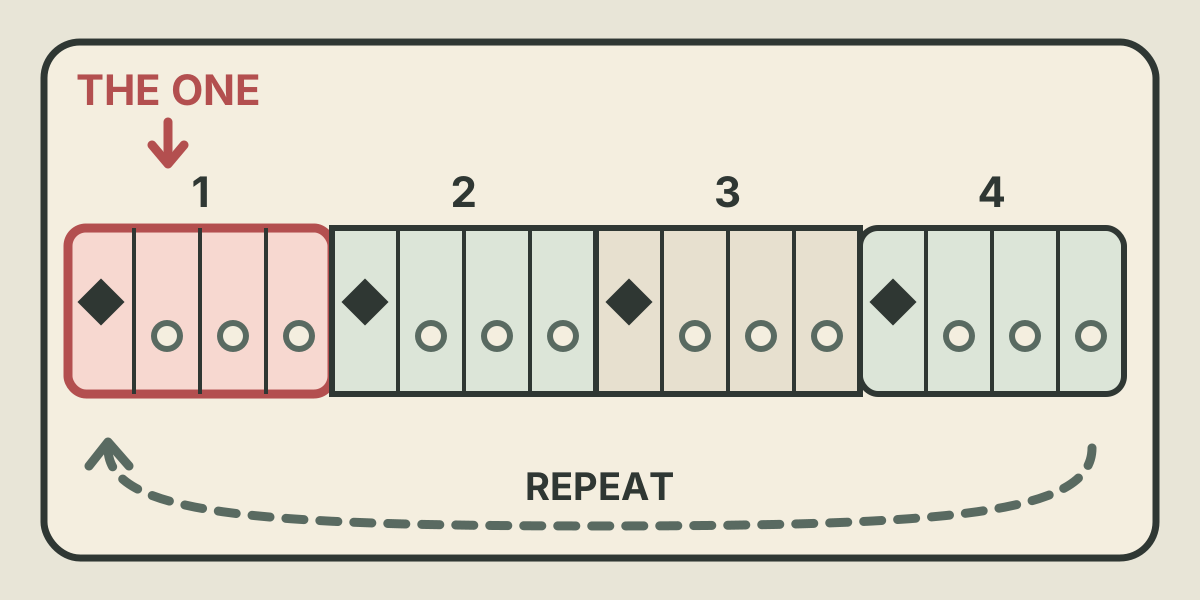
THE ONE is the idea of clearly recognizing the first beat of a bar. William Paterson University’s teaching material describes funk through emphasis on beat one and eighth-note and sixteenth-note grooves that include syncopation. When beat one is clear, it is easier to keep track of the start of the bar even when later sounds fall between beats or deliberate spaces are left open.
In 4/4 time, one bar has four beats: 1, 2, 3, and 4. Dividing each beat evenly in two produces eighth-note positions; dividing it in four produces sixteenth-note positions. That gives eight and sixteen positions respectively within one bar. Syncopation can create a sense of displacement against the steady beat by placing accents away from the beat itself. Not every subdivision has to sound: compare which positions are played and which are left empty.
Repeated units include an ostinato that repeats a bass line, a riff that repeats a short melodic or rhythmic figure, and a vamp that repeats a passage of several bars. Using the same bar or short passage as a foundation gives the parts a shared place to return even if the exact notes are not identical every time. The diagram divides one bar into sixteen positions and shows both the start of each beat and positions inside it. It is a concept diagram for comparing accents within repetition, not a transcription of a particular track.
Bass and drums support the same beat in different roles
The bass repeats short figures in a low register and shapes the outline of the rhythm. William Paterson University’s funk exercise asks the bass to maintain a set bass line. Berklee Online explains that even over the same basic beat, a bass part that strongly pushes eighth notes or creates a lighter sixteenth-note feel can shift the result toward a rock or funk sound. When isolating the bass, follow where the same shape returns and how it lands on beat one before concentrating on pitch.
Drums mark beat positions and finer subdivisions with kick, snare, hi-hat, and other elements. Berklee Online separates the parts for practice and then combines and repeats them, pointing to sixteenth-note feel and a tight, restrained hi-hat as clues in funk. When listening to the drums, do not follow only the loudest hits. Check how the hi-hat marks fine positions and where the kick and snare overlap with them.
Hear guitar and horns as parts of the rhythm too
Funk guitar contributes to the rhythm not only with sustained chords, but also with short single-note riffs and accompaniment cut off quickly. William Paterson University’s teaching material gives guitar and piano exercises using sparse accompaniment and single-note riffs. It also gives palm muting as a method for guitar. Instead of trying to name the chord first, follow the moments when the strings sound and stop, and how those moments enter the spaces left by bass and drums.
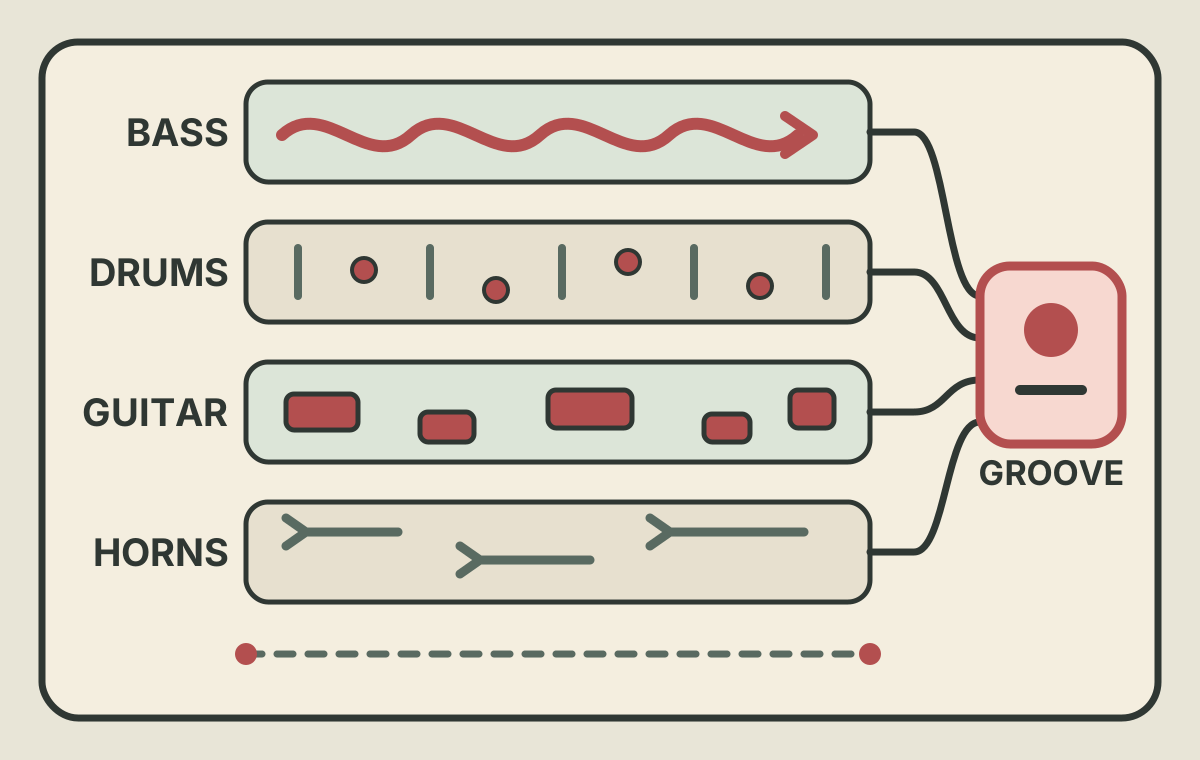
Horns do not only carry long melodies. Columbia University’s glossary notes the use of horns for rhythmic patterns in funk. When short cues or accents return in the same place, the horns become another layer creating the groove rather than decoration placed above the song. The role diagram separates bass as low repetition, drums as beat divisions, guitar as short accompaniment, and horns as grouped accents, then brings all four into one bar.
Check each role with modern original BGM
The three tracks below are modern original BGM from this site. They are not historical recordings or recreations of performances by the musicians introduced above. Choose one track first, then use the instruments or purposes named in its public description as cues for focusing in turn on bass repetition and short accompaniment.
The first track is 1 minute 20 seconds long. Its public description calls it cheerful funk for changes of scene in gameplay videos. It is a short option for following repetition. Open it from the track page or listen from 10:27 in the compilation video.
The second track is 2 minutes 36 seconds long. Its public description mentions a brass-like synth and funk bass, with livestream openings and project announcements among its uses. It is an option for following the low end and grouped accents separately. Listen from the track page or from 17:13 in the compilation video.
The third track is 2 minutes 52 seconds long. Its public description mentions choppy rhythm guitar and electric piano and lists product introductions as a use. It is an option for focusing on the positions of short guitar sounds. Listen from the track page or from 3:33 in the compilation video.
Terms for using the tracks in videos and streams
These three tracks are free BGM available for download. Under this site’s usage guide, they may be used in commercial and non-commercial videos, streams, and similar work without credit. They are royalty-free in the sense that no additional fee is charged according to the number of uses or plays, but copyright has not been waived.
Reselling or redistributing the audio by itself and using it as AI-training data are prohibited. Before using a track, check its current download indication and the current terms in the usage guide. These conditions describe the three tracks from this site; they do not apply to the historical recordings cited in the sources or to funk music as a whole.
References
- 1
Funk
Compare three currently published modern original BGM tracks using the purposes and instrument cues in their public descriptions. They are not historical recordings or recreations of performances from the 1960s.
Use it forGameplay scene changes, Livestream openings and announcements, Product and shop-item introductions
These sounds from arcalune
- Rolling Up Sleeves1:20
- Curtain Up2:36
- Window Shopping2:52
You do not need to understand every instrument at once when listening to funk. Find beat one first, then follow bass repetition, the finer drum divisions, short guitar accompaniment, and horn accents one at a time. Returning to the same bar lets you hear how separate short parts become one groove.
Compare not just which instrument stands out, but how low repetition, beat divisions, short accompaniment, and accents combine. When choosing a track for your own video, check the length and intended use before listening, and review the usage terms as well.
FAQ
- What is funk music?
Funk places the overlap of repeated rhythms and accents at the center of the music, with bass, drums, rhythm guitar, horns, and other parts dividing up short rhythmic figures. The relationship among several parts matters more than any one instrument or timbre.
- When and where did funk begin?
Funk took shape in the United States in the mid-1960s through the music of James Brown and others. Recordings from 1964 and 1965 help trace its formation, although views differ on which was the first funk song. It later developed across different regions and ensembles.
- What is THE ONE?
THE ONE is the idea of clearly recognizing the first beat of a bar. Hearing beat one as the return point of repetition makes it easier to follow the start of the bar even when fine notes or spaces follow.
- Why does funk repeat the same riffs and bass lines?
When the parts share a short repeated unit, they can layer different accents, note density, and spaces while keeping a common return point. Ostinato, riff, and vamp describe different kinds of repeated units.
- What do bass, drums, guitar, and horns do in funk?
Bass can provide low repetition, drums the beat and fine subdivisions, guitar short accompaniment or single-note riffs, and horns grouped rhythmic cues. Since the actual instrumentation and roles vary by track, listening to one part at a time makes them easier to identify.
- Can I use the three tracks in this article in videos or streams?
Current public information says all three may be used commercially or non-commercially without credit. Reselling or redistributing the audio by itself and using it for AI training are prohibited. Check each track page and the latest usage guide before use.