
What Is Bossa Nova? Its History, Features, and Links to Samba and Jazz
Bossa nova took shape in Brazil in the late 1950s by recasting samba rhythm as a new kind of guitar accompaniment and pairing it with relaxed, speech-like singing. In emblematic early performances, the guitar carries harmony and rhythm at once while the singer avoids projecting loudly and delivers words almost as speech.
This article first explains what the guitar batida does and how to listen separately to voice and accompaniment. It then follows two recordings from 1958, a US trip in 1962, and an album release in 1964 to trace how samba-based music reached listeners abroad while meeting jazz musicians. Finally, three modern original background-music (BGM) tracks from our catalog appear as listening examples distinct from the historical recordings.
Batida: turning samba motion into one guitar accompaniment
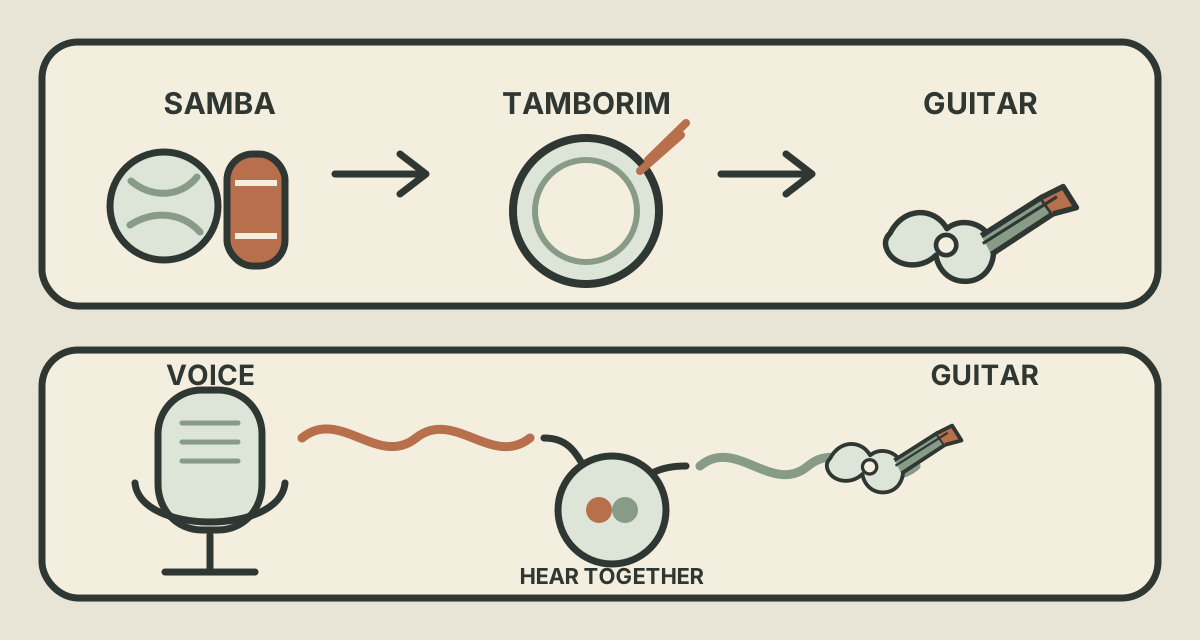
In bossa nova, batida is a rhythmic pattern played while the guitar sounds chords. Roberto Menescal, who took part in bossa nova’s formative years, recalled that João Gilberto did not try to imitate all of samba’s percussion. Instead, he drew out the motion of the tamborim and organized it for guitar. In this account, the ensemble was not merely reduced in size; its motion was recast as playable guitar accompaniment.
A research paper describes this accompaniment as placing accents on weak beats and having a rhythmic structure of its own rather than simply following the vocal melody. To listen for it, first keep a steady pulse, then follow where the guitar chords sound more strongly. Notice how the guitar’s pattern continues as the voice stretches, stops briefly, or rests; that reveals how the batida supports the accompaniment.
Menescal said that bossa nova rhythm came from Brazilian music and that the music then went back to jazz and was accepted there. Hearing samba as the rhythmic foundation, with jazz connected through harmony, instrumentation, and exchanges among musicians, explains the relationship without treating bossa nova as another name for either one.
Listen to the voice and guitar as separate rhythms
A clue to early bossa nova singing is the way words are delivered as if spoken nearby rather than pushed through volume. A USP paper describes João’s voice as intimate and speech-like, avoiding exaggerated gestures and strain. The arrangement also avoids crowding every space, leaving room among voice, guitar, and other instruments.
On the first listen, follow the words and changes in vocal intensity. On the second, move your attention away from the voice and follow only the guitar. Even when the voice sustains a phrase, cuts it short, or rests, the guitar marks chords in its own rhythm. On a third listen, hear both together: instead of duplicating the same movement, their different rhythms interlock as one performance.
Harmony is part of the accompaniment too. Contemporary criticism discussed in the paper identified altered chords, dissonant sonorities, modulation, and rhythmic accompaniment independent of the voice as new features. Rather than naming every chord, listen for how brightness or tension shifts when the harmony changes; this makes the guitar’s dual role in rhythm and harmony easier to hear.
In 1958, a singer’s recording was followed by João’s own
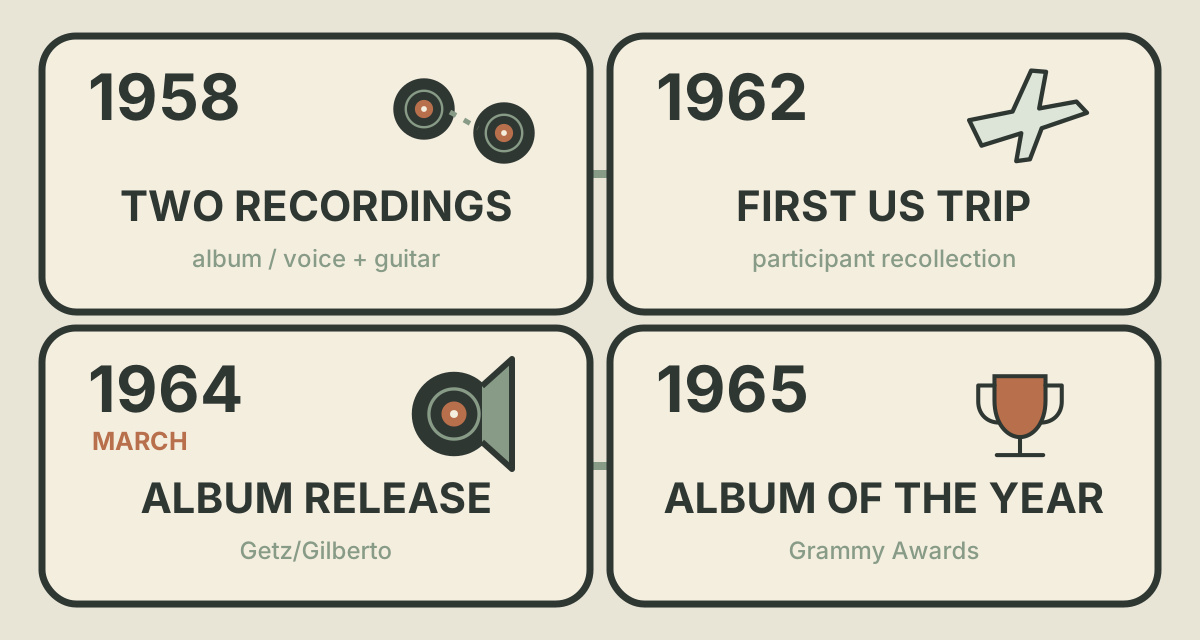
On the 1958 album Canção do Amor Demais, Elizeth Cardoso sang works by Antônio Carlos Jobim and Vinicius de Moraes. João played guitar on Chega de saudade and Outra vez, recording the batida that would later become emblematic of bossa nova. A paper published in UFMG’s academic journal likewise places the album where João’s guitar and batida appeared on record.
On July 10 that same year, João recorded Chega de saudade with his own voice and guitar. On the earlier album, Elizeth sings and João contributes guitar; in the later recording, João performs both voice and guitar. They are two recordings of the same song with different combinations of singer and performance.
The 1962 US trip and 1964 album release carried it abroad
Menescal recalled that when he and his colleagues first traveled to the United States in 1962, jazz musicians including Gerry Mulligan and Cannonball Adderley met them at the airport. His recollection suggests that the music had arrived before the performers themselves: US jazz musicians had already heard performances built from samba rhythm in Brazil.
In March 1964, Verve Records released Getz/Gilberto, an album by American saxophonist Stan Getz and João. The label’s official information identifies Jobim as pianist and composer and lists tracks including The Girl from Ipanema, Desafinado, and Corcovado. Verve’s history says the collaboration expanded bossa nova in popular culture and that the album received Album of the Year at the 1965 Grammy Awards.
The sequence is therefore: a new relationship between voice and guitar was recorded in Brazil in 1958; the musicians traveled to the United States in 1962; and an album joining Brazilian and American performers was released in 1964. It traces how a samba-rooted rhythm reached listeners abroad through collaboration with jazz musicians.
Compare instruments and uses in three modern originals
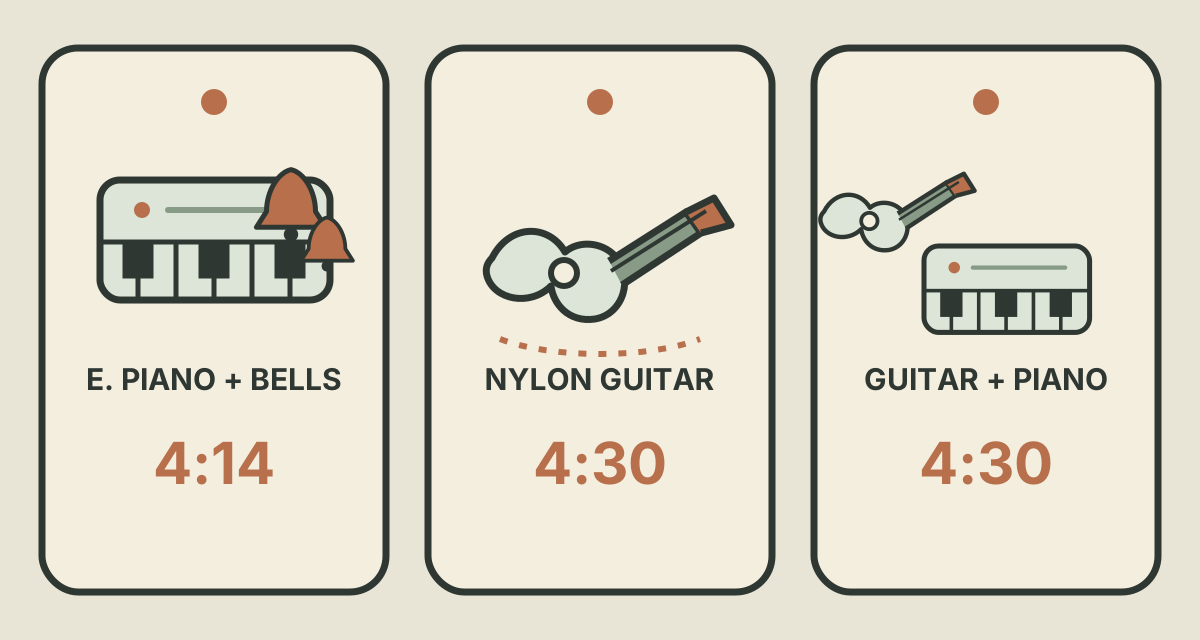
The next three tracks are modern original BGM tagged Bossa Nova in our catalog. They are not recreations of 1958 recordings or traditional pieces. Use the instruments, uses, and durations in their published descriptions to compare one track at a time.
Jelly Lake Boat runs 4:14. Its published description identifies a loose bossa with electric piano and bells for chatty streams or work. Open the track page or start the YouTube video at 13:24, then try to locate the electric piano and bells named in the description.
Ribbon and Brown Paper runs 4:30. Its published description identifies a light bossa nova on nylon-string guitar for handwork, product shots, or gift-wrapping scenes. Listen on the track page or from 18:39 in the YouTube video, then test how the guitar fits the speech or work footage you plan to place over it.
Skis Against the Wall runs 4:30. Its published description identifies a light bossa nova of guitar and piano for café footage or stylish introductions. Open the track page or start at 9:05 in the YouTube video and follow the guitar and piano named in the description one at a time. Keeping the same volume as for the first two tracks makes comparison easier.
Separate listening from using a track as media material
To compare the three tracks, simply play them from their track pages or the specified YouTube positions. To use them in a video, stream, game, or other project, check the download label on each page and the current usage guide. All three are currently available as original BGM that can be downloaded free, used commercially, and used without credit.
On this site, royalty-free means that the current terms do not add a fee according to the number of uses or plays. It does not mean that copyright has been waived, that no ads can appear, or that the audio may be redistributed freely. Reselling or redistributing the audio by itself and using it as AI-training data are prohibited.
- 1
Bossa Nova
Compare three currently available original BGM tracks tagged Bossa Nova by the instruments, uses, and durations stated in their published descriptions. They are not recreations of historical recordings or traditional pieces. Listen from each track page or YouTube starting point, and check the current download label and usage guide before using them as media assets.
Use it forChatty streams and work, Handwork, product shots, and gift wrapping, Café footage and introductions
These sounds from arcalune
When listening to bossa nova, first follow pulse and accents in the guitar batida, then move your attention to the speech-like voice, and finally hear how the vocal and accompaniment rhythms interlock. Samba-derived motion, guitar harmony, and spacious singing meet within one performance.
Historical sources and modern BGM track pages serve different purposes. When studying origins, keep the recordings, travel, and release from 1958 through 1964 distinct. When choosing media, check each track’s published description, duration, starting point, and current terms.
FAQ
- What kind of music is bossa nova?
It took shape in late-1950s Brazil by organizing samba rhythm into guitar batida and pairing it with relaxed, speech-like singing. Its rhythmic foundation is Brazilian music, and it also connected deeply with jazz through harmony and collaboration.
- What is batida in bossa nova?
It is a rhythmic guitar pattern played while sounding chords. Roberto Menescal explained that João Gilberto drew out the motion of the samba tamborim and organized it as accompaniment for one guitar.
- How are bossa nova, samba, and jazz related?
Its guitar rhythm is rooted in samba. Harmonic and arranging ideas were added, and exchanges and collaborations with US jazz musicians helped it spread abroad in the 1960s. It is useful to hear it as Brazilian music born from samba and in dialogue with jazz.
- Is the 1958 Chega de saudade a single recording?
No. One version on Canção do Amor Demais has Elizeth Cardoso singing with João Gilberto on guitar. In the same year, João separately recorded a version with his own voice and guitar.
- Do the Japanese spellings ボサノバ and ボサノヴァ refer to different music?
Both are Japanese renderings of the Portuguese term bossa nova. The Japanese version of this article consistently uses ボサノバ.
- Can I download and use these three tracks commercially for free?
At present, all three can be downloaded free, used commercially under the guide, and used without credit. There is no additional fee based on uses or plays. Reselling or redistributing the audio by itself and using it for AI training are prohibited, so check each download label and the latest guide before use.